Proszę uważnie wysłuchać dialogu i zaznaczyć właściwą odpowiedź. Uwaga! Nagranie zostanie odtworzone dwa razy.
On the exam this recording is played twice.
State certificate in Polish · level B1
Practise every task type of the written part of the Polish B1 state exam – listening with audio in natural Polish voices, reading, grammar and writing – with explanations in English or Ukrainian. Then sit a full 190-minute mock exam and see your score in each part against the official 50% rule.
The exam at a glance
The B1 exam for adults has a written part made of four modules, taken in a fixed order, and a separate oral part. The written part lasts up to 190 minutes in total, with breaks of at least 10 minutes between modules. The oral part lasts up to 15 minutes and is held the same day or the next. Module times below follow the 2024 exam papers and are indicative.
Short utterances, dialogues and announcements from everyday life. The 2024 paper had five tasks; some recordings are played once, others twice.
Notices, e-mails, articles and adverts. You choose the right answer, decide whether statements are true, and match titles to paragraphs.
Cases, verb forms, aspect and conjunctions in short texts. The 2024 paper had eight tasks, more than any other module.
You choose one set out of three and write two texts, a and b. Two examiners assess them against three criteria worth 10 points each.
A conversation with examiners, separate from the written part. In the app you practise the three oral tasks with an AI estimate (without pronunciation, out of 36).
All in one place
Tasks in the exam format with explanations in English, AI feedback on your writing and a full 190-minute mock exam scored part by part.
Start practisingTo pass B1 as an adult you need at least 50% in each written module – 15 out of 30 points in listening, in reading, in grammar and in writing – and at least 50% of the oral part, which means 20 out of 40 points. A very good result in one module does not make up for a weak one: 28 points in reading and 14 in grammar is a fail.
This is why preparation has to be balanced. Many learners spend most of their time on the module they enjoy and discover their weakest part only on exam day. In PolishExam every result is shown per part, so you see at once which module is closest to the line. You can also enter your own points in the score calculator.
Aim for a safety margin of a few points above 15 in every module, not for a high total.
How it works
Filter tasks by exam part, topic, task type and difficulty, or start a short mixed session. The tasks are in Polish, exactly like on the exam; the interface is in English or Ukrainian.
Each answer is checked straight away, with an explanation of why this answer is right. If you are stuck, use “Show answer”. When a typed answer is correct except for Polish letters such as ą, ę or ł, the app points it out instead of simply marking it wrong.
Your text is assessed against the three official writing criteria, 0–10 points each. Errors are marked in your own text with corrections and short explanations, and you get a corrected version and a model text.
Take the whole written part as one exam – 120 points, one 190-minute timer – or any single part with its own time. You get a result for each part and a review with the key and explanations.
See results by exam part, task type and topic, the history of your sessions and mock exams, and a suggestion of what to practise next.
Inside the app
Real screenshots of the app, taken in the browser and on a phone.
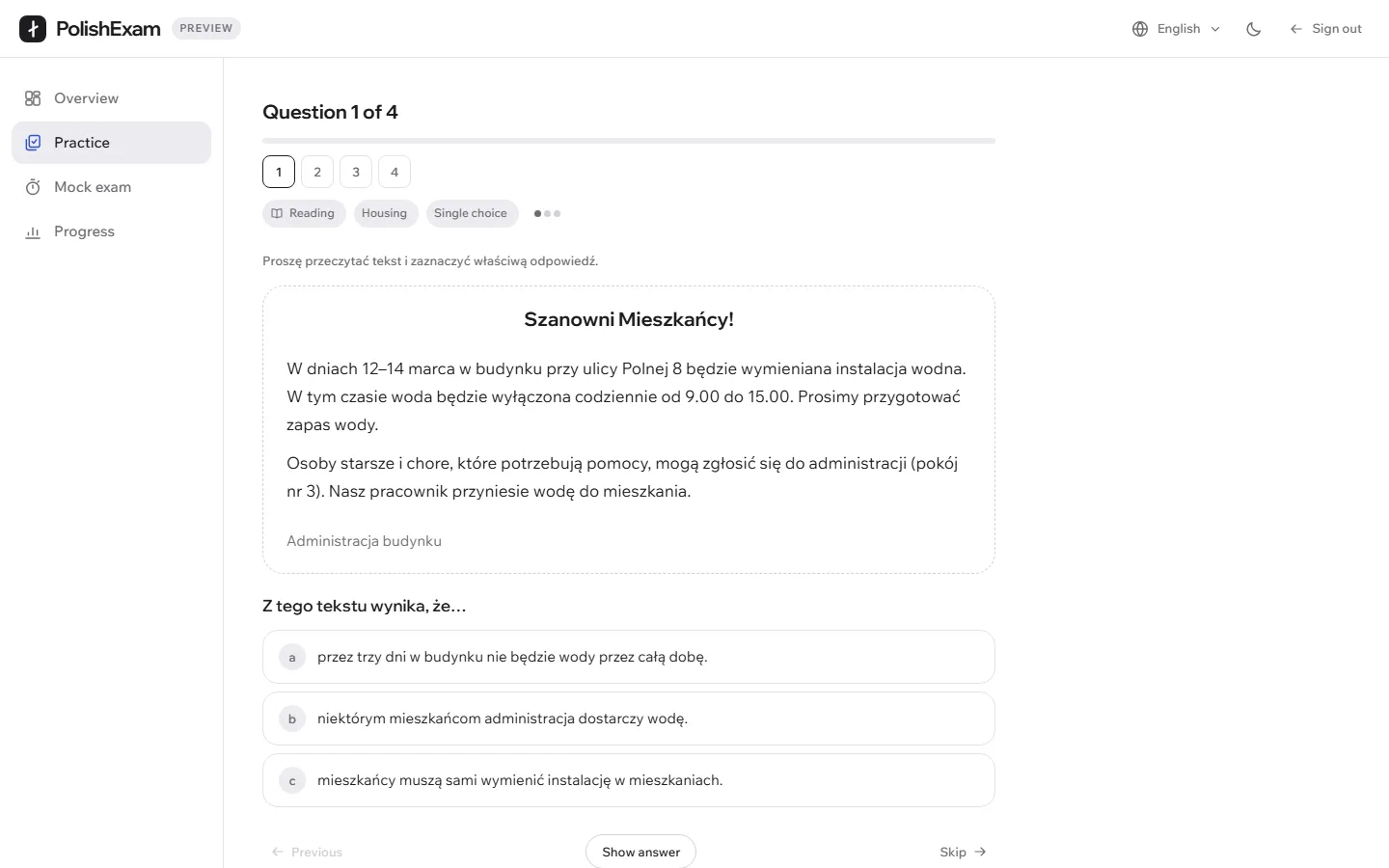
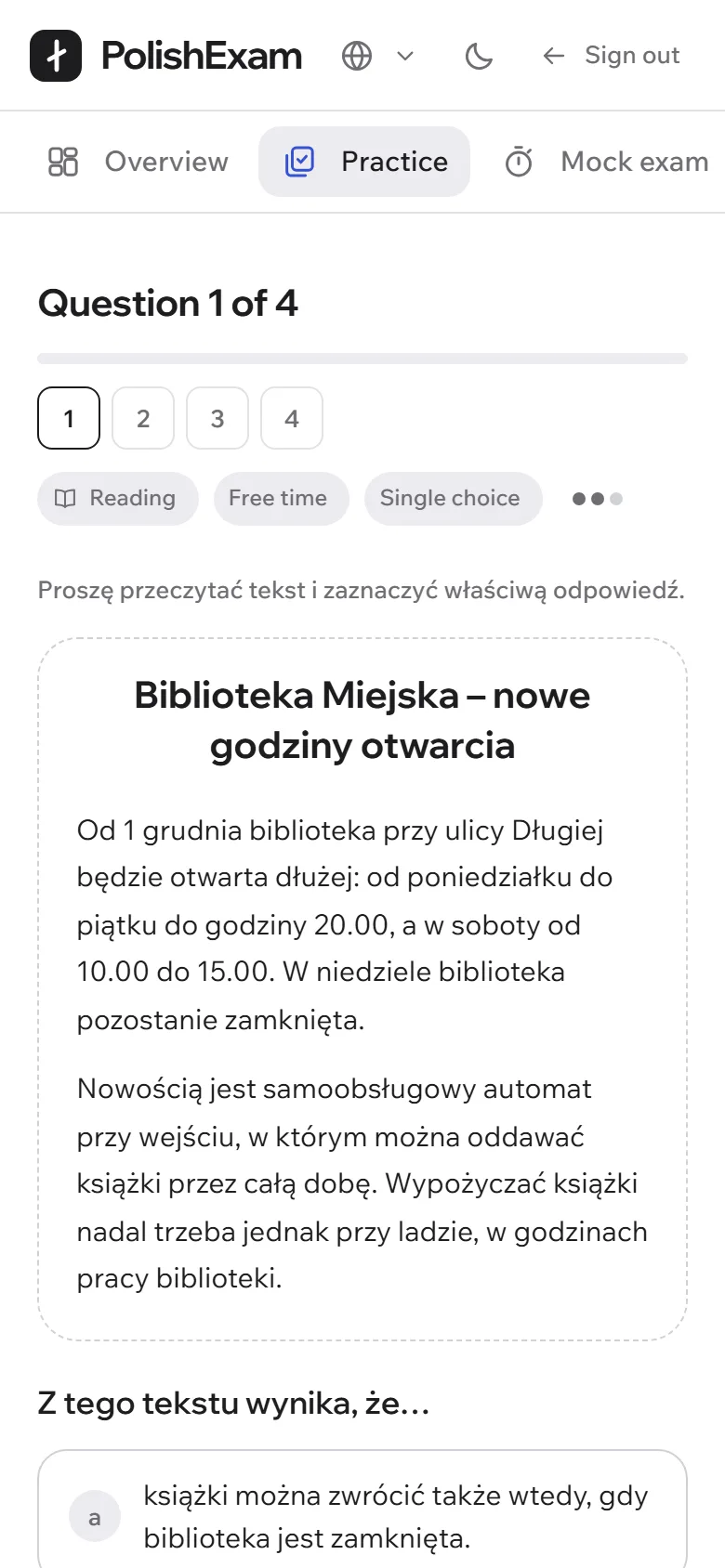
A reading task as it appears in practice: the Polish text and the question side by side, with the instructions in Polish as on the real paper.
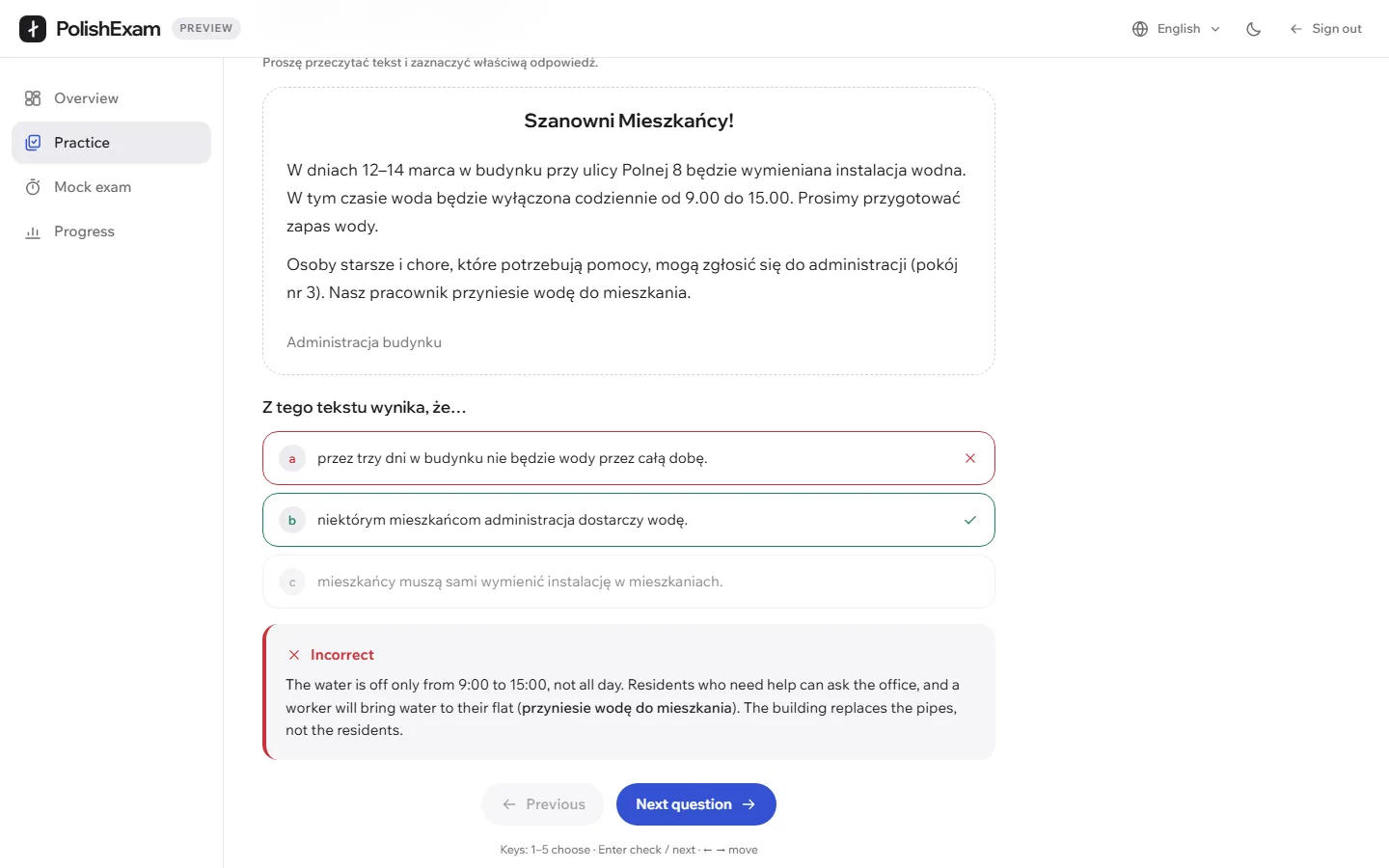
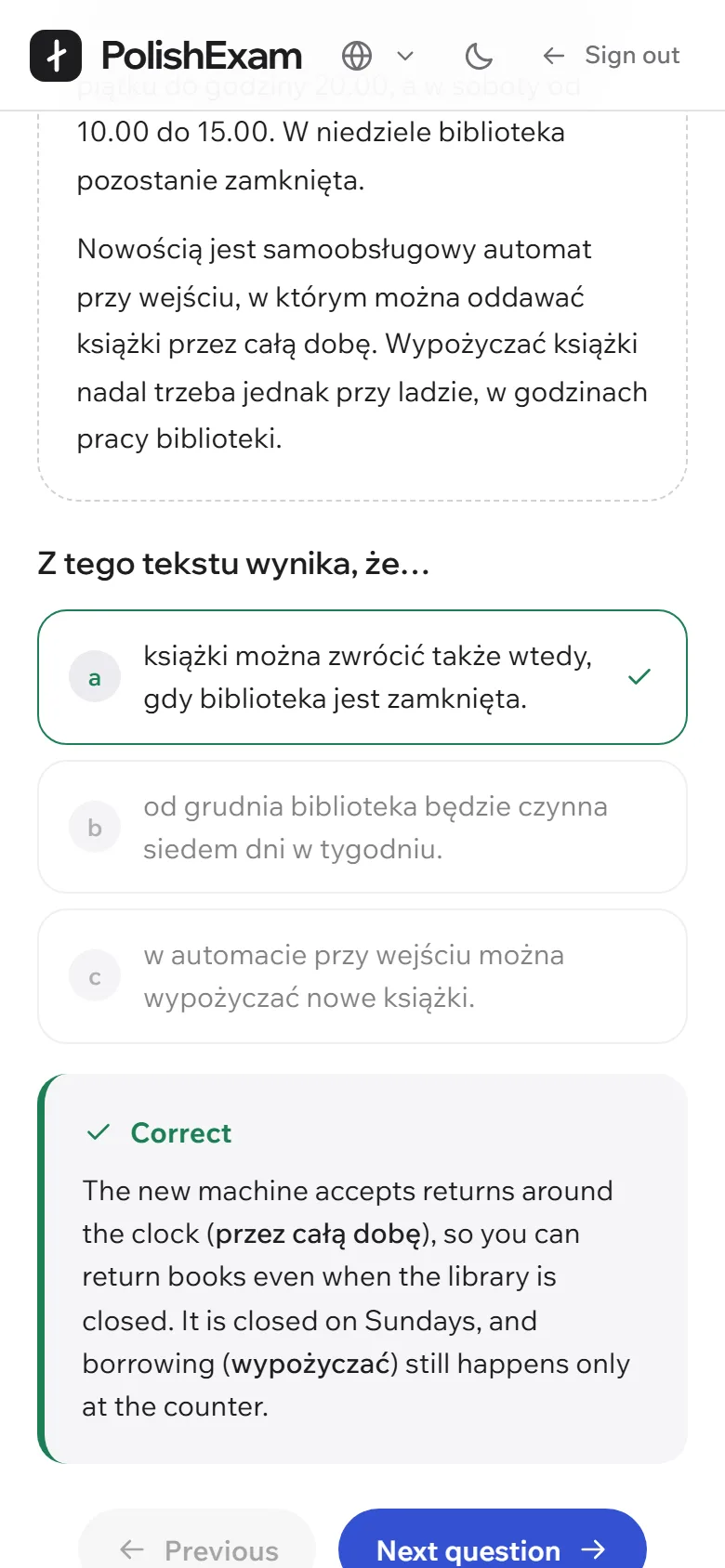
After checking you see whether you were right and why. The explanation is in English or Ukrainian and refers to the exact words in the Polish text.
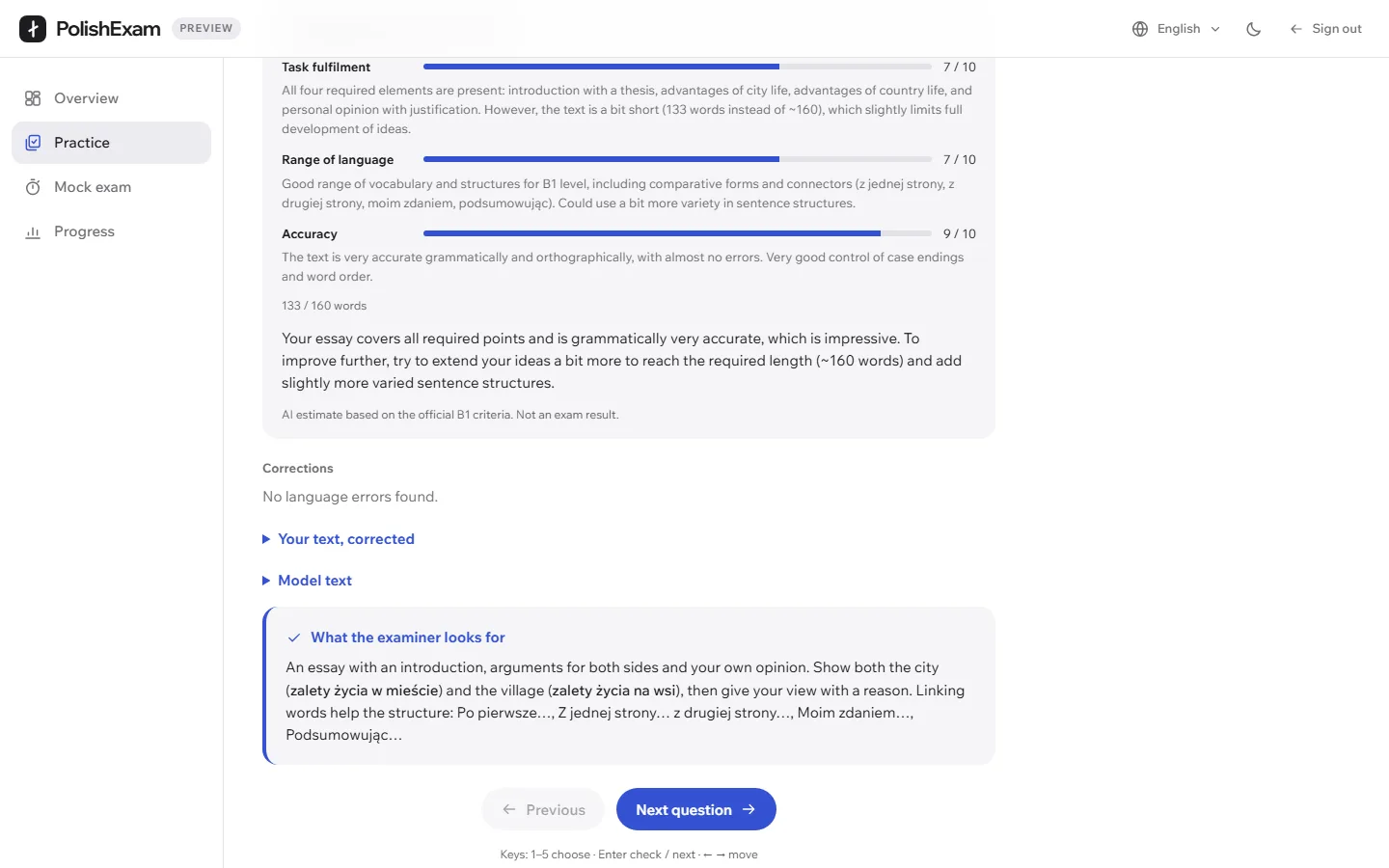
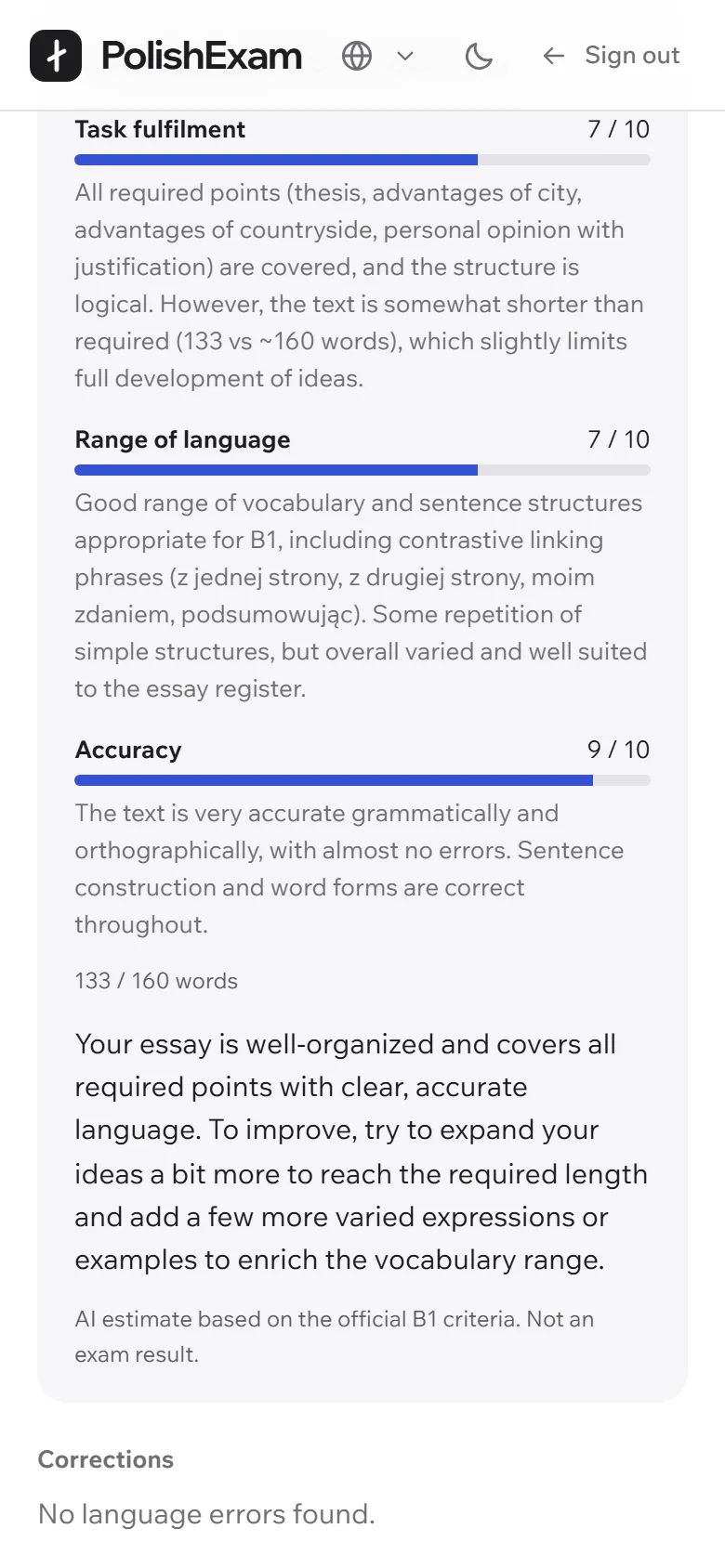
Errors are marked in your text, each with a correction and a short explanation, plus points for the three official criteria. It is an AI estimate meant for practice, not an official score.
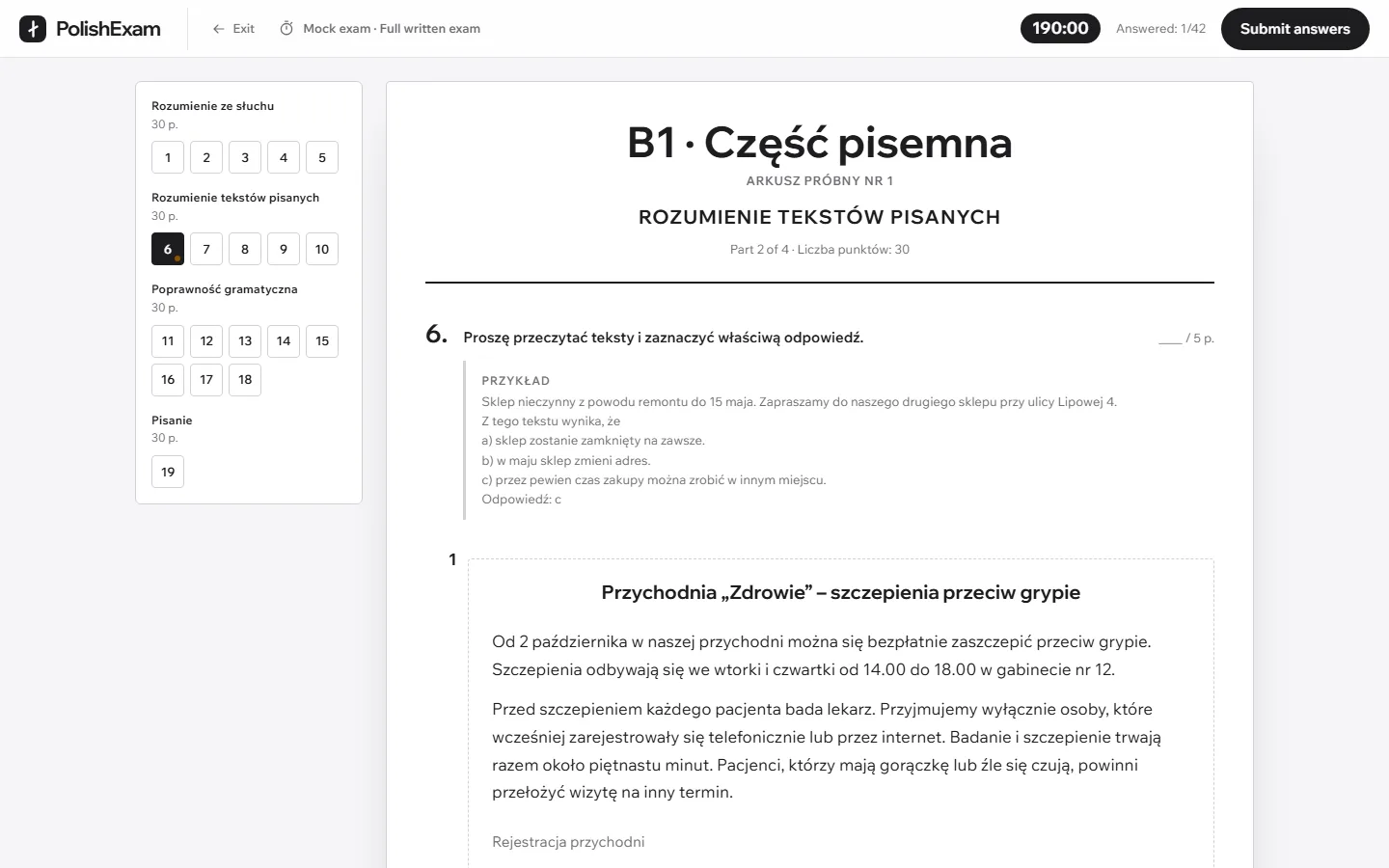
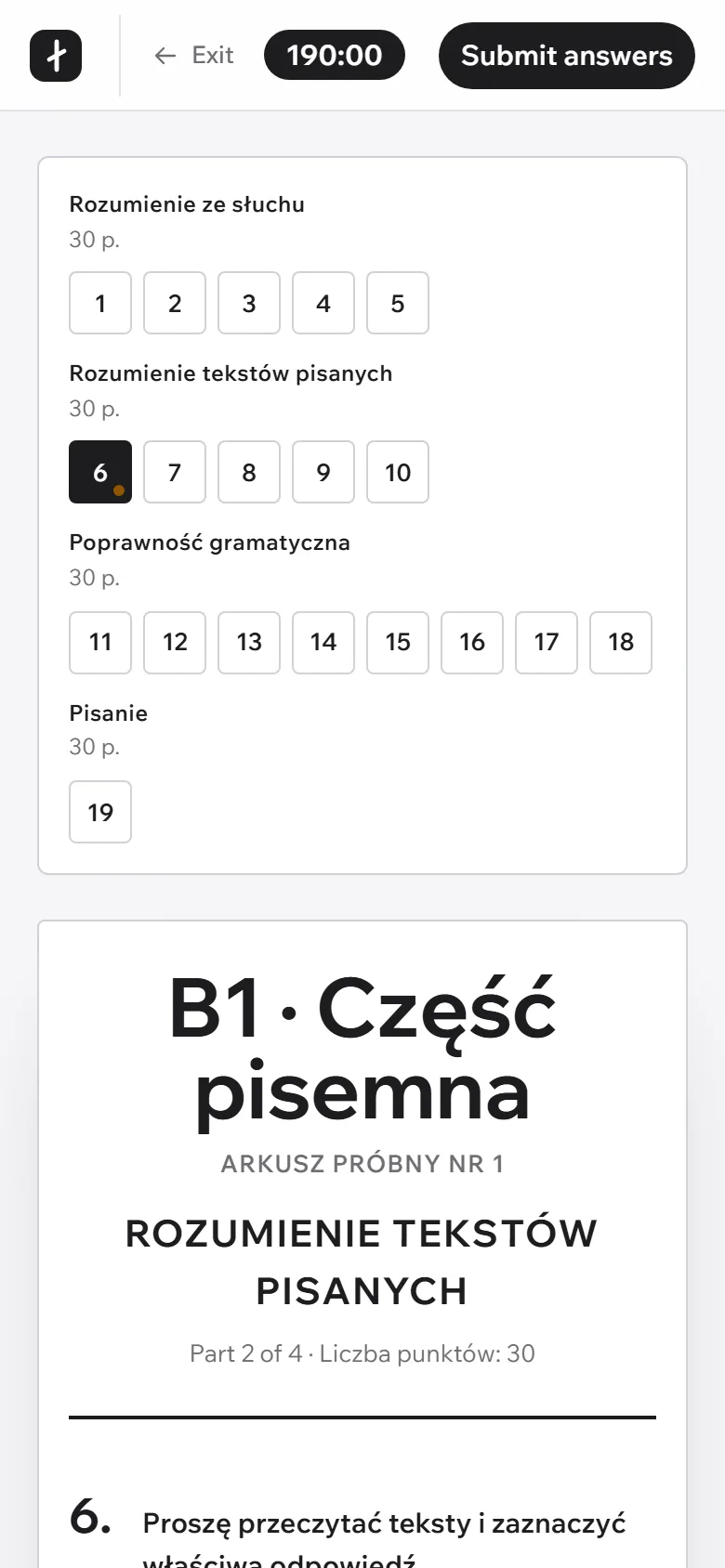
The whole written part as one exam: tasks 1–19 in a side panel, one 190-minute timer, free movement between tasks and one hand-in, like on exam day.
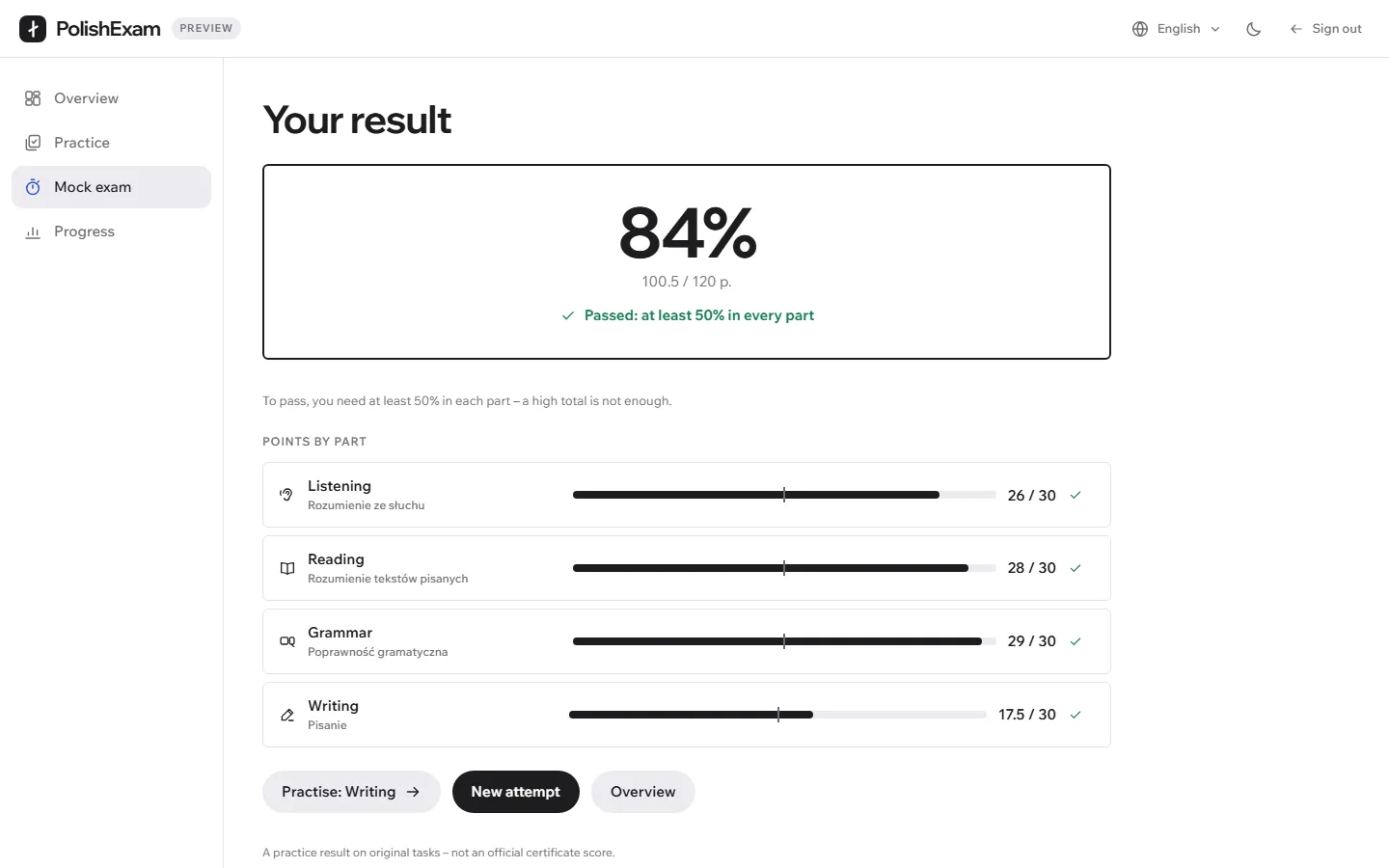
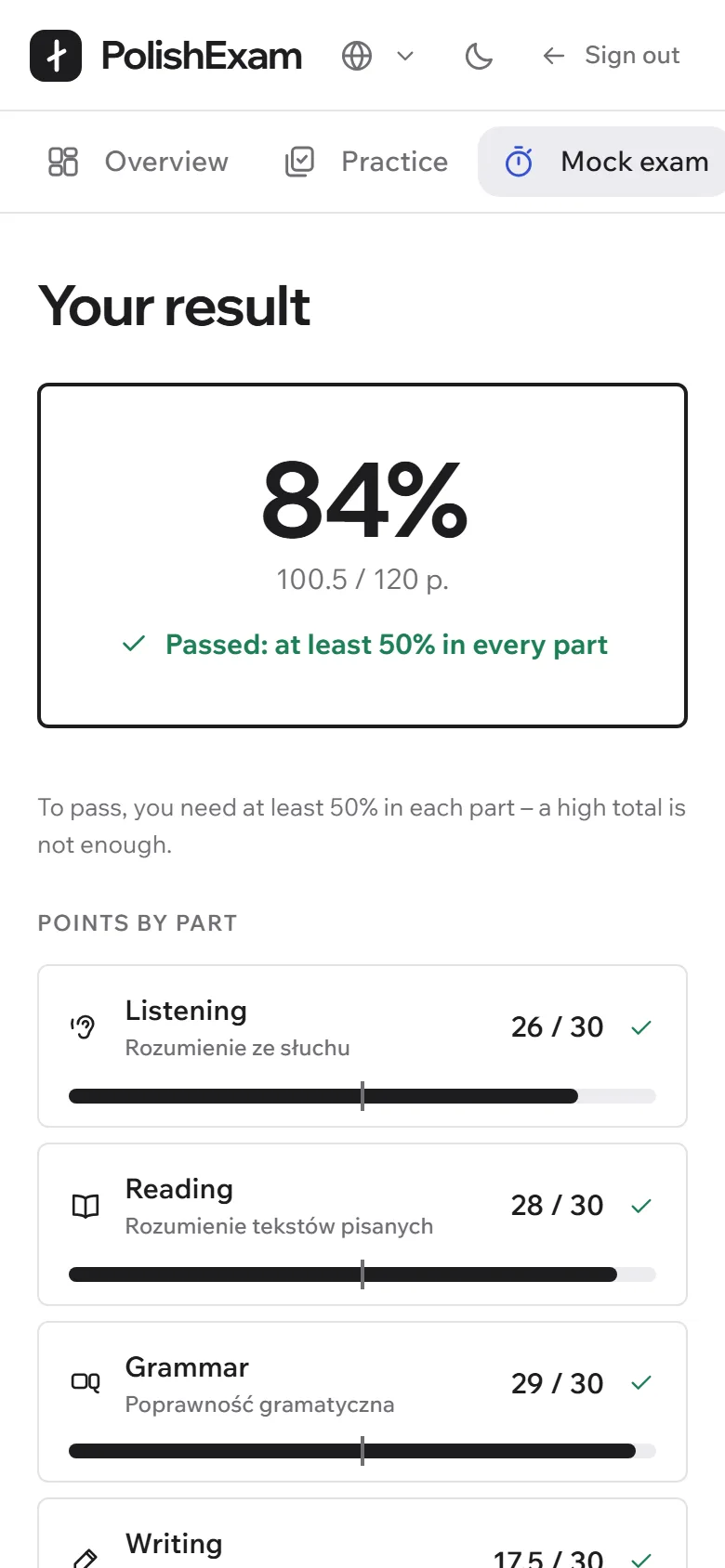
After hand-in you see your points in listening, reading, grammar and writing, and whether each part reached 50%. Then you can go through the paper with the key.
Try it now
Original tasks in the formats of the B1 exam, one of each kind: a dialogue to listen to, a notice and a set of headings to read, and two grammar tasks – choose the form or type it yourself. Answer them here, check the result and read why. There are ten such tasks in the free sample test.
Proszę uważnie wysłuchać dialogu i zaznaczyć właściwą odpowiedź. Uwaga! Nagranie zostanie odtworzone dwa razy.
On the exam this recording is played twice.
Proszę przeczytać tekst i zaznaczyć właściwą odpowiedź.
Drodzy Klienci!
W najbliższy piątek nasz sklep będzie zamknięty z powodu inwentaryzacji. W sobotę zapraszamy jak zwykle od 8.00. Zamówienia przez internet można w tym czasie składać bez zmian.
Zamówienia z odbiorem w sklepie, które miały być gotowe w piątek, wydamy w sobotę. Jeśli wolą Państwo dostawę do domu, prosimy zadzwonić do nas do czwartku. W takiej sytuacji kurier przywiezie zamówienie bez dodatkowej opłaty.
Przepraszamy za utrudnienia i dziękujemy za wyrozumiałość.
Proszę dopasować tytuły (A–E) do fragmentów tekstu (1–4). Uwaga! Jeden tytuł jest niepotrzebny.
Mniej jedzenia w koszu
Wyrzucamy do kosza zaskakująco dużo jedzenia. Kilka prostych nawyków pomoże to zmienić i zaoszczędzić trochę pieniędzy.
Proszę podkreślić poprawne formy wyrazów podanych w nawiasach.
Przykład
Wieczorem idę z (mój brat / moim bratem / mojego brata) do kina. → moim bratem
Proszę uzupełnić tekst poprawnymi formami czasowników podanych w nawiasach (czas teraźniejszy lub przeszły).
Who it is for
Most adults who sit B1 need the certificate as proof of Polish for a residence or citizenship procedure, or for their job.
Citizenship by recognition requires Polish at least at B1. The state certificate counts, as does a certificate from a school in Poland; TELC and ECL certificates do not. A government draft would raise the level to B2, but so far it is only a draft.
The permit requires confirmed knowledge of Polish: a certificate at least at B1 or a Polish school certificate or diploma. For this permit ECL and TELC certificates are accepted as well.
Some professions set a level: nursing chambers expect B1, while the civil service asks for B2. Doctors and dentists can show a centre’s confirmation of a passed exam until the certificate is issued.
We built the app around the real exam, not around a general Polish course.
On the exam every instruction is in Polish, so all tasks in the app are in Polish too. What changes with your language is everything around the task: the interface, the hints and, above all, the explanations. Reading why an answer is right in your own language is faster and clearer than decoding a grammar note in Polish.
Ukrainian speakers often understand a lot thanks to the closeness of the two languages, but that closeness can be misleading: similar-looking words and endings do not always behave the same way. The Ukrainian explanations are written with this in mind, not translated word for word from English.
An amendment adopted in 2026 changes several rules from 1 January 2027. Age groups will be “people aged 16 and over” and “under 16” instead of today’s adult and youth groups. The maximum exam fee for B1 and B2 will be linked to the average wage – 7% of the national average for the third quarter of the previous year – and the certificate will cost 100 zł. People with a hearing or speech disability will be able to be exempted from the oral part.
The spelling reform matters too: new Polish spelling rules apply from 1 January 2026, and in the years 2026–2030 the exam accepts both the old and the new spelling. Dates, fees and registration are explained in detail on the dates and fees page.
An independent preparation tool
PolishExam is not affiliated with the Państwowa Komisja do spraw Poświadczania Znajomości Języka Polskiego jako Obcego and does not issue certificates. All tasks are original. Official past papers are linked on our pages, never copied. You sit the real exam at a centre authorised by the ministry.
Blog · News

On 30 October 2026 the State Commission announced that Inozemna Mowa (Lutsk, Ukraine) withdrew from the 5–6 December session. What the Act says about refunds.

Polish numbers, dates and clock times for B1 listening: która godzina and o której, wpół do, za pięć, dates in the genitive, prices, phone numbers, 12 vs 20.

A four-part frame for the monologue in the Polish B1 oral exam: opening, points with reasons, an example from your life and a closing, with phrases and a model.

In the Polish B1 listening module some recordings are played once and others twice. Two routines, drills for each and the small Polish words that change the answer.
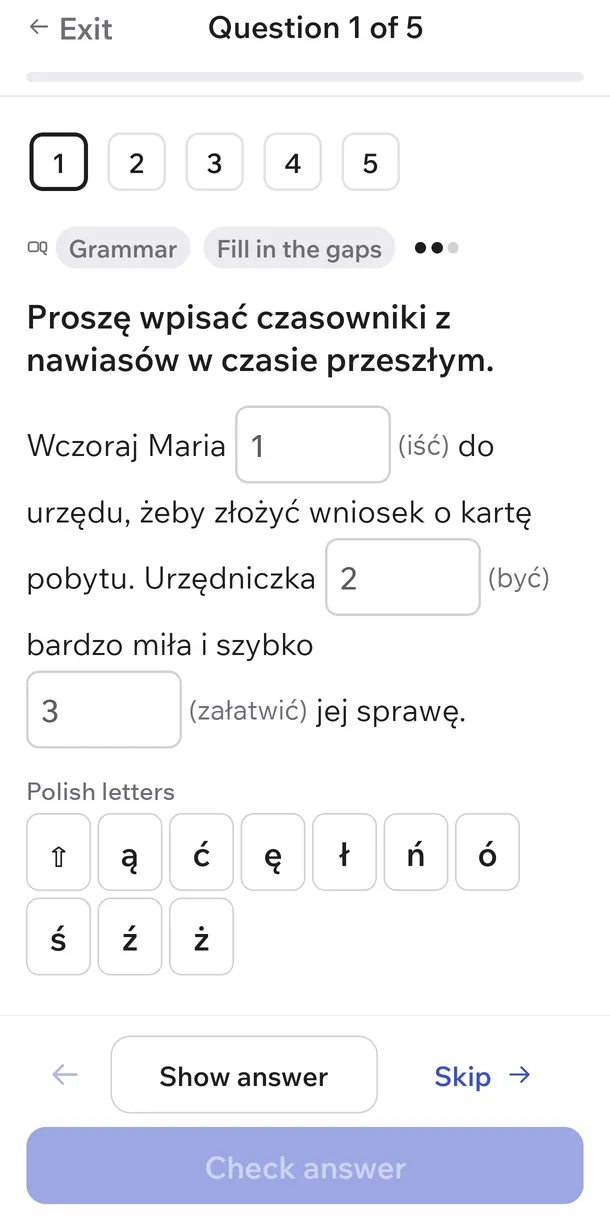
Practise on your phone, too
The PolishExam Android app has the same tasks, mock exam, speaking practice and vocabulary trainer. One account on the website and in the app. About the app

No. PolishExam is an independent practice tool. The official exam is organised by the State Commission and held at authorised centres in Poland and abroad. We do not issue certificates.
The written part lasts up to 190 minutes in total, with breaks of at least 10 minutes between the four modules. The oral part lasts up to 15 minutes and takes place the same day or the next.
At least 50% in each written module (15 of 30 points) and at least 50% of the oral part (20 of 40). A high total is not enough if one module is below 15 points. Check your numbers in the score calculator.
Yes. The sample tasks on our pages are free and need no account – try the sample test. To practise in the app, save progress and sit mock exams, you register with your e-mail.
The tasks are in Polish, as on the exam. The interface and the explanations of answers are in English or Ukrainian, whichever you choose.
Yes. The Speaking section has practice of the photo description, the monologue and the role-play with an AI examiner, plus an oral mock exam. AI gives an estimated score on the official criteria; pronunciation is not assessed, so the result is out of 36 points instead of 40. The speaking page explains how the real oral exam works.
No. It is an estimate based on the three official criteria, meant to show what to improve. On the exam two examiners mark your texts. There is a daily limit of assessed texts.
Yes. The law in force requires at least B1 for citizenship by recognition. A government draft published in October 2026 proposes B2, but it is only a draft. Details are on the citizenship page.
Create an account with your e-mail, pick a part of the exam and do your first tasks in a few minutes.