Citizenship and residence
Polish citizenship language requirement: B1 explained
To be recognised as a Polish citizen you must prove Polish at at least B1. Here is what the law accepts as proof, what does not count, how this compares with residence permits, the Karta Polaka and studies, and which changes are being proposed.
Facts checked:

- B1minimum level for citizenship today
- Art. 30(2)Act on Polish Citizenship
- 50%needed in every part of the B1 exam
- ~8 weeksfrom exam to certificate, in practice
Current law
What the Act on Polish Citizenship requires
The language requirement for citizenship is set out in art. 30(2) of the Act on Polish Citizenship (ustawa o obywatelstwie polskim, consolidated text Dz.U. 2025 item 1611). It applies to uznanie za obywatela polskiego – recognition as a Polish citizen, the route most foreign residents use. The law asks for knowledge of Polish at least at level B1 and says exactly which documents prove it.
There are three accepted proofs: the state certificate of proficiency in Polish issued under art. 11a of the Act on the Polish Language (the certificate you get after passing the state exam), a school certificate from a school in Poland, or a certificate from a school abroad where Polish is the language of instruction. If you already have one of the school certificates, you may not need to sit the exam at all.
One detail changed recently: since 1 July 2025 a certificate from a post-secondary school (szkoła policealna) no longer counts as proof for citizenship (art. 30(2a)). Certificates obtained by 30 June 2025 still counted only in proceedings started between 1 July 2025 and 30 June 2026 (art. 15(2) of Dz.U. 2025 item 622) – details on post-secondary school certificates.
Certain minors are exempt from proving Polish – the cases listed in art. 30(1) points 4–5. Adults applying in their own name are not exempt, whatever their age or how long they have lived in Poland.
Many websites still say that citizenship requires B2. Under the law in force on 11 November 2026 the requirement is B1. B2 appears only in a government draft – see planned changes.
Watch out
What does not count for citizenship
The list in art. 30(2) is closed. A document that is not on it will not satisfy the requirement, even if it shows a high level of Polish.
- TELC and ECL certificates. They are not named in the Act on Polish Citizenship, so they do not count for citizenship – even though both are accepted for the EU long-term resident permit. See TELC vs the state certificate.
- Post-secondary school certificates (szkoła policealna) issued in Poland – not accepted for citizenship since 1 July 2025.
- Course completion certificates from language schools or online courses: they show that you studied, not that you passed the state exam. PolishExam does not issue certificates of any kind.
- A B1 certificate from a university’s own exam that is not the state certificate. For citizenship it has to be the state certificate under art. 11a of the Act on the Polish Language.
- A lower level. A state certificate at A2 is a real certificate, but it does not meet the B1 requirement.
Comparison
B1 for citizenship vs residence permits, Karta Polaka and studies
Language rules differ from one procedure to another. This is the most common source of confusion – especially the difference between citizenship and the EU long-term resident card.
| Procedure | Polish required? | Minimum level | What counts as proof | Exemptions and notes |
|---|---|---|---|---|
| Citizenship by recognition (art. 30, Act on Polish Citizenship) | Yes | B1 | State certificate; school certificate from a school in Poland; certificate from a school abroad with Polish as the language of instruction | Certain minors exempt (art. 30(1)(4)–(5)). TELC, ECL and post-secondary certificates do not count. |
| EU long-term resident permit (art. 211, Act on Foreigners) | Yes | B1 | State certificate, ECL, TELC, a university certificate under conditions, sworn translator status; or a certificate or diploma from a Polish school or university | People under 16 are exempt. Transition for post-secondary school certificates until 30.06.2026. |
| Permanent residence permit (art. 195, Act on Foreigners) | No | – | No language requirement | Do not confuse it with the EU long-term resident permit. |
| Karta Polaka | Yes | “At least basic” | No certificate required: a certificate of any level, a school certificate, or a conversation with the consul | Assessed by the consul if you have no document. |
| Studies in Polish (candidates from outside the EU) | Yes | B2 | State certificate B2–C2, ECL, TELC, or a preparatory course of at least 9 months | B1 is not enough (since 31.07.2025). |
Sources: Act on Polish Citizenship (Dz.U. 2025 item 1611), Act on Foreigners (Dz.U. 2025 item 1079), Dz.U. 2023 item 1076, Act on the Karta Polaka (Dz.U. 2026 item 76), Dz.U. 2025 item 1045. Status on 11 November 2026.
Residence
B1 for the long-term resident card
If you are applying for the EU long-term resident permit (zezwolenie na pobyt rezydenta długoterminowego UE), the Act on Foreigners (art. 211(1)(3)) also asks for documented knowledge of Polish. The proof is a certificate of at least B1 or a certificate or diploma from a Polish school or university (art. 211(3)); people under 16 are exempt (art. 211(4)).
Here the list of certificates is wider than for citizenship. A regulation (Dz.U. 2023 item 1076) accepts the state certificate, ECL, TELC, a university certificate meeting set conditions, and the status of a sworn translator. So a TELC B1 is enough for the residence card but not for citizenship later.
This requirement is not new. In 2025 only the rules on school certificates were tightened, with a transition for post-secondary schools that ended on 30 June 2026. A permanent residence permit (art. 195) has no language requirement at all.
Planning both a residence card now and citizenship later? Take the state exam once: it counts for both, and the certificate does not expire.
Planned changes – only drafts as of 11 November 2026
On 27 October 2026 an entry for draft UD491 appeared in the government’s legislative work list (adoption by the government planned for Q4 2026). It would raise the citizenship requirement from B1 to B2 and add a civic knowledge test, a declaration of loyalty and a longer period of residence. It is only a draft: it is not law and may change or be dropped. Separately, a presidential bill (Sejm print 1759) would extend the residence period from 3 to 10 years; on 4 November 2025 it was referred to first reading in committee, with no further stage as of 9 November 2026. Today B1 still applies. Whether and how transitional rules would treat existing B1 certificates is not known yet. Each stage is tracked on citizenship law changes.
Practical path
From “do I need it?” to your citizenship application
Check whether you need the exam
If you have a school certificate from a school in Poland (not post-secondary) or from a Polish-language school abroad, it may already be your proof. Check whether you fall under the minors’ exemption. Graduates of some Polish schools and universities can also get the state certificate without an exam (see below).
Choose a session and a centre
The B1 exam for adults runs in fixed sessions – the last one in 2026 is on 5–6 December; for 2027 (when the adult group becomes the 16+ group) the planned dates are 6–7 March, 24–25 April, 12–13 June, 2–3 October and 27–28 November. Registration is with an authorised centre in Poland or abroad, usually opening about two months before. See dates and fees and how to get a seat.
Register and pay
The centre sets the price, but until 31 December 2026 it may not exceed €150 for B1 adults; from 2027 a new cap applies. The centre must enter you in the Commission’s database at least a month before the exam, so do not leave registration to the last week.
Prepare for all five parts
The written part has listening, reading, grammar and writing (190 minutes in total, 120 points), followed by speaking (up to 15 minutes, 40 points). At B1 you need at least 50% in every part – one weak part means a fail. Start with our free sample test.
Sit the exam
Bring a photo ID. The written part comes first with breaks of at least 10 minutes between modules; the oral part takes place the same or the next day. The whole exam, including instructions, is in Polish.
Collect your certificate
The centre tells you the result in writing within 3 days of receiving the protocol. The certificate is issued by the State Commission; in practice it takes around 8 weeks after the exam. It is valid indefinitely.
Submit your citizenship application
Add the certificate (or school certificate) to your application for recognition as a Polish citizen. Ask the voivodeship office (urząd wojewódzki) handling your case which form of the document it needs.
Graduates
The state certificate without an exam
Some graduates of Polish schools and universities can apply for the state certificate without sitting the exam. Applications go through the NAWA online system. Whether you qualify depends on the type of school and diploma, so check the conditions on the Commission’s page Certificate without an exam before you register for a session.
If you do not qualify – or if your only Polish school document is from a post-secondary school – the B1 exam is the route that works for citizenship.
The exam
What the B1 exam looks like
The state exam is organised by the Państwowa Komisja do spraw Poświadczania Znajomości Języka Polskiego jako Obcego and run by authorised centres. For adults at B1 it has a written part of four modules – Rozumienie ze słuchu (listening), Rozumienie tekstów pisanych (reading), Poprawność gramatyczna (grammar) and Pisanie (writing), 30 points each – and an oral part, Mówienie, worth 40 points.
The pass rule is what catches people out: you need at least 50% in each written module and 50% in the oral part. A strong grammar score does not compensate for weak listening. Read the full B1 exam guide or try the score calculator.
From 1 January 2027 some rules change: the adult group starts at 16 instead of 18, and fees are capped differently. The level and the citizenship rule stay the same.
Not legal advice
This page summarises the acts listed below as of 11 November 2026. It is not legal advice, and PolishExam is not connected with the State Commission or any office. Your individual situation – exemptions, documents, deadlines – is decided by the authority handling your case: check with the voivodeship office (urząd wojewódzki) or a qualified adviser before you apply.
Prepare with PolishExam
Practise every written part with help in English
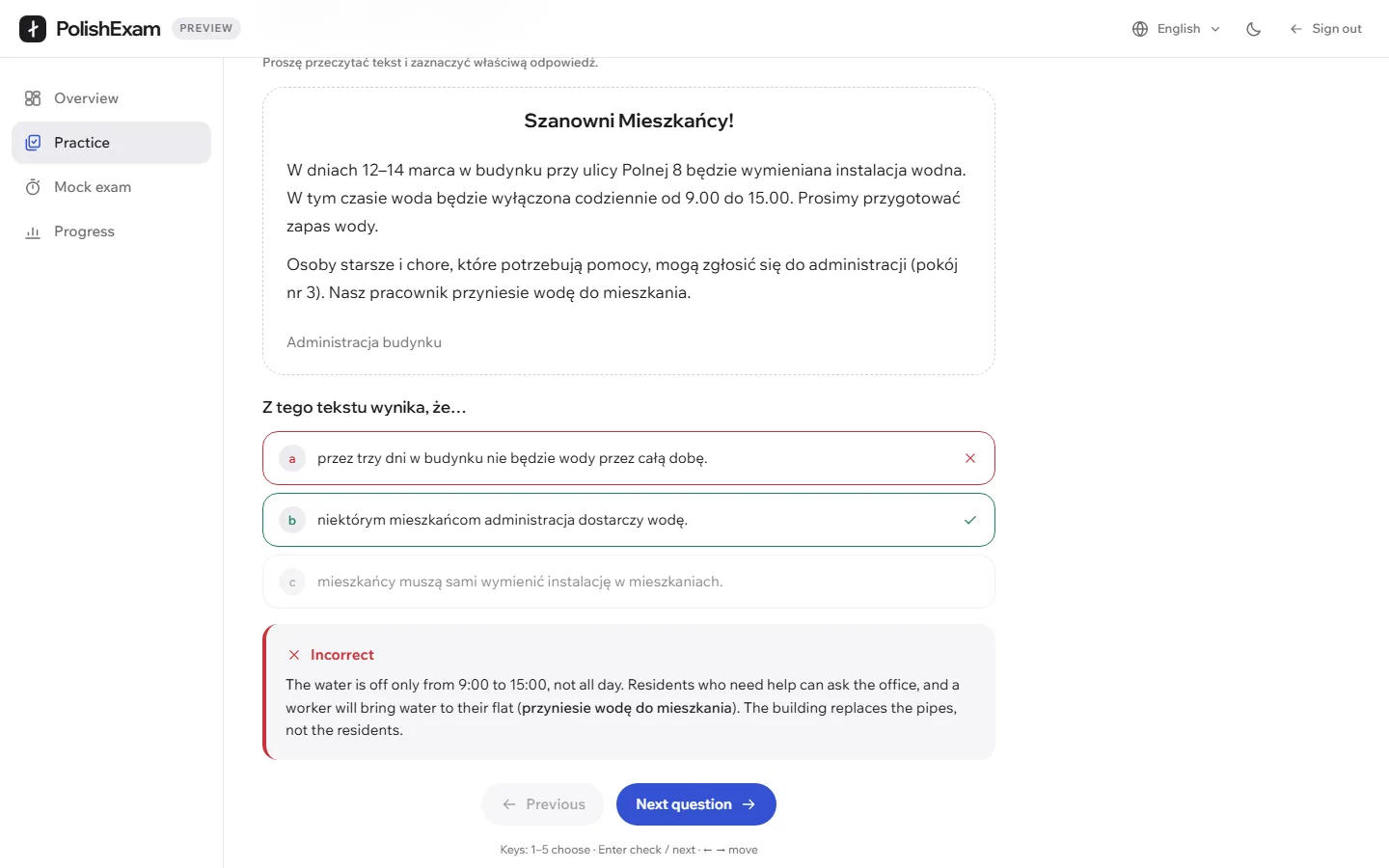
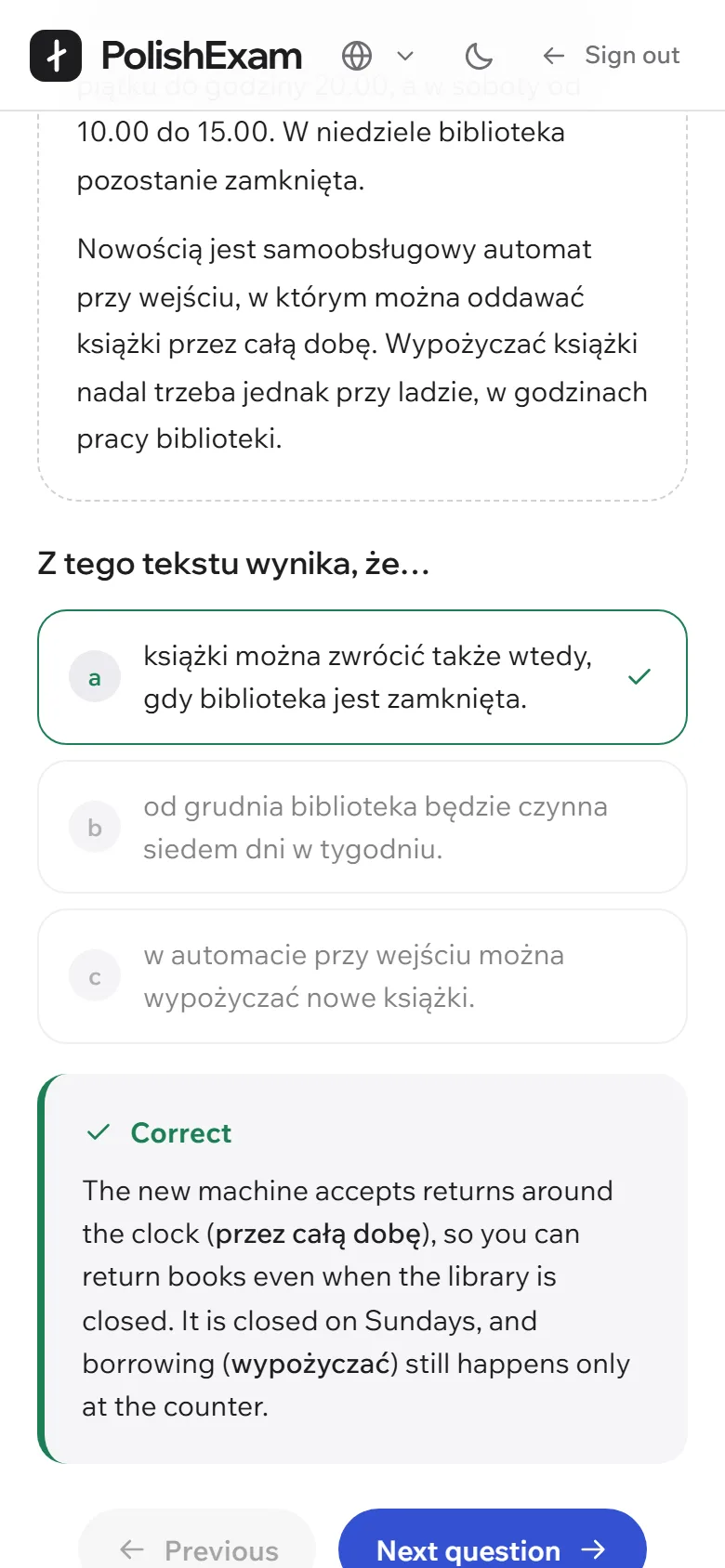
Instant check with an explanation
Tasks in the official B1 formats, in Polish like on the exam. After each answer you see why it is right or wrong – explained in English or Ukrainian.
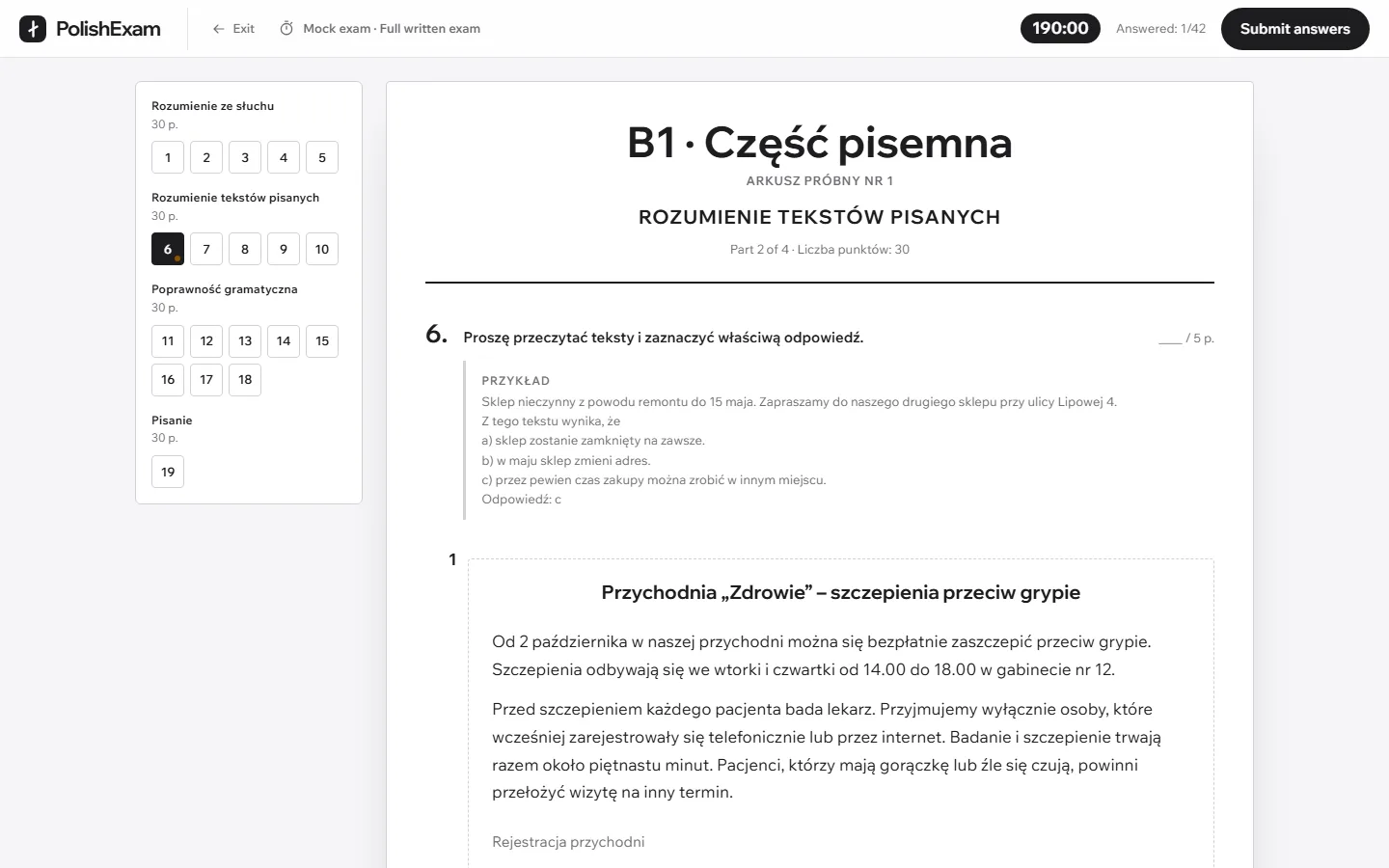
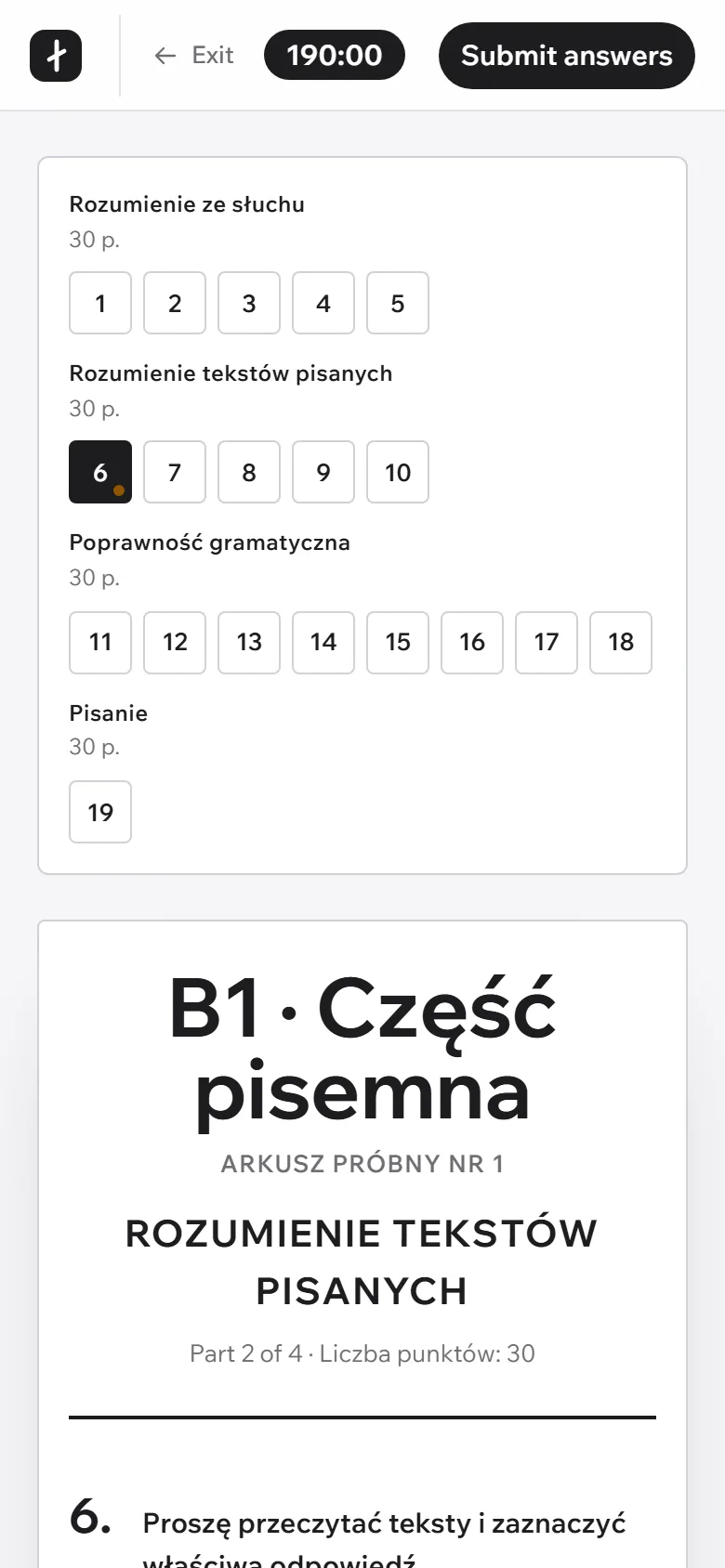
A full mock exam on one timer
The whole written part as one exam: 190 minutes, 120 points, tasks 1–19, and the result per part with the official 50% rule.
Frequently asked questions
What level of Polish do I need for Polish citizenship?
At least B1, under art. 30(2) of the Act on Polish Citizenship (Dz.U. 2025 item 1611). This applies to recognition as a Polish citizen. B2 is only proposed in a government draft and is not law as of 11 November 2026.
Does a TELC or ECL certificate count for citizenship?
No. The Act lists only the state certificate and school certificates, so TELC and ECL do not count for citizenship. They are, however, accepted for the EU long-term resident permit.
Who is exempt from the language requirement?
For citizenship, certain minors listed in art. 30(1) points 4–5 of the Act. For the EU long-term resident permit, people under 16. Adults applying for citizenship are not exempt.
Does a certificate from a Polish post-secondary school count?
Not for citizenship: since 1 July 2025 certificates from post-secondary schools (szkoła policealna) are excluded (art. 30(2a)). A certificate from a school in Poland of another type, or from a Polish-language school abroad, still counts.
Do I need B1 for permanent residence or the Karta Polaka?
The permanent residence permit (art. 195, Act on Foreigners) has no language requirement. The Karta Polaka needs “at least basic” Polish but no certificate – the consul can check it in a conversation. The EU long-term resident permit does require B1.
Does the B1 certificate expire?
No. The state certificate is valid indefinitely, so a certificate obtained for a residence card can be used later for citizenship.
Will citizenship require B2 in 2027?
Not under current law. Government draft UD491 (published 27 October 2026) proposes B2 and a civic knowledge test, but it is only a draft. We update this page if it passes.
How long does it take to get the certificate?
The centre gives you the result in writing within 3 days of receiving the protocol. The certificate itself, issued by the State Commission, usually arrives around 8 weeks after the exam – plan your application with that in mind.
Sources
- Act on Polish Citizenship, consolidated text Dz.U. 2025 item 1611 (ISAP/ELI) – art. 30(1)–(2a): B1, accepted proofs, exemptions
- Act on the Polish Language, consolidated text Dz.U. 2026 item 81 – art. 11a–11m: the state certificate
- Regulation on exams in Polish as a foreign language, Dz.U. 2025 item 217 – exam structure, results, certificate
- Act on Foreigners, consolidated text Dz.U. 2025 item 1079 – art. 195 (permanent residence), art. 211 (EU long-term resident)
- Regulation on accepted language certificates, Dz.U. 2023 item 1076 – EU long-term resident: state certificate, ECL, TELC and others
- Act on the Karta Polaka, consolidated text Dz.U. 2026 item 76 – art. 2(1)(1), art. 13(7)–(8)
- Regulation on studies for foreigners, Dz.U. 2025 item 1045 – B2 for studies in Polish, from 31.07.2025
- Government draft UD491 amending the Act on Polish Citizenship (gov.pl) – draft published 27.10.2026
- Presidential bill, Sejm print no. 1759 – residence period, legislative progress
- certyfikatpolski.pl – certificate without an exam
- certyfikatpolski.pl – exam sessions in 2027
Start preparing for B1
Practise listening, reading, grammar and writing in the official formats, then check yourself with a timed mock exam.