Exam part 2 · Rozumienie tekstów pisanych

Polish B1 reading practice

The reading module, Rozumienie tekstów pisanych, gives you short notices, an e-mail, an article and a gapped text, with 35 items to answer in about 40 minutes. This page shows the official task types, what kinds of texts to expect, three free sample tasks and a plan for using your time well.

Facts checked:

Reading
Reading
  • 30points (pass: 15)
  • 40 minaccording to the 2024 paper
  • 5tasks, 35 scored items
  • 60–250words per text, approximately

What the part tests

What Rozumienie tekstów pisanych checks at B1

Reading is the second written module, after listening and before grammar and writing. It is worth 30 of the 120 written points, and at B1 for adults you need at least 50% in every written module: 15 points in reading is a hard minimum. The whole written part takes 190 minutes in total.

The texts are the kind of Polish you meet when you live in Poland: a notice in a shop, a message from a landlord, a short article with practical advice, information from an office or a school. The tasks check whether you understand the main message of a short text, details and conditions (who, when, for whom, for how much), the structure of a longer text (how sentences connect) and vocabulary in context.

You never have to write a sentence: answers are A/B/C, TAK/NIE, letters for matching, or a word chosen from three. What decides your score is careful reading of the exact wording, not speed alone.

The fixed question Z tego tekstu wynika, że… means “It follows from this text that…”. The answer must be stated or clearly implied in the text, not merely plausible.

Task types

The five reading tasks of the B1 paper

Structure of the 2024 B1 paper for adults. Text lengths are approximate. Points add up to 30.

TaskTextWhat you doItems × points
I5 short texts of about 60–90 words: notices, adverts, short articlesComplete Z tego tekstu wynika, że… for each text (3 options)5 × 1 = 5
IIone text of about 200–250 words6 statements: TAK (true) or NIE (false)6 × 1 = 6
IIIone text of about 200–250 words with 7 sentences removedPut fragments A–H back into gaps 1–7; one fragment is extra7 × 1 = 7
IV7 short fragments, e.g. sections or tips of one articleMatch titles A–H to the fragments; one title is extra7 × 1 = 7
Vone text of about 150 words with 10 gapsChoose the best word of three for each gap (vocabulary, collocations)10 × 0.5 = 5

The 2024 paper gives 40 minutes for reading; an older Commission table gives 45. We plan for 40.

Free, no account

Try three reading tasks

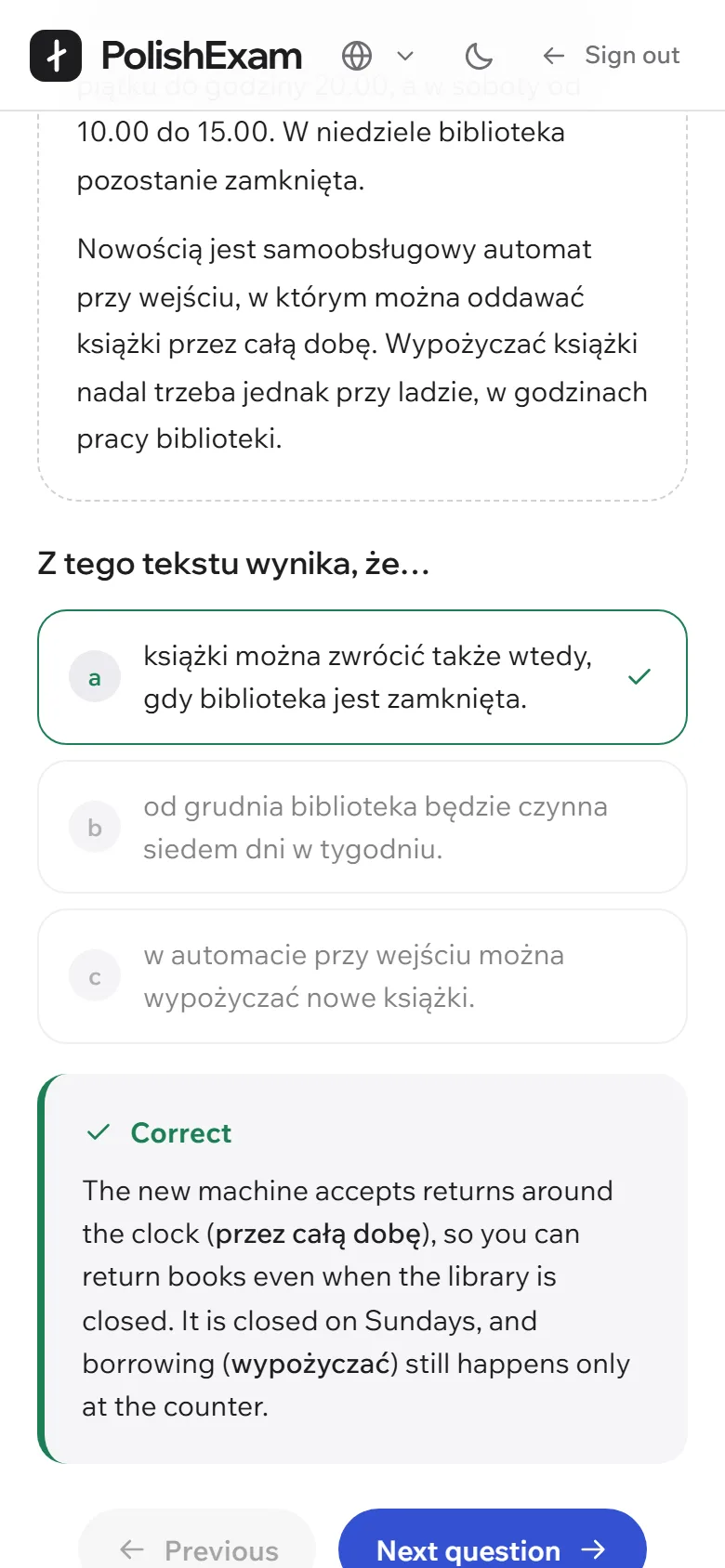
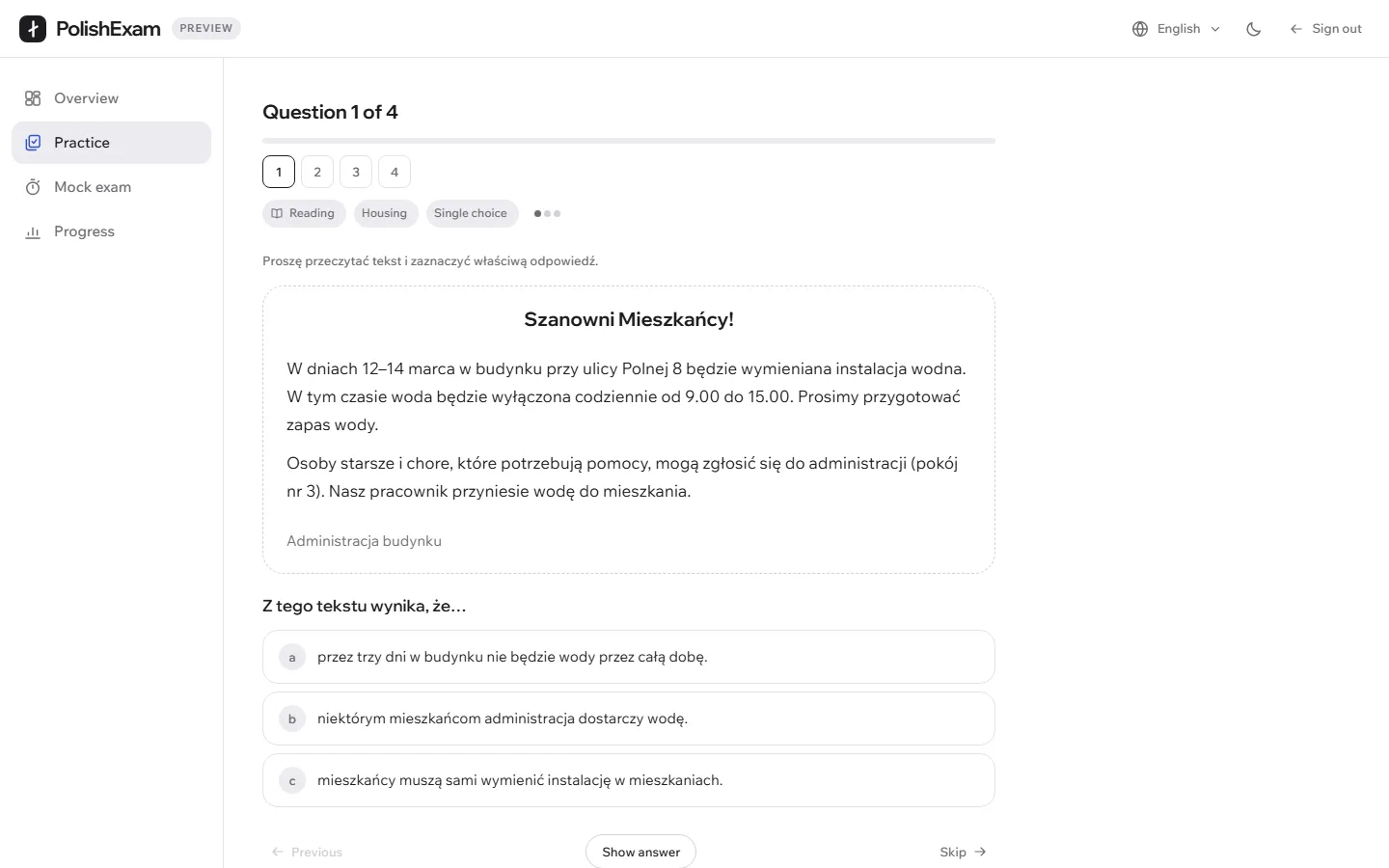
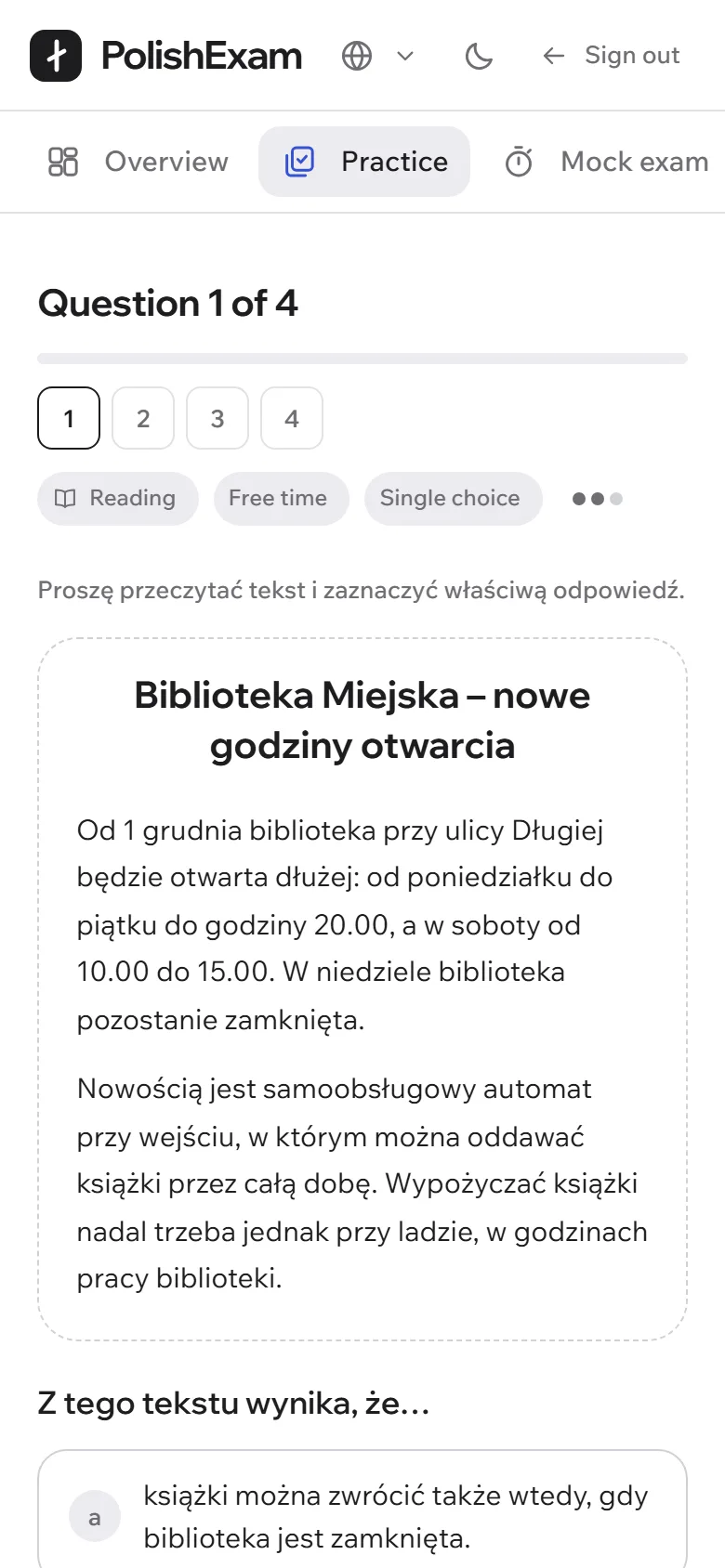
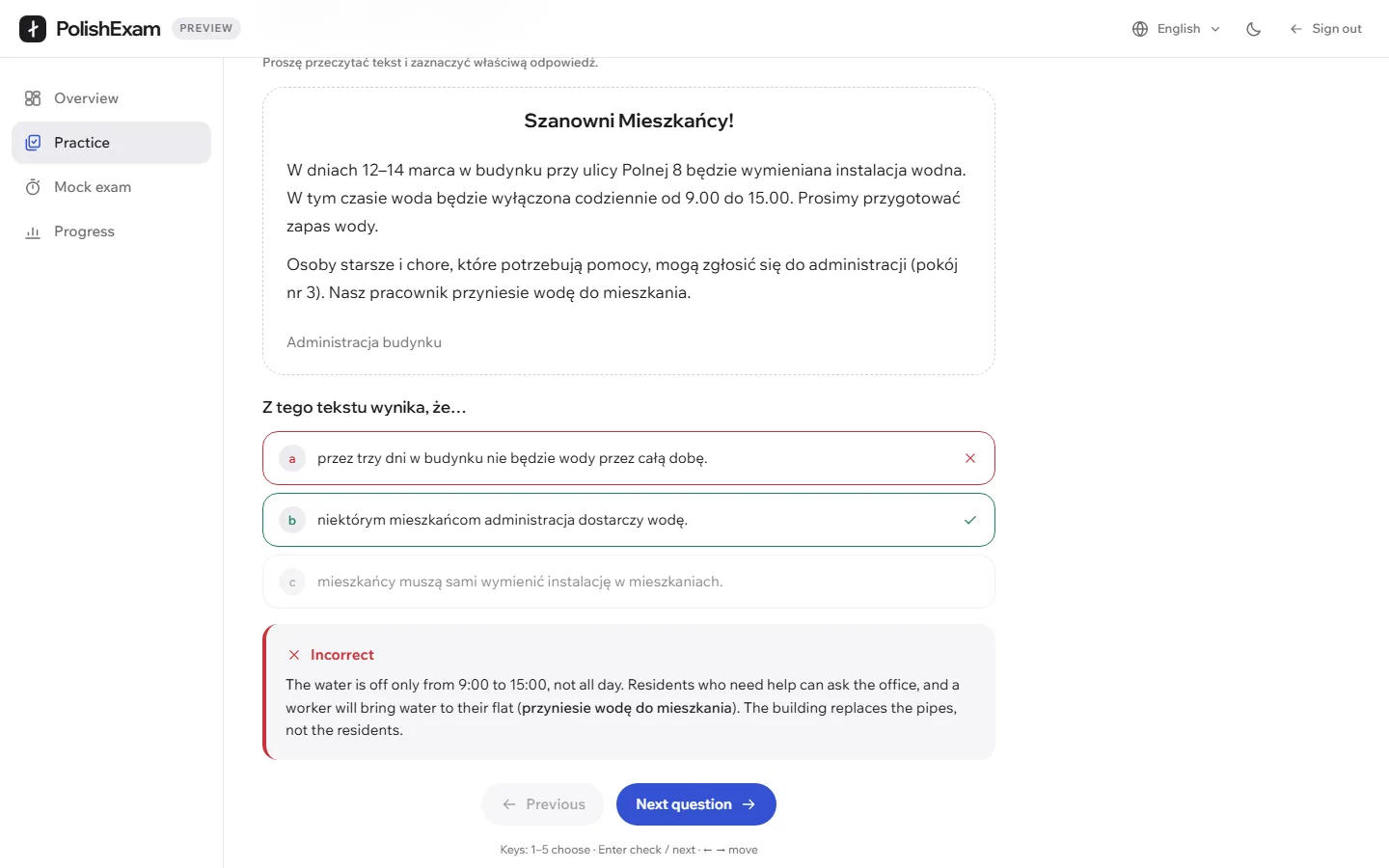
Original tasks in the official formats: a shop notice (like task I), an e-mail from a landlord with TAK/NIE statements (like task II) and an article on food waste where you match titles (like task IV, shortened to four fragments and five titles). After answering you see the key and an explanation quoting the decisive words.

Rozumienie tekstów pisanych

Proszę przeczytać tekst i zaznaczyć właściwą odpowiedź.

Drodzy Klienci!

W najbliższy piątek nasz sklep będzie zamknięty z powodu inwentaryzacji. W sobotę zapraszamy jak zwykle od 8.00. Zamówienia przez internet można w tym czasie składać bez zmian.

Zamówienia z odbiorem w sklepie, które miały być gotowe w piątek, wydamy w sobotę. Jeśli wolą Państwo dostawę do domu, prosimy zadzwonić do nas do czwartku. W takiej sytuacji kurier przywiezie zamówienie bez dodatkowej opłaty.

Przepraszamy za utrudnienia i dziękujemy za wyrozumiałość.
Z tego tekstu wynika, że…
Rozumienie tekstów pisanych

Proszę przeczytać tekst i zaznaczyć: TAK – gdy zdanie jest zgodne z tekstem, NIE – gdy nie jest zgodne z tekstem.

Krzysztof Malinowski

Przegląd instalacji gazowej

Dzień dobry Pani Natalio,

w przyszły wtorek w całym budynku odbędzie się obowiązkowy przegląd instalacji gazowej. Technik przyjdzie do Pani mieszkania między 10.00 a 13.00. Wiem, że o tej porze jest Pani zwykle w pracy, dlatego mogę przyjść sam i otworzyć mieszkanie swoim kluczem – oczywiście tylko wtedy, jeśli Pani się na to zgodzi. Gdyby wolała Pani być w domu w czasie przeglądu, mogę poprosić firmę o inną godzinę, ale tylko w ten sam dzień.

Przegląd trwa około piętnastu minut i lokatorzy nic za niego nie płacą. Proszę tylko, żeby w kuchni był łatwy dostęp do kuchenki i do licznika gazu. Jeśli technik zauważy jakiś problem, naprawę zorganizuję i opłacę ja.

Bardzo proszę o odpowiedź do piątku, żebym mógł potwierdzić termin w firmie.

  1. Właściciel proponuje, że sam wpuści technika do mieszkania.
  2. Przegląd odbędzie się tylko w mieszkaniu Natalii.
  3. Za przegląd lokatorzy muszą zapłacić.
  4. Ewentualną naprawę opłaci właściciel mieszkania.
Rozumienie tekstów pisanych

Proszę dopasować tytuły (A–E) do fragmentów tekstu (1–4). Uwaga! Jeden tytuł jest niepotrzebny.

Mniej jedzenia w koszu

Wyrzucamy do kosza zaskakująco dużo jedzenia. Kilka prostych nawyków pomoże to zmienić i zaoszczędzić trochę pieniędzy.

  • ADrugie życie resztek
  • BNajpierw sprawdź, co masz w domu
  • CPromocje nie zawsze się opłacają
  • DDwie różne daty
  • EStarsze produkty na przód

Strategy

How to work through the reading module

  1. Read the questions first, then the text

    For task I and task II, read the options or statements first. You then read the text looking for specific information, and you notice the sentence that decides the answer.

  2. Find the evidence, then mark

    For every answer, put your finger on the sentence that proves it. If you cannot point to it, you are answering from memory or from logic. In the notice sample, wydamy w sobotę is the evidence for option A.

  3. Watch small words that change meaning

    tylko, wszyscy, nigdy, bez, nie, jeszcze, już, dopiero. A TAK/NIE statement is false when one of these does not match the text: tylko w mieszkaniu Natalii versus w całym budynku.

  4. In gapped texts, read around the gap

    In task III look at the sentence before and after each gap: pronouns (ten, to, ona), connectors (dlatego, jednak, poza tym) and repeated nouns show which fragment fits. Fill the easy gaps first; the extra fragment becomes visible at the end.

  5. Match titles to the main idea

    In task IV a title summarises the whole fragment, not one word in it. A title that repeats a word from the text is often the trap. Expect one title to be left over.

  6. In the vocabulary task, think of word partners

    Task V tests collocations: zrobić zakupy, złożyć wniosek, zdać egzamin, wziąć urlop. Read the full sentence with each option and choose what a Pole would actually say.

  7. Keep a time plan

    With 40 minutes for 35 items, a workable plan is about 6 minutes for task I, 8 for II, 10 for III, 8 for IV, 6 for V and the rest for checking. Never leave an item blank: there is no penalty for a wrong answer.

Typical mistakes

Mistakes that cost points in reading

  • Choosing an option because it sounds sensible, not because the text says it.
  • Matching by a repeated word instead of by meaning; distractors often reuse words from the text.
  • Treating “not mentioned” as true. In TAK/NIE tasks a statement the text does not confirm is NIE.
  • Overlooking conditions and exceptions: jeśli, tylko wtedy, oprócz, z wyjątkiem.
  • Trusting look-alike words: sklep is a shop, dywan a carpet, uroda beauty, zapominać to forget.
  • Spending 15 minutes on task III and rushing the last two tasks, which together are worth 12 points.
  • Reading every word slowly with a dictionary in mind. On the exam you need the decisive sentence, not a full translation.

What to know at B1

Text types and lengths at B1

Most texts come from everyday and practical life. Knowing their typical form helps you find information quickly.

Text typeTypical lengthWhat to look for
Notice, announcement (ogłoszenie, komunikat)about 60–90 wordsWhat changes, when, for whom, what you have to do
Advert, offer (oferta, reklama)about 60–90 wordsPrice, conditions, limits (tylko, do wyczerpania zapasów)
E-mail or letter (wiadomość, list)about 200–250 wordsWho writes to whom, request or proposal, deadlines
Article or report (artykuł)about 200–250 wordsMain idea of each paragraph, connectors, opinions vs facts
Advice text in sections (porady)7 short fragmentsOne main idea per fragment for titles
Short gapped textabout 150 wordsCollocations and words that fit the context

Lengths are approximate and based on the 2024 paper. Topics at B1 cover everyday life: housing, work, health, shopping, transport, education, free time, offices.

In the app

How PolishExam trains the reading part

Reading tasks in every official format

Reading tasks in every official format

Short texts, TAK/NIE, gapped texts, matching titles and vocabulary gaps, all in Polish like on the exam. Choose task type, topic and difficulty to work on what is weak.

  • Texts styled like the real genre: notice, e-mail, article
  • Instructions in Polish, help in English or Ukrainian
Explanations that quote the text

Explanations that quote the text

After you check an answer, the explanation shows the Polish words that decide it and why the other options are wrong. This is how you learn to find evidence instead of guessing.

  • “Show answer” when you are stuck
  • Results by task type and topic in your progress

Official materials

Official reading materials to practise with

Finish your preparation on real papers from the State Commission. We link to them; we never copy them.

Frequently asked questions

How long is the B1 reading part?

40 minutes according to the 2024 paper; an older Commission table gives 45. It is the second module of the written part, which takes 190 minutes in total.

How many points do I need in reading?

At least 15 of 30. At B1 for adults the rule is 50% in every written module plus 50% in the oral part.

How long are the texts?

In the 2024 paper roughly 60–90 words for the five short texts, about 200–250 words for the longer texts and about 150 words for the vocabulary gap-fill.

Can I use a dictionary?

Prepare to work without one: the tasks are built so that you can answer without knowing every word, and your exam centre tells you which aids are allowed. In practice, look up words only after you have answered.

What does TAK/NIE mean exactly?

TAK: the statement agrees with the text. NIE: it does not. If the text does not confirm a statement, the answer is NIE.

Does spelling matter in reading?

No. You only choose options or letters. Spelling and Polish letters matter in grammar and writing.

Are your texts taken from real exams?

No. All our tasks are original texts written in the official formats. Real papers are linked from the official materials section above.

Read like an examiner expects

Practise every official reading task type with instant checking and explanations in English or Ukrainian.