Pisanie · module 4 of the written part
Polish B1 writing exam: format, criteria and model texts
The last module of the written part asks for two texts in Polish: a short practical one and a longer one of about 150–175 words. Here is what the examiners check, which text types appear at B1, how many words to write and two original model texts with notes on why they work.
Facts checked:

- 30 p.three criteria, up to 10 points each
- 75 minfor the module, according to the 2024 paper
- 1 of 3sets to choose from
- a + btwo texts in the chosen set
Format
How the writing module works
Pisanie is the fourth and last module of the written part of the B1 exam for adults. It comes after listening, reading and grammar, with a break of at least 10 minutes between modules. The whole written part takes 190 minutes in total; in the 2024 paper the writing module had 75 minutes, which makes it the longest module. It is worth 30 of the 120 points of the written part, and as in every other module you need at least 50% of its points, so 15, to pass. A strong result in grammar does not make up for a weak text.
The paper contains three sets (zestawy), usually numbered I, II and III. You choose one of them and write both of its texts. Each set has a short practical text a and a longer text b. The instructions, like everything on the exam, are in Polish, and they list the content points your text must cover.
The word ranges are given in each set’s instructions, so read them every time. As a rule of thumb, text a is roughly 25–50 words (an SMS, a note, a short invitation or advert) and text b roughly 150–175 words (an e-mail or letter, a story, a report, a description or an opinion). Typical B1 instructions name a narrower range, for example about 30 words for a and about 160–175 for b.
Choosing the set is part of the task. Read all three before you write a word. Pick the set where you can cover every point in text a and in text b, not the one with the most interesting topic. The set is chosen as a whole: you cannot take text a from set I and text b from set III.
Underline the content points in each instruction (proszę napisać, podziękować, zaproponować…). They are the checklist the examiners use for task fulfilment.
Assessment
The three criteria and what they mean in practice
Your texts are marked against three criteria, up to 10 points each, 30 in total. The module is assessed by two examiners. The table translates each criterion into things you can check in your own writing.
| Criterion | Points | What it means in practice |
|---|---|---|
| Task fulfilment (wykonanie zadania) | 0–10 | Every content point from the instruction is covered and developed, not just mentioned. The text type is right (an invitation looks like an invitation), the register fits the reader (Pan/Pani for an office, ty for a friend) and the length stays close to the range. |
| Range of language (środki językowe) | 0–10 | You use varied vocabulary for the topic and more than one sentence pattern: linking words (ponieważ, dlatego, jednak), past, present and future, conditional forms such as chciałbym. Repeating the same three verbs keeps this score low. |
| Accuracy (poprawność językowa) | 0–10 | Cases after prepositions and verbs, verb endings, aspect, agreement of adjectives, spelling and Polish letters (ą, ę, ł, ó, ś, ż…). Errors that make a sentence hard to understand weigh more than a single slip. |
Criteria names follow the official description of the exam. The examples in the third column are our explanation for learners, not an official marking scheme.
Text types
Polish B1 writing task examples: text types and useful phrases
These are the kinds of texts you can meet in the B1 writing module. Short practical texts usually appear as text a, longer ones as text b. Learn a few set phrases for each: they cost no thinking time on the day and they are safe for accuracy.
| Text type | Usually | Useful Polish phrases |
|---|---|---|
| Invitation (zaproszenie) | text a | Serdecznie zapraszam na… · Impreza odbędzie się w sobotę o 18:00 w… · Proszę o potwierdzenie do piątku. |
| Notice or advert (ogłoszenie) | text a | Sprzedam rower w bardzo dobrym stanie. · Szukam pokoju do wynajęcia od 1 marca. · Zainteresowanych proszę o kontakt. |
| Wishes (życzenia) | text a | Z okazji urodzin życzę Ci dużo zdrowia i szczęścia. · Wszystkiego najlepszego! · Wesołych Świąt! |
| Message, note or SMS (wiadomość) | text a | Niestety nie mogę przyjść, bo… · Klucze zostawiłam u sąsiadki. · Zadzwoń, jak wrócisz. |
| E-mail or letter (e-mail, list) | text b | Formal: Szanowni Państwo, · Piszę, ponieważ chciałbym zapytać o… · Z poważaniem. Informal: Droga Kasiu, · Dziękuję za Twój e-mail. · Pozdrawiam serdecznie |
| Description or character sketch (opis, charakterystyka) | text b | To wysoki mężczyzna w średnim wieku. · Jest bardzo życzliwa i zawsze można na nią liczyć. · Moje mieszkanie znajduje się na trzecim piętrze. |
| Report (sprawozdanie) | text b | W zeszłą sobotę wziąłem udział w… · Impreza rozpoczęła się o… · Najbardziej podobał mi się koncert. · Na zakończenie… |
| Story (opowiadanie) | text b | Pewnego dnia… · Najpierw…, potem…, nagle… · Na szczęście… · W końcu wszystko dobrze się skończyło. |
| Opinion (opinia) | a or b | Moim zdaniem… · Uważam, że…, ponieważ… · Z jednej strony…, z drugiej strony… · Polecam ten sklep, bo… |
Phrases are written with masculine or feminine past forms as examples (wziąłem, zostawiłam): use the form that matches you.
Model text a
Example 1: a short invitation (text a)
Our instruction (original, in the style of the exam): Organizuje Pan grilla dla sąsiadów. Proszę napisać zaproszenie na tablicę ogłoszeń w bloku. Proszę napisać, kiedy i gdzie będzie grill, co trzeba przynieść i do kiedy trzeba potwierdzić udział. Range: about 30–40 words.
Drodzy Sąsiedzi! Zapraszam wszystkich na grilla w sobotę 14 czerwca o 17:00 na podwórku za naszym blokiem. Mięso i napoje kupię sam, ale proszę o przyniesienie sałatki albo ciasta. Proszę o potwierdzenie udziału do czwartku (mieszkanie 12). Marek Kowalczyk
That is 40 words, including the greeting and the signature. Each content point gets its own sentence, so the examiner can tick them off one by one.
Why this invitation would meet the criteria
| Criterion | What the text does |
|---|---|
| Task fulfilment | All three points are there: when and where (w sobotę 14 czerwca o 17:00 na podwórku), what to bring (sałatki albo ciasta) and the deadline (do czwartku). It reads like a real notice: a group greeting, the invitation, a signature and a flat number for replies. |
| Range of language | For 40 words it shows enough variety: the future perfective kupię, the contrast ale, the noun phrase proszę o przyniesienie and a date with a month in the genitive (14 czerwca). |
| Accuracy | Cases are correct after prepositions (na podwórku, za naszym blokiem, do czwartku) and after proszę o (accusative: potwierdzenie). Sąsiedzi is capitalised as a polite form of address in a letter-like text. |
This is our own model text, not an officially scored answer. It shows what the criteria ask for; it does not guarantee a score.
Model text b
Example 2: a Polish B1 letter example (text b)
Our instruction (original): Od miesiąca pracuje Pani w nowej firmie. Proszę napisać e-mail do polskiej koleżanki. Proszę napisać, gdzie Pani pracuje i co Pani robi, jacy są ludzie w pracy, co się Pani podoba, a co nie, i jakie ma Pani plany na przyszłość. Range: about 150–175 words.
Cześć, Aniu! Dziękuję za Twój ostatni e-mail i przepraszam, że odpisuję dopiero teraz. Mam dużą nowinę: od miesiąca pracuję w nowej firmie! To biuro podróży w centrum Wrocławia. Pracuję tam od poniedziałku do piątku, od dziewiątej do piątej. Odpowiadam na telefony i e-maile klientów, a czasem pomagam im zaplanować wycieczkę.
Ludzie w pracy są bardzo mili. Moja szefowa, pani Beata, jest wymagająca, ale cierpliwa, a koleżanki zawsze pomagają mi, kiedy czegoś nie rozumiem. W piątki jemy razem obiad w małej restauracji obok biura.
Najbardziej podoba mi się to, że codziennie mówię po polsku i uczę się nowych słów. Zarabiam też trochę więcej niż wcześniej w kawiarni. Nie podoba mi się tylko to, że muszę wstawać o szóstej, bo dojazd zajmuje mi prawie godzinę.
W przyszłości chciałabym zostać przewodniczką i oprowadzać turystów po mieście. Dlatego we wrześniu zapiszę się na kurs dla przewodników. A co u Ciebie? Napisz, jak się masz i kiedy przyjedziesz do Wrocławia! Pozdrawiam serdecznie, Oksana
About 160 words. The four content points from the instruction map onto four paragraphs, with a short opening and a closing question to the reader, as in a real e-mail to a friend.
Why this e-mail would meet the criteria
| Criterion | What the text does |
|---|---|
| Task fulfilment | Each point is covered and developed with a detail: the job and duties (biuro podróży, odpowiadam na telefony), the people (szefowa… wymagająca, ale cierpliwa), likes and dislikes (najbardziej podoba mi się… nie podoba mi się tylko…) and plans (chciałabym zostać przewodniczką). The informal register with ty (Twój, napisz) fits a friend, and the length is inside the range. |
| Range of language | Present, past and future tenses; the conditional chciałabym; a comparison (więcej niż wcześniej); linking words ale, bo, dlatego, kiedy; topic vocabulary such as dojazd, zarabiam, oprowadzać turystów. |
| Accuracy | Feminine forms are consistent with the writer (chciałabym, przewodniczką). The cases are correct: vocative Aniu, genitive after negation (czegoś nie rozumiem), instrumental after zostać (przewodniczką). Twój and Ciebie are capitalised, the polite convention in Polish letters. |
Again our own text, not an official answer. In the app you can write your own version of a similar task and compare it with the model text after the feedback.
More prompts and model texts
Practise on a bank of B1 writing prompts grouped by topic, or read more model texts with a comment on each criterion.
Polish B1 writing topics
Prompts for text a and text b by topic, with the content points to cover.
Polish B1 sample texts
Model texts of each type with what earns the points and what loses them.
Avoid
Typical mistakes in the B1 writing module
- Missing a content point. Answering two of three questions is the most expensive mistake, because task fulfilment is a third of the score. Tick each point off after writing.
- Wrong register. Writing Cześć! to an office, or mixing Pan/Pani and ty in one letter (Szanowna Pani, czy możesz…). Decide who the reader is before the first line and keep it.
- Too short or far too long. A text far below the range rarely covers all points well; a text far above it adds errors and eats time you need for checking. Count roughly by lines once you know your average words per line.
- Ignoring Polish letters. Prosze, dziekuje and zle are spelling errors, not style. Diacritics count towards accuracy, so check every ą, ę, ł, ó, ś, ć, ń, ź, ż at the end.
- Imperfective instead of perfective (and vice versa). For a single completed event in a story or report use the perfective (kupiłam bilet, spóźniłem się); for habits and background use the imperfective (codziennie jeździłem).
- A list instead of a text. Bullet-like sentences with no linking words (ponieważ, dlatego, potem) keep the range score low even when the grammar is right.
- Changing the topic. Writing a prepared text that only half-fits the instruction. Examiners assess the task you were given, not the one you rehearsed.
Time
How to plan your 75 minutes
There is no official split between the two texts. This is the plan we suggest; adjust it after one or two timed attempts.
Read all three sets and choose (about 5 minutes)
Underline the content points in texts a and b of each set. Choose the set where you have words for every point, not the most attractive topic.
Write text a (about 15 minutes)
Two minutes to list the points and the register, ten to write, three to check. Short texts are quick to lose points in: one missing detail is a large share of the task.
Plan text b (about 10 minutes)
One line per paragraph: opening, one paragraph per content point, closing. Note the key words and two or three linking words you want to use.
Write text b (about 30 minutes)
Follow your plan, one point per paragraph. If a sentence feels risky, write a simpler one you are sure of: accuracy usually rewards that more than an ambitious structure with errors.
Check both texts (about 15 minutes)
Go through them three times with one question each: are all points there? are the endings and cases right? are the Polish letters in place? Then estimate the length.
In the app
Practise writing with AI feedback
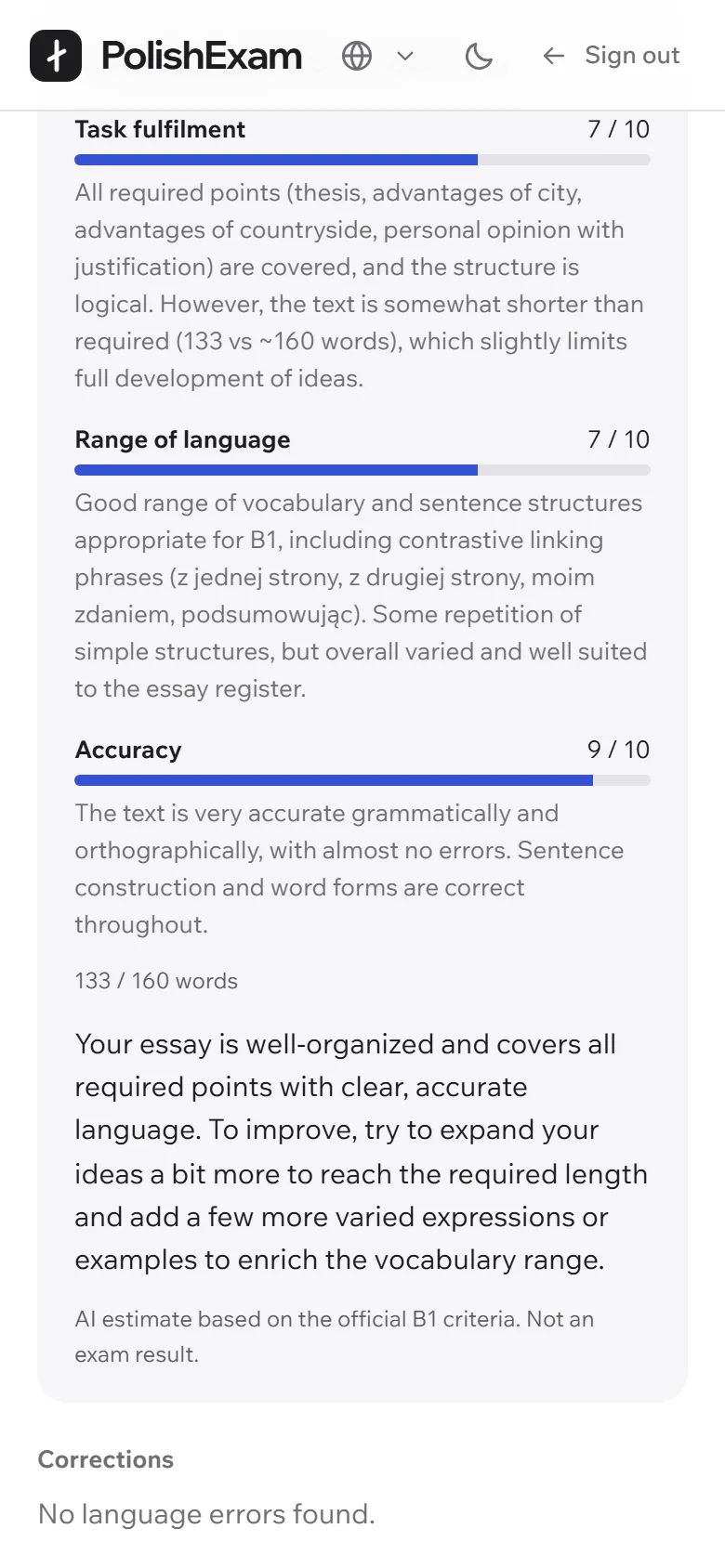
In PolishExam the writing tasks follow the format of the module: sets with a text a and a text b, with content points in Polish. When you submit a text, it is assessed with AI against the three criteria.
Choose the writing module
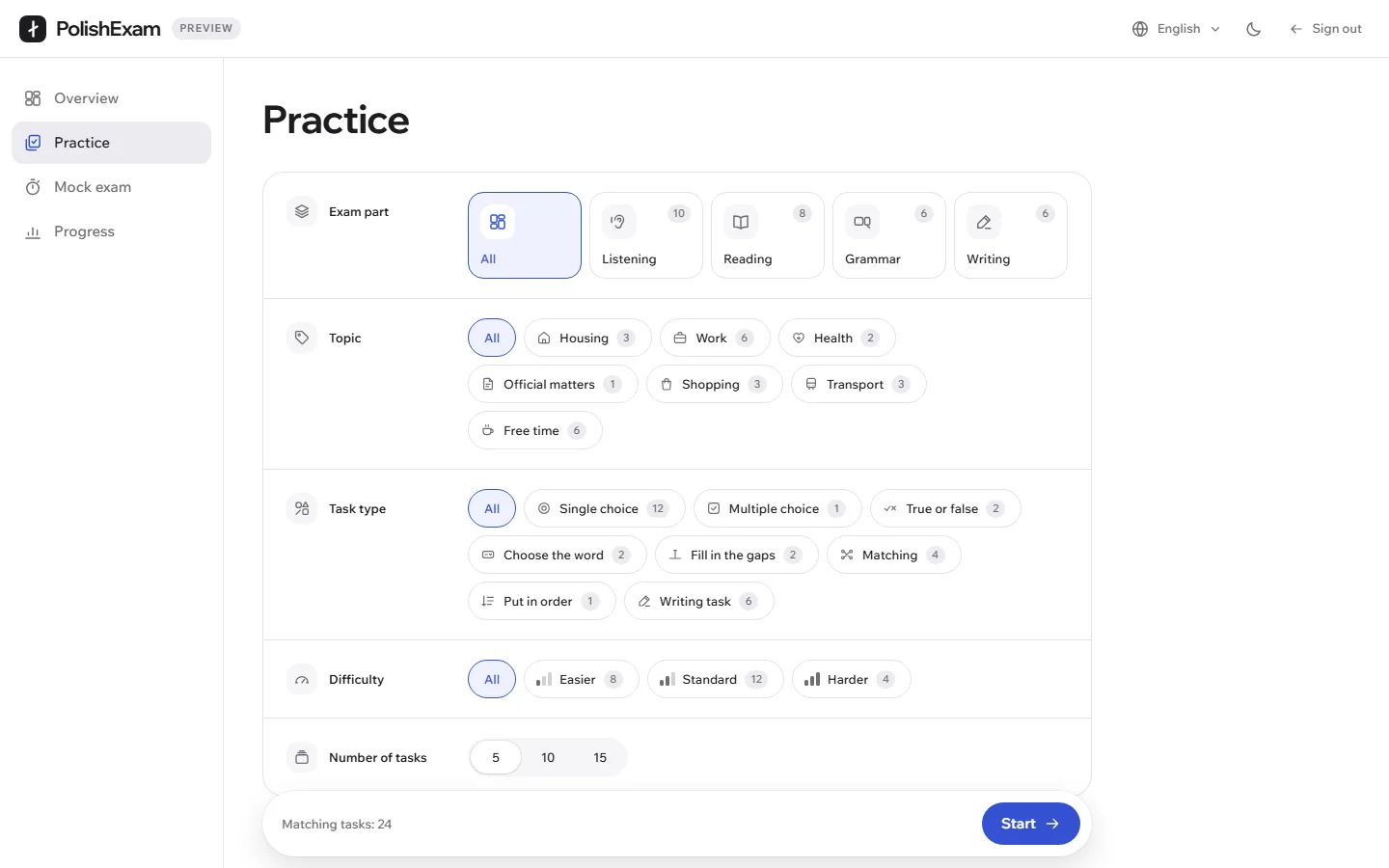
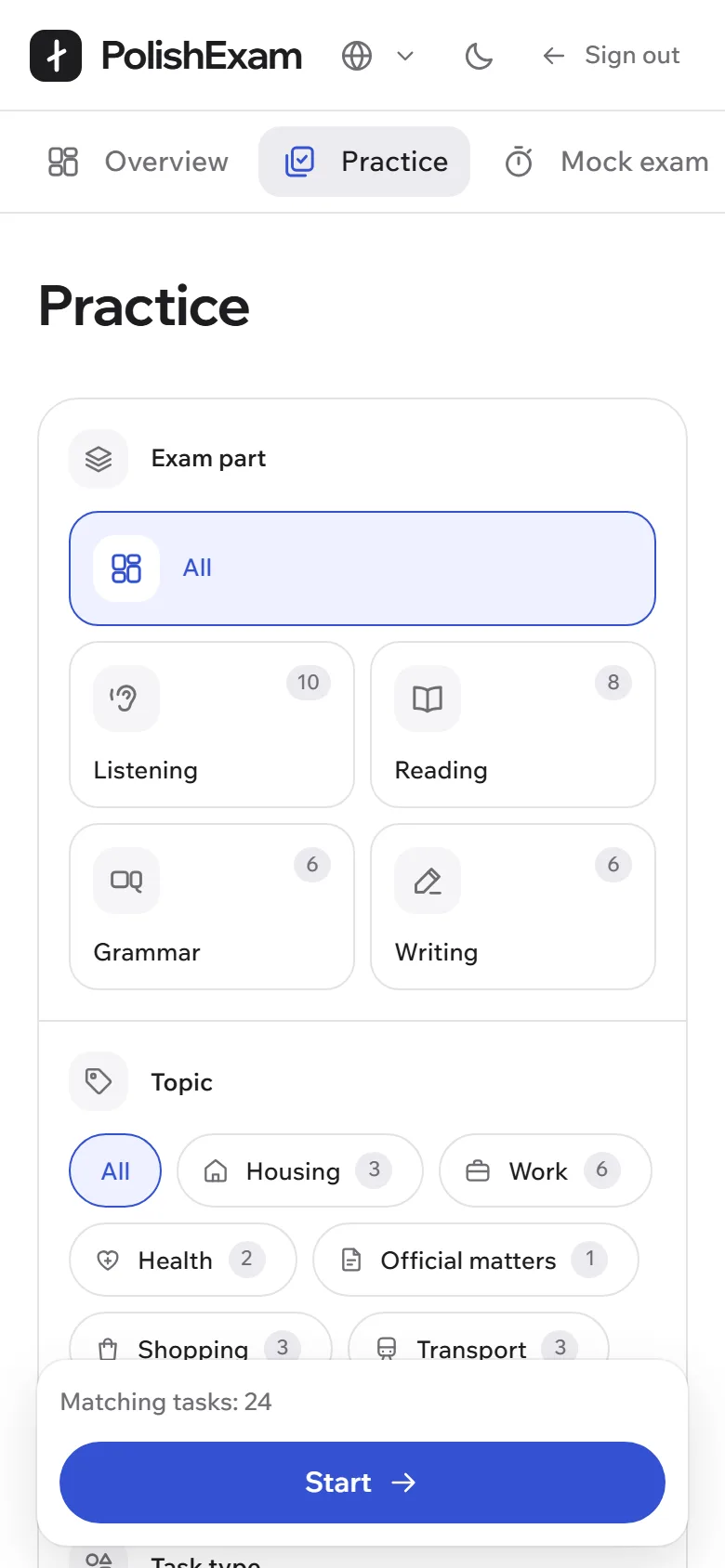
Pick Pisanie in the practice filters, together with a topic and difficulty if you want. Writing tasks never mix into general practice.
- Sets with text a and text b
- Content points shown with the instruction
Get feedback on your text
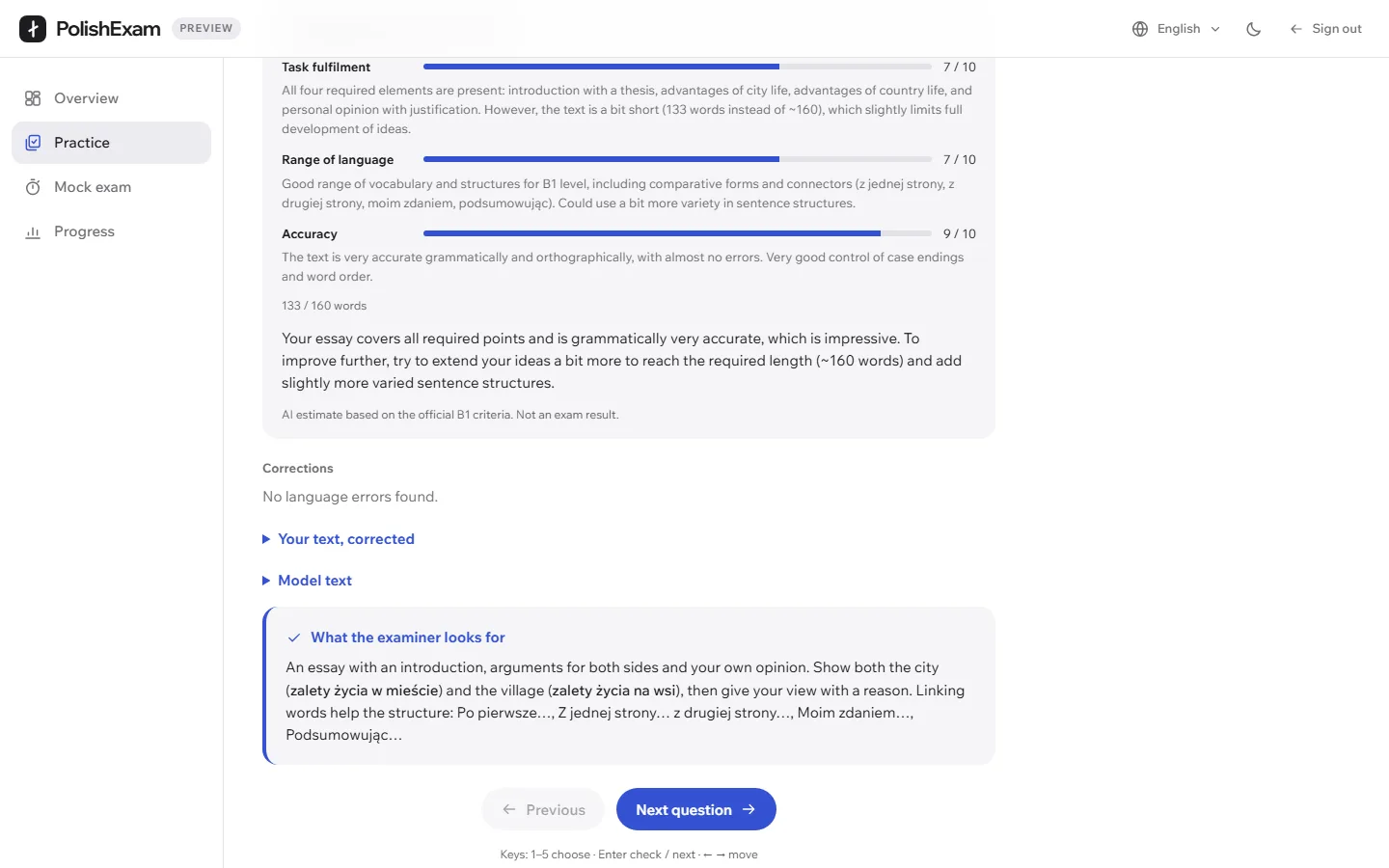
A score estimate of 0–10 for each criterion, your errors marked in your own text with corrections and short explanations in English or Ukrainian, a corrected version and a model text.
- Task fulfilment, range, accuracy
- Corrections quote your own words
- Model text shown after the assessment
An estimate, not an official score
The AI assessment is a learning tool. It applies the published criteria, but it is not the State Commission and it cannot predict your real result exactly. The number of assessed texts per day is limited.
Blog
Read more on this topic
Polish B1 vocabulary: what to learn and how to make it stay
How to learn vocabulary for the Polish B1 exam: the sixteen topic areas of the official standard, words learned in sentences with their forms, and spaced reviews.
Writing at B1: how the three criteria are scored, with an annotated sample
How the Polish B1 writing module is scored: three criteria, the official score sheet with its sub-points, and our own sample e-mail annotated line by line.


Frequently asked questions
How many words do I need to write in the Polish B1 writing exam?
Two texts. Text a is short, roughly 25–50 words, and text b is longer, roughly 150–175 words. Each set states its own range, so always follow the numbers in the instruction you chose.
What happens if my text is shorter or longer than the range?
Length is part of fulfilling the task. A much shorter text usually cannot develop all the content points, and a much longer one adds errors and takes time away from checking. Aim for the middle of the range.
Can I choose which texts to write?
You choose one of the three sets and write both texts in it, a and b. You cannot combine texts from different sets.
How many points do I need to pass the writing module?
At least 50% of its 30 points, so 15. At B1 for adults you need at least 50% in every module of the written part and in the oral part; points from another module do not compensate.
Do mistakes in Polish letters (ą, ę, ł…) cost points?
They are spelling errors and count towards accuracy. In 2026–2030 both the old and the new spelling rules (in force since 1 January 2026) are accepted, but missing diacritics are wrong under both.
Should I write formally or informally?
It depends on the reader named in the instruction. Use Pan/Pani and Szanowni Państwo for offices, landlords, shops and strangers; ty for friends, family and colleagues you know. Keep the same form through the whole text.
Is the AI score in the app my exam score?
No. It is an estimate based on the published criteria, meant to show what to improve. Only the examiners at the exam give an official result.
Can I write by hand in the app?
You type your texts in the browser. On the real exam you write on paper, so practise some texts by hand as well, especially to check your speed and your Polish letters.
Sources
- certyfikatpolski.pl – structure of the exam
- certyfikatpolski.pl – past exam papers (B1 2023–2024) – source of the 75-minute module time
- certyfikatpolski.pl – sample B1 tests with keys
- Regulation of 14 February 2025 on exams in Polish as a foreign language (Dz.U. 2025 item 217) – order of modules, breaks, pass thresholds
- Communication on Polish spelling rules at the exams (February 2026)
Write your first B1 text today
Choose a set, write text a or b and see where you stand on each criterion, with your errors corrected and a model text to compare.