Choosing an exam
TELC or the state certificate: which Polish exam counts where
There are several Polish language certificates, and Polish law does not treat them equally. For citizenship only the state certificate (or a school certificate) counts. For the EU long-term resident card, TELC and ECL are accepted too. Here is the full picture, act by act.
Facts checked:
- State onlycertificate accepted for citizenship
- TELC, ECLalso accepted for the EU resident card
- B1minimum for both citizenship and resident card
- No expiryof the state certificate
At a glance
Which certificate counts where
Status on 11 November 2026. “Yes” means the act names that document as proof of Polish for the procedure; “no” means it is not on the list.
| Procedure | State certificate | TELC | ECL | Level |
|---|---|---|---|---|
| Citizenship by recognition (art. 30, Act on Polish Citizenship) | Yes | No | No | at least B1 |
| EU long-term resident permit (art. 211, Act on Foreigners) | Yes | Yes | Yes | at least B1 |
| Karta Polaka (art. 13, Act on the Karta Polaka) | Yes (the act names no level) | Not named – the consul checks your Polish in a conversation | Not named – as for TELC | “at least basic” |
| Studies in Polish, candidates who are not EU citizens (Dz.U. 2025 item 1045) | Yes, B2–C2 | Yes | Yes | at least B2 |
School certificates and diplomas are a separate route in each procedure – see below. Sources at the bottom of the page.
Citizenship
Why TELC does not count for citizenship
Art. 30(2) of the Act on Polish Citizenship (Dz.U. 2025 item 1611) lists exactly three proofs of Polish: the state certificate issued under art. 11a of the Act on the Polish Language, at at least B1; a certificate from a school in Poland; or a certificate from a school abroad with Polish as the language of instruction.
The list is closed. TELC and ECL certificates are not on it, whatever their level, so they do not satisfy the citizenship requirement. Neither does a certificate from a post-secondary school (szkoła policealna) – art. 30(2a).
The state certificate is issued by the Państwowa Komisja do spraw Poświadczania Znajomości Języka Polskiego jako Obcego after you pass the exam at an authorised centre. More on the requirement: citizenship and B1.
EU long-term resident
What the resident card accepts
Art. 211(3)(1) of the Act on Foreigners asks for a certificate of at least B1 from a list set by regulation. The annex to Dz.U. 2023 item 1076 names these documents:
- The state certificate under art. 11a of the Act on the Polish Language.
- ECL – certificates of the European Consortium for the Certificate of Attainment in Modern Languages.
- TELC – certificates of telc GmbH, WBT Weiterbildungs-Testsysteme GmbH.
- A university certificate confirming Polish according to the CEFR, issued by a university approved to admit foreign students (or not subject to approval and not banned), after classes in Polish as a foreign language.
- A sworn translator’s certificate issued by the Minister of Justice, or confirmation of entry on the list of sworn translators.
Karta Polaka, studies and school certificates
For the Karta Polaka you show “at least basic” Polish. Art. 13(7) of the Act on the Karta Polaka accepts the state certificate (the provision names no level), a certificate of a school or studies in Poland, or a certificate of a school abroad with Polish as the language of instruction. If you do not show your Polish this way, the consul (or, in cases under art. 12(4), the voivode) assesses it in a conversation (art. 13(8)).
For studies in Polish, candidates who are not EU citizens need at least B2. The annex to Dz.U. 2025 item 1045 lists, among others, the state certificate, ECL or TELC at B2, C1 or C2, a preparatory course of at least nine months, a diploma of studies taught in Polish in Poland and sworn translator status. A B1 certificate is not on the list.
School documents are an alternative to a certificate, but the lists differ. For the resident card: a certificate of a school in Poland or abroad taught in Polish, or a diploma of studies taught in Polish (art. 211(3)(2)–(3)). For citizenship: a certificate of a school in Poland or of a school abroad taught in Polish – university diplomas are not named in art. 30(2). Certificates of post-secondary schools are excluded in both procedures.
In practice
One exam or two?
The difference matters most for people who plan the resident card first and citizenship later. A TELC or ECL B1 is enough for the resident card, but when you apply for citizenship you will still need the state certificate (or a school certificate). One state certificate at B1 counts for both, and it does not expire.
We do not describe the TELC or ECL exams themselves – their format, prices and dates are set by the providers, and we have no official Polish source for them. Check them with the provider or a centre that runs them.
Your situation – which procedure, which document, whether an exemption applies – is decided by the office handling your case. This page only summarises what the acts say; it is not legal advice.
Not sure the state exam is the hard one? It has five parts and you need at least 50% in every part. See how it is built in the B1 exam guide.
Prepare for the state exam
Practise in the official B1 formats
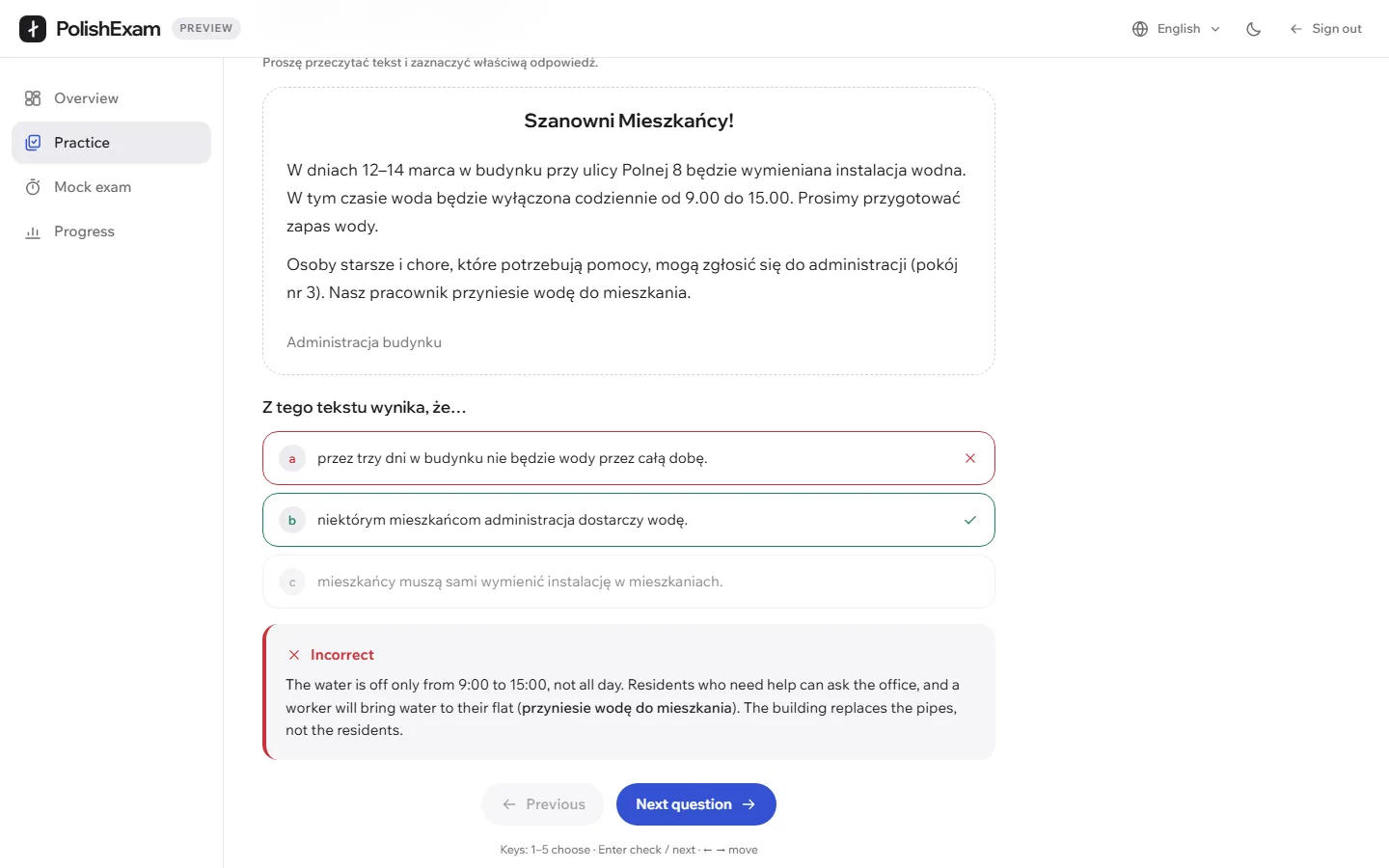
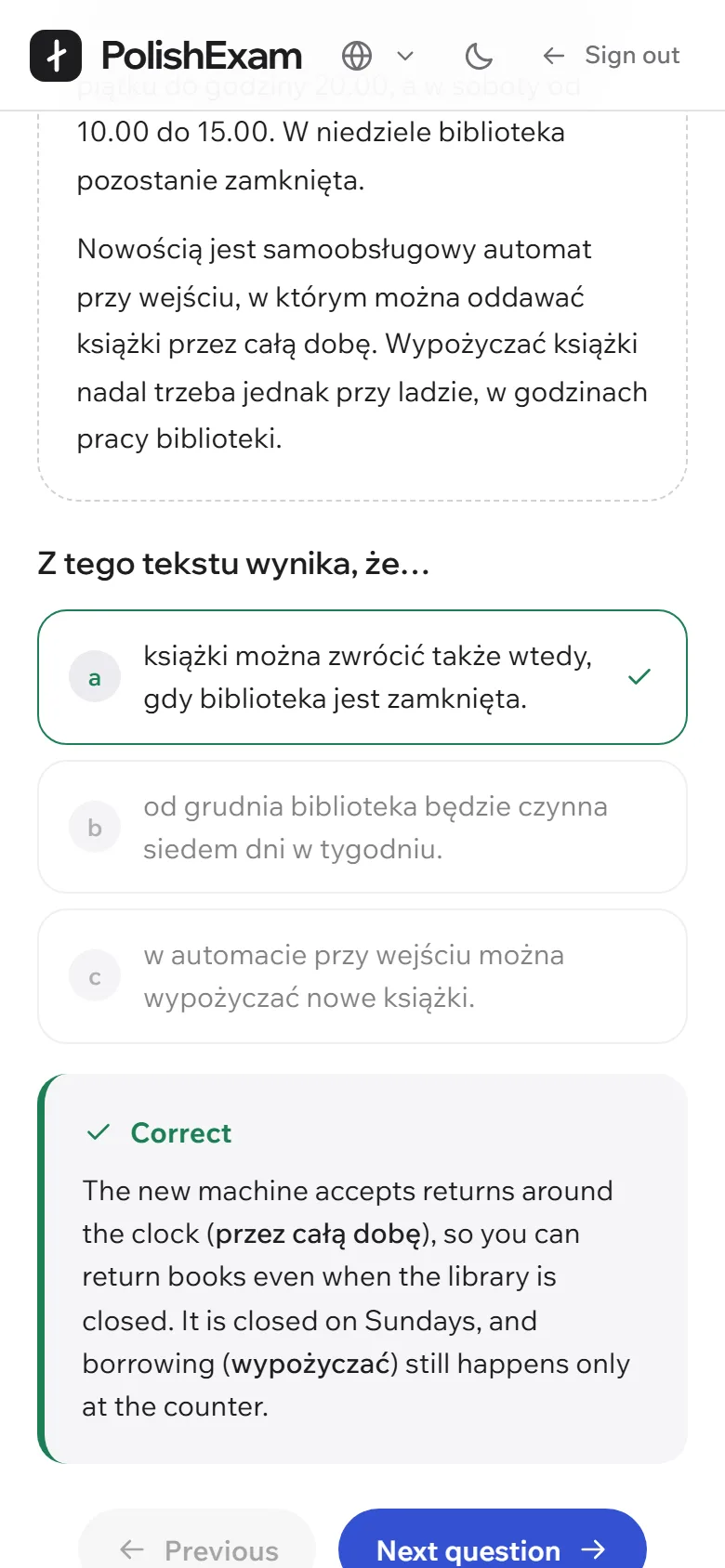
Tasks like on the state exam
Listening, reading, grammar and writing in the formats of the state B1 exam, in Polish, with explanations in English or Ukrainian.
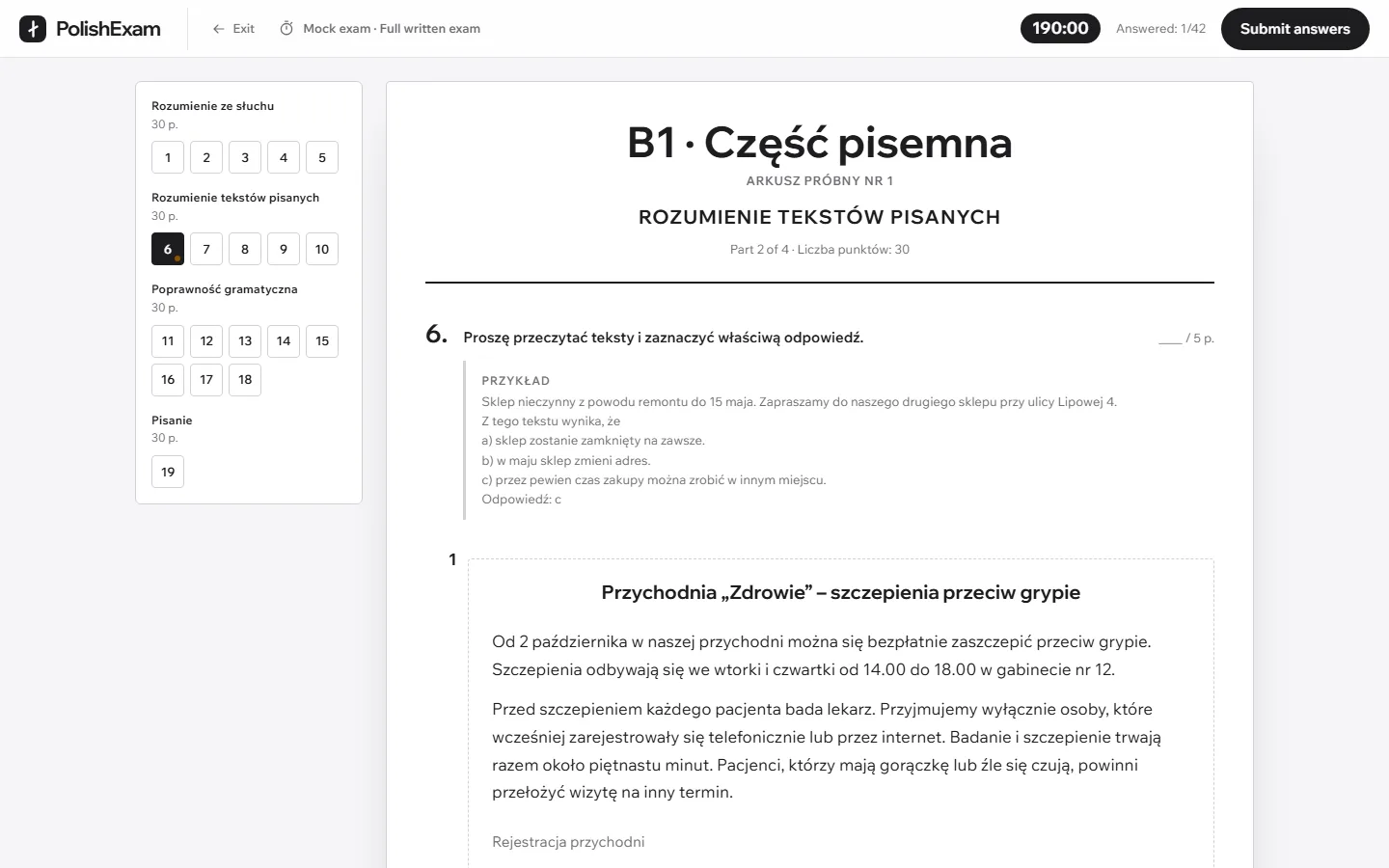
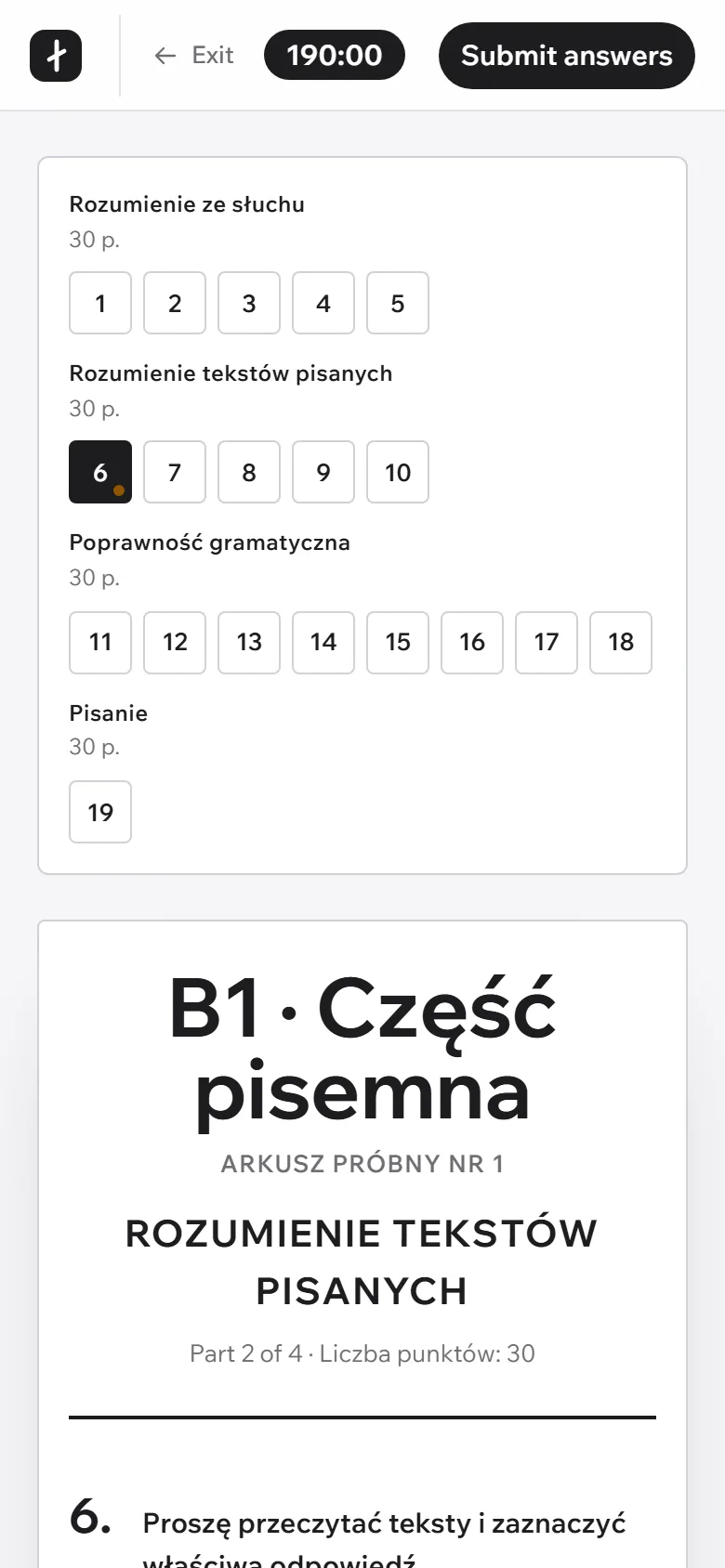
A full mock exam
The whole written part on one timer: 190 minutes, 120 points, and the result per part with the official 50% rule.
Frequently asked questions
Does a TELC Polish B1 certificate count for Polish citizenship?
No. Art. 30(2) of the Act on Polish Citizenship accepts only the state certificate (at least B1) and certain school certificates. TELC and ECL are not on the list.
Can I use TELC for the EU long-term resident card?
Yes. The regulation Dz.U. 2023 item 1076 lists TELC and ECL certificates, at least at B1, next to the state certificate, a university certificate and sworn translator status.
Is the state certificate accepted everywhere a TELC is?
For citizenship, the resident card, the Karta Polaka and studies in Polish – yes, at the required level. It is the only certificate accepted in all four.
Do I need a certificate for the Karta Polaka?
No. You can show the state certificate (art. 13(7) names no level) or a Polish school certificate; if you do not, the consul assesses your Polish in a conversation (art. 13(8)).
Is TELC B1 enough for studies in Polish?
No – studies in Polish require at least B2. TELC at B2 or higher is on the list in Dz.U. 2025 item 1045, as are the state certificate and ECL at B2–C2, a preparatory course of at least nine months and some other documents.
Is TELC easier than the state exam?
We cannot say: we have no official source on the TELC exam format. What we know is that the state B1 exam requires at least 50% in each of its five parts.
Sources
- Act on Polish Citizenship, consolidated text Dz.U. 2025 item 1611 – art. 30(2)–(2a): accepted proofs for citizenship
- Act on Foreigners, consolidated text Dz.U. 2025 item 1079 – art. 211(1)(3), (3)–(5): EU long-term resident
- Regulation on accepted Polish language certificates, Dz.U. 2023 item 1076 – annex: state certificate, ECL, TELC, university certificate, sworn translator
- Act on the Polish Language, consolidated text Dz.U. 2026 item 81 – art. 11a: the state certificate
- Act on the Karta Polaka, consolidated text Dz.U. 2026 item 76 – art. 13(7)–(8)
- Regulation on studies for foreigners, Dz.U. 2025 item 1045 – B2 for studies in Polish
Going for the state certificate?
It is the one certificate that counts for citizenship. Practise every written part and check yourself with a timed mock exam.