Difficulty
How hard is the Polish B1 exam?
B1 is an intermediate level: you do not need perfect Polish, but you must cope with everyday texts, conversations and short writing in Polish only. What makes the state exam hard is one rule: at least 50% in every part, so one weak module fails the whole exam. Below are the rule, the official description of B1 and what the published numbers really show.
Facts checked:
- 50%needed in each of the 5 parts, not on average
- 15 / 30minimum in each written module
- 20 / 40minimum in the oral part
- 21 830B1 candidates in 2025 (Commission statistics)
The rule that decides
Why one weak part is enough to fail
At B1 in the adult group you pass only with at least 50% of the points in every written module and in the oral part (§ 23(1)(b) of the regulation). Each part is scored separately as a percentage (§ 22(3)). There is no total score that can save a weak part.
In points that means at least 15 of 30 in listening, reading, grammar and writing, and at least 20 of 40 in speaking. A candidate with 28 points in reading and 14 in grammar fails, even though the written total looks good.
Higher levels are stricter: B2, C1 and C2 need 60% in every part. The young people’s exam counts only the written part as a whole and the oral part (§ 23).
Before you pay for a session, check that your weakest part, not your average, is safely above 50%. Our score calculator applies the official rule.
What you face
Five parts, one pass mark each
Structure of B1 for adults according to the Commission’s table; the written part lasts at most 190 minutes in total and the modules come in this order (§ 14).
| Part | Tasks | Points | You need at least |
|---|---|---|---|
| Listening (rozumienie ze słuchu) | 4–5 | 30 | 15 |
| Reading (rozumienie tekstów pisanych) | 4–5 | 30 | 15 |
| Grammar (poprawność gramatyczna) | 8 | 30 | 15 |
| Writing (pisanie) | 3 (one set is chosen: tasks a and b) | 30 | 15 |
| Speaking (mówienie), up to 15 min | 3 | 40 | 20 |
Status on 11 November 2026. Commission page “Kto może zdawać egzamin”; pass rule: § 23 of Dz.U. 2025 item 217. The whole exam, including the instructions, is in Polish.
What B1 means
The official description of a B1 candidate
The regulation’s standard (annex 1) says B1 candidates understand the main content and intentions of spoken and written texts expressed simply and clearly, when the topic is everyday life, family, free time, school, travel or work. They can use Polish in typical situations, write for example a notice, an invitation, wishes or a text on a general topic, describe events and give and justify their opinion.
The standard also allows imperfection: gaps in fluency, pronunciation, vocabulary, grammar and spelling are acceptable as long as they do not seriously disrupt communication. You do not need native-like Polish. You need Polish that works.
Where it gets difficult
What makes each part demanding
There are no official statistics on which module candidates fail most often. These are the demands that follow from the exam format itself.
Grammar
Eight tasks on forms in context: cases, conjunctions, verb forms, aspect and prepositions. Knowing a word is not enough – you must use the right form.
Listening
Tasks on everyday conversations and announcements. In the April 2024 paper, the recording in task I is played only once, the others twice.
Writing
Two texts in 75 minutes from the set you choose. They are marked on task completion, range of language and accuracy.
Speaking
Three tasks with an examiner: a photo, a short monologue and a role-play. You have to keep talking in Polish, not just answer yes or no.
The numbers
What is the pass rate? What the official data show
The government’s regulatory impact assessment of the bill amending the Polish Language Act (Sejm print no. 2361, 11 March 2026) gives the Commission’s figures: in 2016–2024, 86% of all candidates obtained a certificate (59,317 of 68,518). The yearly rate ranged from 83% to 89%; in 2024 it was 86% (18,726 of 21,781).
These figures cover all levels together, not B1 alone. Most candidates, however, are adults at B1 (57,590 of 68,524, or 84%), so the overall rate says a lot about B1 too. A pass rate for B1 alone has not been published.
The 82.79% in the Ministry of the Interior’s reply of 7 July 2026 to interpellation no. 17778, called the B1 “pass rate” there, is something else: on the Commission’s statistics page the reply cites, it is B1’s share of all candidates in 2016–2025 (97,551 of 117,823).
Roughly one candidate in seven does not pass. Because one weak part fails the whole exam, that part is usually the one to train. The statistics also show growth: 862 B1 candidates in 2016, 11,441 in 2021 and 21,830 in 2025, with 65 exam centres in 2025.
Official statistics
B1 candidates per year
| Year | B1 candidates (adults) | All levels |
|---|---|---|
| 2021 | 11 441 | 12 763 |
| 2022 | 13 314 | 15 300 |
| 2023 | 14 757 | 17 487 |
| 2024 | 18 131 | 21 781 |
| 2025 | 21 830 | 27 518 |
| 2016–2025 | 97 551 | 117 823 |
Source: certyfikatpolski.pl, “Statystyki”, read on 11 November 2026. For 2023 the yearly table on the same page shows 17 489 candidates, the per-level table 17 487.
Looking ahead
Will it get harder?
For the B1 exam itself, the amendment that takes effect on 1 January 2027 changes fees, age groups and procedures. The pass rule is set by a regulation, and a new one has not been published yet – see changes in 2027.
For citizenship, the same reply says the ministry plans to raise the requirement from B1 to B2. This is a plan in a draft, not law: today citizenship by recognition still requires B1. We follow the drafts on the citizenship law tracker.
Find your weak part
Know your result in each part before the exam does
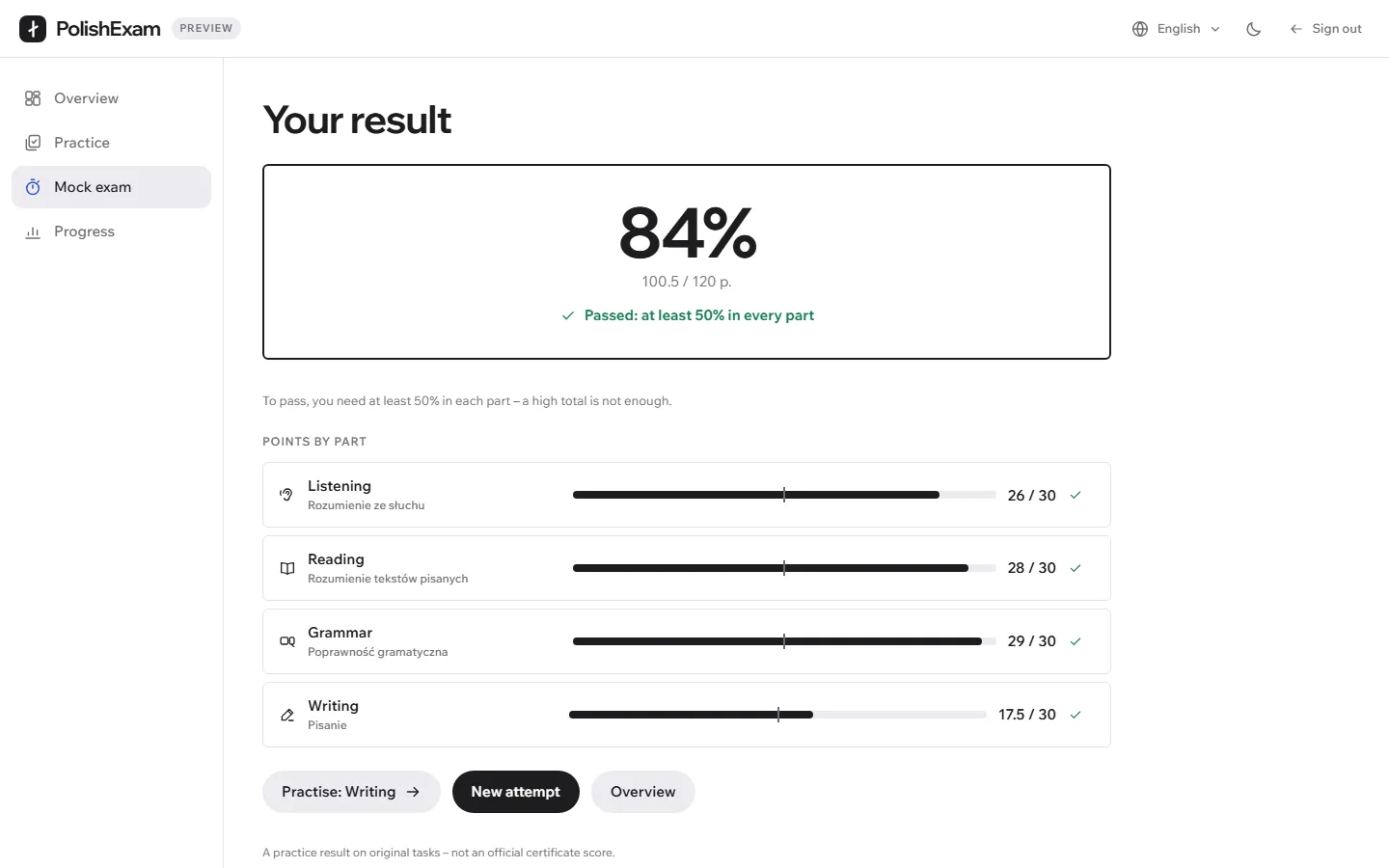
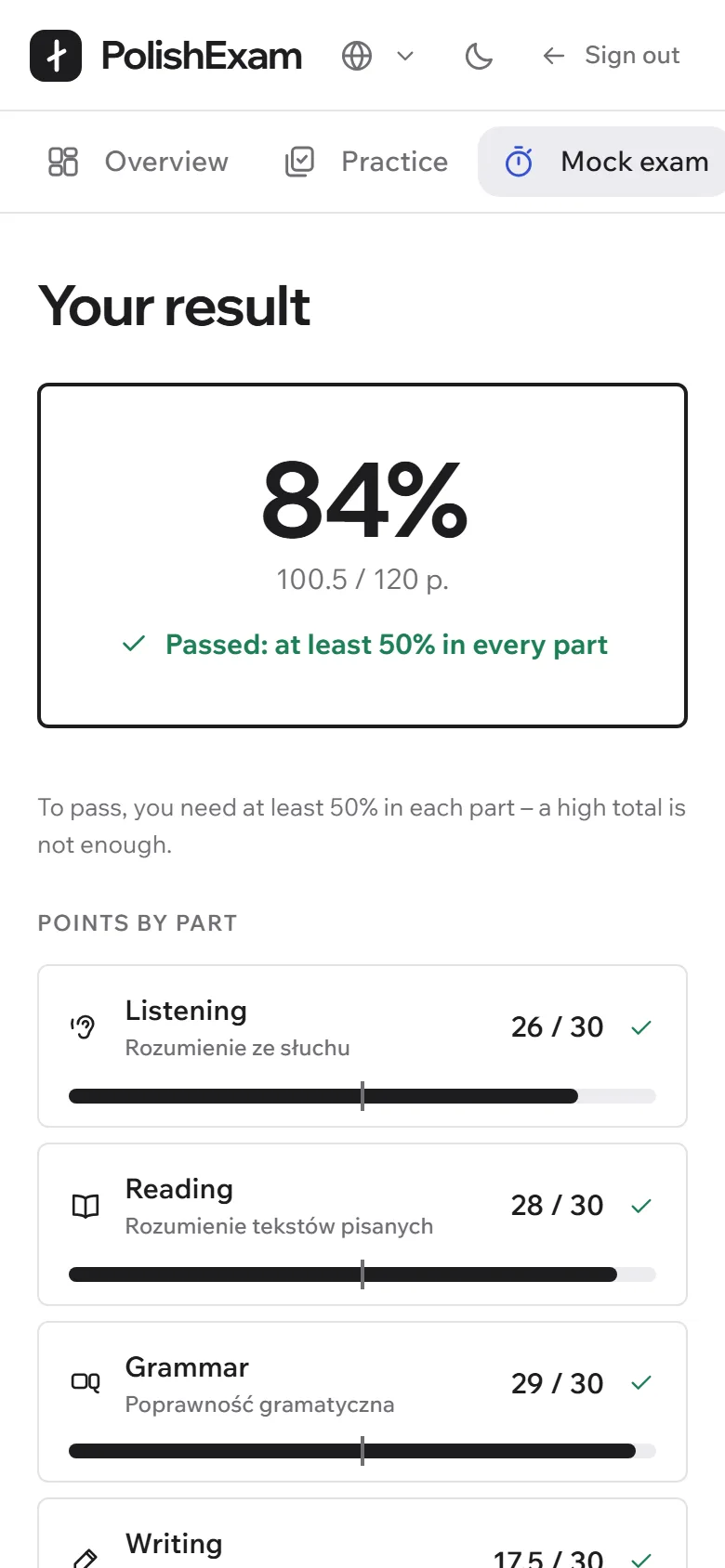
Every part against the 50% line
A full timed mock exam scored like the real one: four written modules, each with its own result.
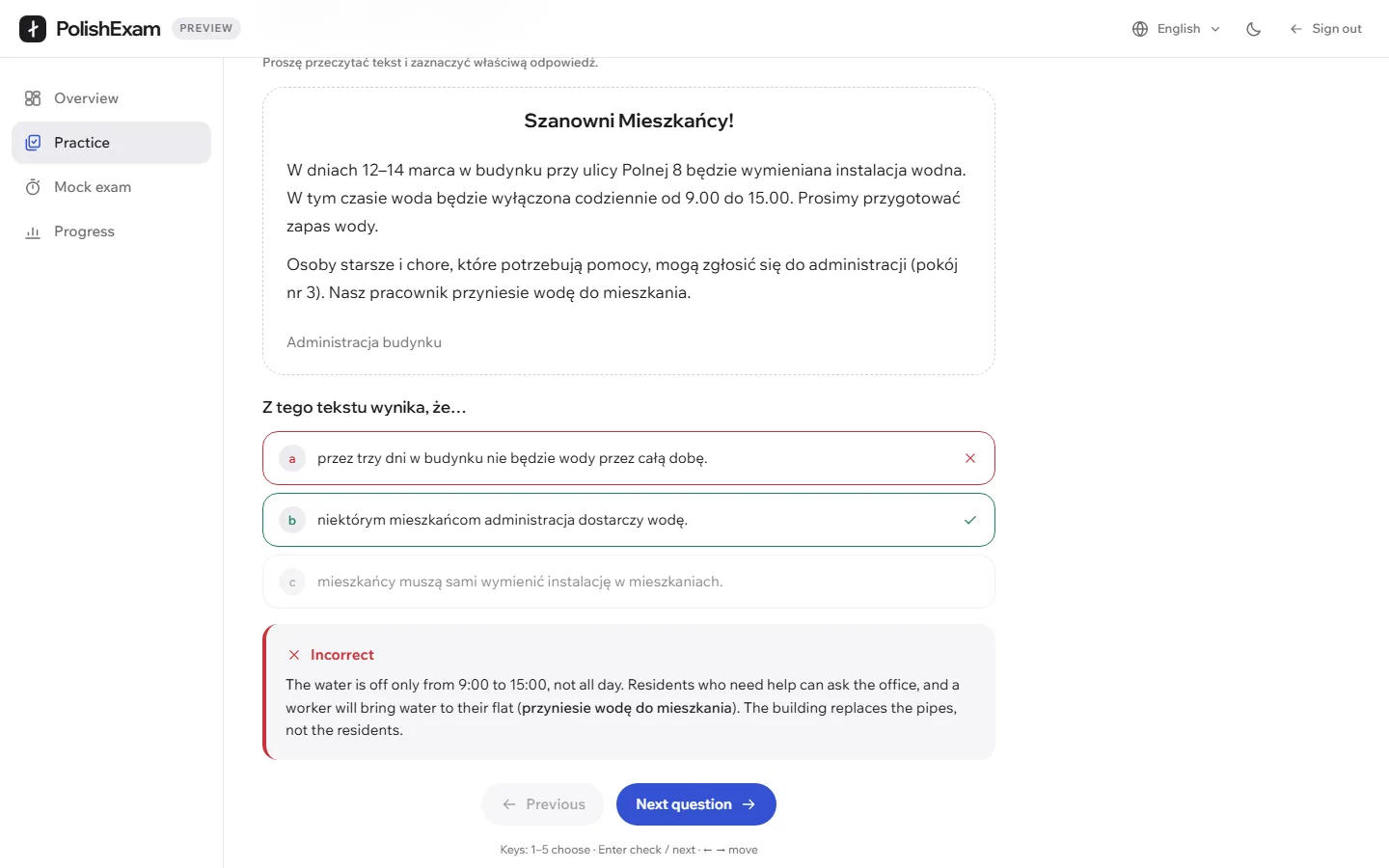
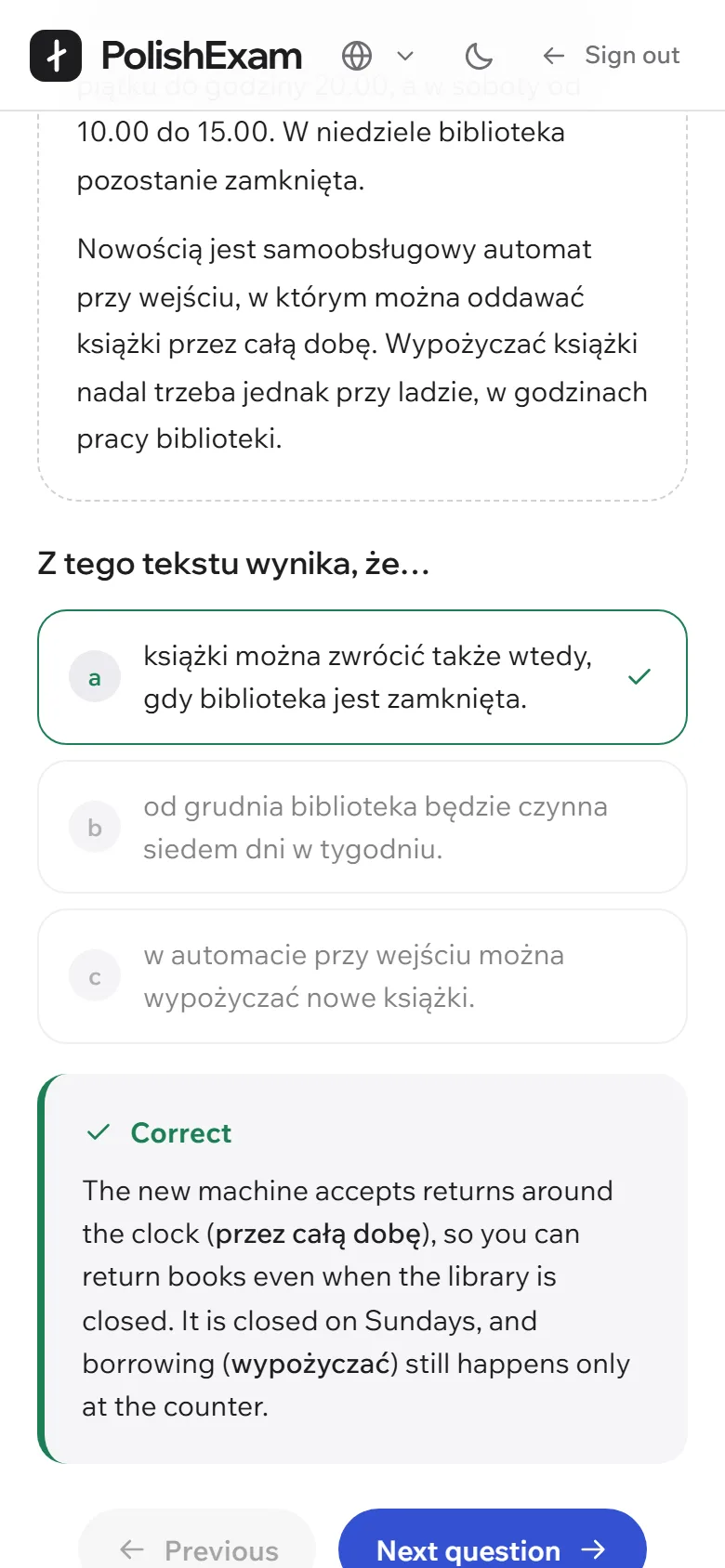
Then practise that part
Tasks in the official B1 formats with a short explanation in English or Ukrainian after every answer.
Frequently asked questions
Is the Polish B1 exam hard?
It is an intermediate-level exam entirely in Polish. The hardest part for many is the rule: you need at least 50% in each of the four written modules and in speaking, so one weak part means a fail.
What is the pass rate of the Polish B1 exam?
Across all levels, 86% of candidates obtained a certificate in 2016–2024 (83–89% a year; 86% in 2024), according to the government’s impact assessment of Sejm print no. 2361. A pass rate for B1 alone has not been published. The 82.79% quoted by the Ministry of the Interior is B1’s share of all candidates, not a pass rate.
How many points do I need to pass B1?
At least 15 of 30 in each written module (listening, reading, grammar, writing) and at least 20 of 40 in speaking.
Can a good score in one part make up for a bad one?
No. Each part is assessed separately against the 50% threshold (§ 23 of the regulation).
How many people take the B1 exam?
According to the Commission, 21,830 B1 candidates in 2025 and 97,551 in 2016–2025.
Do I need perfect Polish for B1?
No. The official standard accepts gaps in fluency, pronunciation, vocabulary, grammar and spelling as long as they do not seriously disrupt communication.
Sources
- Regulation on exams in Polish as a foreign language, Dz.U. 2025 item 217 – § 14 (order of modules, 190 minutes), § 22–23 (scoring, pass rule), annex 1 (B1 standard)
- certyfikatpolski.pl – statistics – candidates per year and per level, 2016–2025
- certyfikatpolski.pl – who can take the exam (structure of B1) – modules, tasks and points
- certyfikatpolski.pl – FAQ – pass thresholds; retakes
- Reply of the Ministry of the Interior (MSWiA) to interpellation no. 17778, 7.07.2026 – B2 plans; the 82,79% figure
- Government bill amending the Polish Language Act, Sejm print no. 2361, 11.03.2026 – regulatory impact assessment, table 2: pass rate 2016–2024
How hard is it for you? Find out in 15 minutes
Ten free tasks in the exam format, checked at once, no account needed. Then a full mock exam shows every part against the 50% line.