Exam guide
The Polish B1 exam: a complete guide to the state certificate
The Polish B1 exam is the state exam that leads to the certyfikat znajomości języka polskiego at level B1. Here is how it is built, how it is scored, what happens on the day and what changes from 1 January 2027 – with links to the official sources for every rule.
Facts checked:
- 190 minwritten part in total (4 modules)
- 120 + 40points: written part + oral part
- 50%needed in each part, not just overall
- 5B1 sessions for adults a year
The certificate
What the Polish B1 certificate is and who issues it
The B1 exam is part of the Polish state certification system for Polish as a foreign language. If you pass, you receive the certyfikat znajomości języka polskiego jako obcego – the official state certificate confirming that you can use Polish at the B1 (threshold) level of the Common European Framework of Reference.
The legal basis is the Act of 7 October 1999 on the Polish language (consolidated text Dz.U. 2026 item 81), articles 11a–11m. The Act allows foreigners and Poles living permanently abroad to obtain the certificate by passing the exam. The details – modules, timing, scoring, fees and procedures – are set out in the regulation of the Minister of Science and Higher Education of 14 February 2025 on exams in Polish as a foreign language (Dz.U. 2025 item 217), in force since 22 February 2025.
The certificate is issued by the Państwowa Komisja do spraw Poświadczania Znajomości Języka Polskiego jako Obcego (State Commission for the Certification of Proficiency in Polish as a Foreign Language). Its current term runs from 2024 to 2028 and it is chaired by dr hab. Aleksandra Achtelik. Administrative support is provided by NAWA, the Polish National Agency for Academic Exchange (ul. Polna 40, Warsaw).
The Commission does not run the exams itself. They are conducted by centres authorised by the Ministry of Science: universities, schools and language centres in Poland and abroad. You register and pay at the centre; the centre sends the results to the Commission, and the Commission issues the certificate. That is why prices and registration details differ from centre to centre (see dates, fees and registration).
The certificate is valid indefinitely. It has no expiry date, so a B1 certificate you obtain now will still count years later.
Levels and age groups
- A2–C2levels actually offered to adults (the Act allows A1–C2)
- B1–B2levels offered to the youth group (the Act allows A1–B2)
- 18+adult group today: aged 18 on the exam day (youth: 14–17)
- 16+from 1 January 2027: groups “16 and over” and “under 16”
Who takes it
Who takes the Polish B1 exam and why
Polish citizenship. The most common reason. Under article 30(2) of the Act on Polish citizenship (Dz.U. 2025 item 1611), a person applying for citizenship by recognition must know Polish at least at level B1. The proof can be the state certificate, a school certificate from a school in Poland, or a certificate from a school abroad where Polish was the language of instruction. Since 1 July 2025 a certificate from a post-secondary school (szkoła policealna) no longer counts. TELC and ECL certificates are not listed in that article, so they do not work for citizenship. Read the details on our citizenship B1 requirement page.
EU long-term resident permit. Article 211 of the Act on foreigners requires confirmed knowledge of Polish. A certificate of at least B1 is accepted, and here the list of accepted certificates is wider: besides the state certificate it includes ECL, TELC, some university certificates and sworn-translator status. People under 16 are exempt.
Work. Some professional bodies set their own language requirements: nurses’ self-governing bodies expect B1, while the civil service expects B2. Doctors and dentists may show a certificate from the centre confirming that they passed the exam until the certificate itself arrives.
Personal goals. Many people take B1 simply to have an objective, recognised confirmation of their Polish – for a CV, for a job interview or as a milestone after a few years in Poland.
Two common misunderstandings: the permanent residence permit (article 195 of the Act on foreigners) has no language requirement, and the Karta Polaka requires at least basic Polish but no certificate – a consul can check your Polish in an interview. And if you plan to study in Polish as a non-EU candidate, B1 is not enough: universities require at least B2.
B2 for citizenship is only a draft
On 27 October 2026 the government published draft bill UD491, which would raise the citizenship requirement from B1 to B2 and add a civic knowledge test. As of 6 November 2026 it is only a draft: the law still requires B1. Check the current status on our citizenship page before you plan around it.
Structure
Polish B1 exam structure (adults)
The written part lasts at most 190 minutes in total and has four modules, always in this order. The times per module below come from the 2024 B1 papers and are a guide; an older table from the Commission gives 25 minutes for listening and 45 for reading.
| Module | Time (2024 papers) | Tasks | Points | Pass mark |
|---|---|---|---|---|
| Listening – Rozumienie ze słuchu | up to 30 min | 5 tasks | 30 | 15 (50%) |
| Reading – Rozumienie tekstów pisanych | 40 min | 5 tasks | 30 | 15 (50%) |
| Grammar – Poprawność gramatyczna | 45 min | 8 tasks | 30 | 15 (50%) |
| Writing – Pisanie | 75 min | 1 set of 3 to choose, tasks a and b | 30 | 15 (50%) |
| Written part total | 190 min | 120 | each module 50% | |
| Speaking – Mówienie | up to 15 min | oral exam | 40 | 20 (50%) |
Between the written modules there are breaks of at least 10 minutes. The oral part takes place on the same day or the next day.
The parts
Each part of the exam in brief
Every module is scored separately, so each one deserves its own preparation. The guides below go into task types, timing and typical traps.
Listening
Short utterances, dialogues and announcements, some heard once and some twice. Concentration and catching the key information matter more than understanding every word.
Reading
Notices, e-mails, articles and adverts with choice, true/false and matching tasks. The key skill is finding the information the question asks about, not translating the whole text.
Grammar
Eight tasks on cases, verb forms, aspect, conjunctions and word choice. Some answers are written in by hand, so spelling and Polish letters count.
Writing
You choose one of three sets, each with a shorter task a and a longer task b. Two examiners assess task fulfilment, range of language and accuracy, 10 points each.
Speaking
Up to 15 minutes with the examiner: describing a picture, a short monologue and a conversation in an everyday situation. It is scored separately from the written part.
All in one place
Practise every part with us
Tasks in the exam format with explanations in English, AI feedback on your writing and a full 190-minute mock exam scored part by part.
Start practising
Oral part
The oral part: what to expect
The oral part (Mówienie) lasts up to 15 minutes and is worth 40 points. It takes place on the same day as the written part or on the following day; the centre tells you your time slot.
According to the Commission’s official B1 sample oral paper (2017), the oral exam works with sets of tasks drawn by lot and covers three kinds of speaking: describing a picture, a monologue on a given topic and a conversation with the examiner in an everyday situation. The whole conversation is in Polish.
To pass, you need at least 20 of the 40 points (50%). The oral result does not compensate for a weak written module, and a strong written part does not compensate for a weak oral one: both have to reach the threshold.
In our app you can practise speaking in the Speaking section: the three task types and an oral mock exam, with an AI estimate on the official criteria. Pronunciation is not assessed, so the estimate is out of 36 points, not 40. The speaking guide explains the oral exam in detail.
Scoring
Polish B1 exam passing score: the 50% rule in every part
For adults at level B1 the rule is strict: you must score at least 50% in every written module – 15 out of 30 in listening, reading, grammar and writing separately – and at least 50% in the oral part, i.e. 20 out of 40. The total of the written part does not matter on its own. For levels B2 to C2 the threshold is 60%.
This is the most common surprise for candidates. Some websites still describe an average-based rule, a 60% threshold or a 225-minute exam with 40 points per part; those figures are out of date for B1. The current rule is in § 23 of the 2025 regulation and in the Commission’s FAQ.
The youth group is scored differently: young candidates need 50% of the written part as a whole (their written part has three modules, 150 minutes and 100 points) and 50% of the oral part.
Worked example: a good total that still fails
Imagine an adult candidate with these written results:
| Module | Points | Percentage | Threshold reached? |
|---|---|---|---|
| Listening | 18 / 30 | 60% | yes |
| Reading | 14 / 30 | 47% | no – 1 point short |
| Grammar | 22 / 30 | 73% | yes |
| Writing | 20 / 30 | 67% | yes |
| Written part | 74 / 120 | 62% | exam not passed |
Even with 62% overall and an excellent oral result, this candidate does not pass, because reading is below 15 points. Check your own mock results with the score calculator.
How the writing module is marked
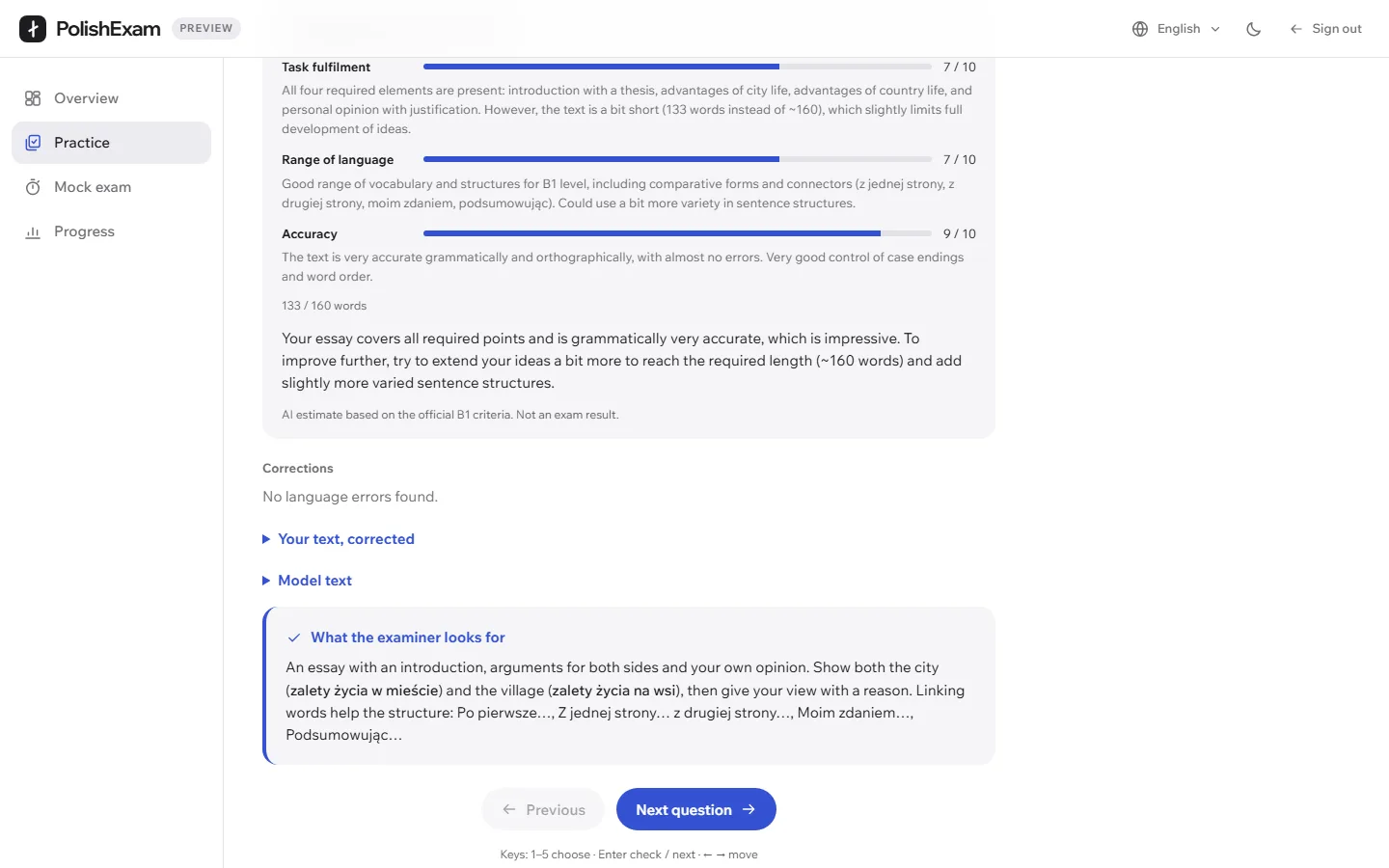
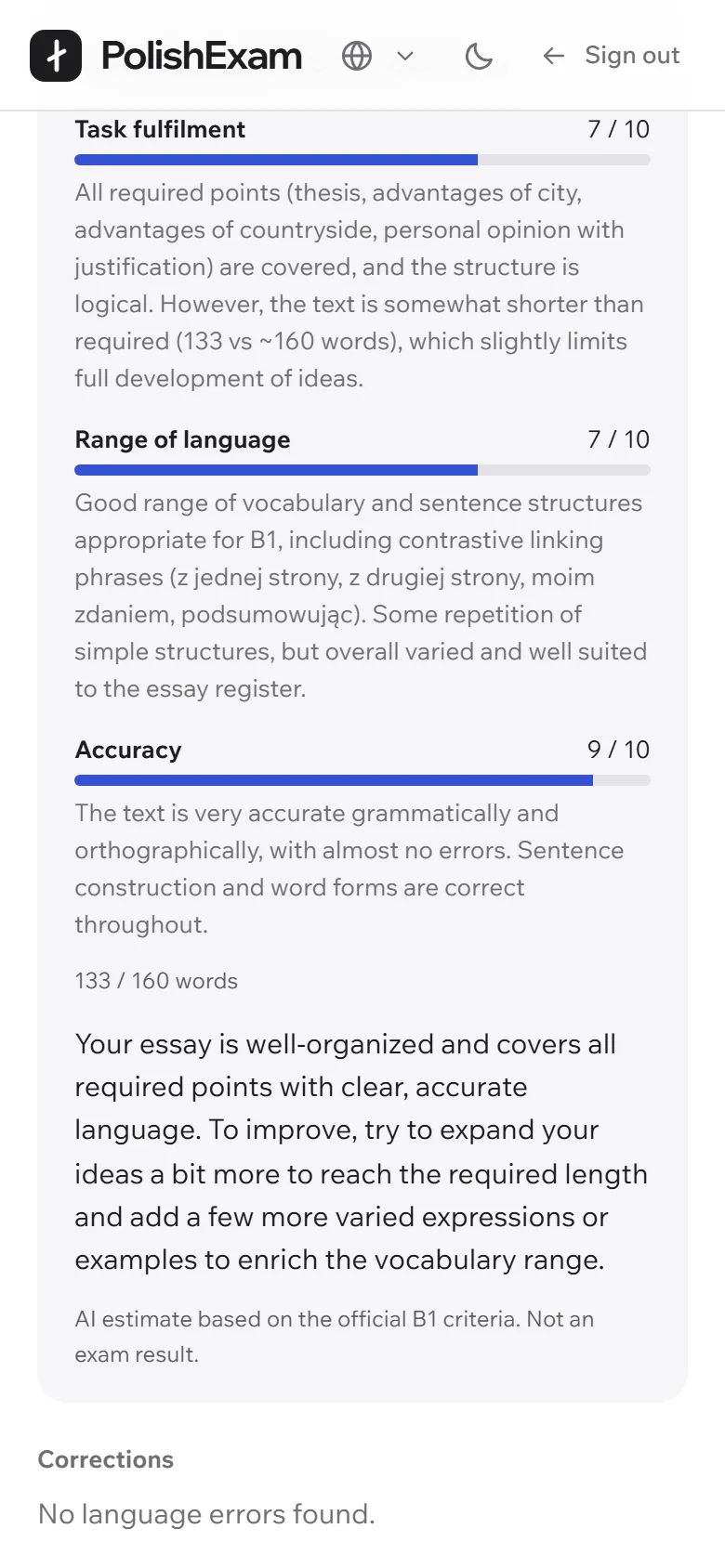
The writing module is assessed by two examiners against three criteria worth 10 points each: task fulfilment (did you cover everything the task asked for, in the right form?), range of language (vocabulary and structures suited to B1) and accuracy (grammar, spelling, punctuation). Together that gives 30 points, of which you need 15.
Task fulfilment is where many candidates lose points they could easily keep: a missing content point, a wrong text type or ignoring who the text is addressed to. In the writing guide you will find how the tasks are built and what examiners look for.
Exam day
How the exam day runs
The details depend on the centre, but the regulation fixes the main frame.
Arrive with photo ID
You need an identity document with a photo. Without it you will not be admitted. Arrive early so that the formalities are done before the first module starts.
Listening first
The written modules always go in this order: listening, reading, grammar, writing. Listening is first, so be fully focused from the very start.
Breaks of at least 10 minutes
Between the modules there are breaks of at least 10 minutes. Use them to rest your eyes and reset, not to cram vocabulary.
Instructions only in Polish
Everything on the exam, including task instructions, is in Polish. Learn the typical wording of instructions in advance so that you do not lose time decoding them.
Oral part the same or next day
The oral exam lasts up to 15 minutes and is held on the day of the written part or the next day, at the time the centre gives you.
Results
Results, the certificate and re-marking
After the session the centre sends a protocol to the Commission. The centre must inform you about your result in writing within 3 days of receiving the protocol. The Commission issues the certificate within 30 days of receiving the protocol. In practice it takes about 8 weeks or more from the exam until you hold the certificate, so plan your citizenship or residence application with that margin.
You may inspect your marked paper within 21 days. Within the same 21 days you can request a re-verification of the written part; the request is considered within 30 days (in some cases up to 60). Until 31 December 2026 the re-verification fee is 20 euros.
The certificate is valid indefinitely. From 2027 you will be able to obtain a duplicate within 25 years of issue.
Some graduates of Polish schools and universities can receive the certificate without the exam, by applying through the NAWA system.
If you do not pass: retaking the exam
There is no waiting period: you can register for the next session. With five B1 sessions for adults a year, the next one is usually a few months away.
Plan to take the whole exam again. We have found no rule that lets you repeat only the module you failed, so do not count on keeping the points from your previous attempt. Use your result sheet to see which module was below 50% and give it most of your practice time.
Special needs and adjustments
If you have a disability or a health condition, you can ask for adjusted exam conditions. Send a request to the chair of the exam at your centre at least one month before the exam, together with a disability certificate or a medical document.
Possible adjustments include extended time, a separate (adapted) exam paper, special equipment and the help of an assistant. From 2027 candidates with a hearing or speech disability can also be exempted from the oral part.
Spelling rules in 2026–2030
New Polish spelling rules came into force on 1 January 2026. The Commission announced that from 2026 to 2030 both the old and the new spelling are accepted in the exam. From 2031 only the new rules will count.
In practice this means you do not need to relearn spelling before your B1 exam, but if you learn new words now, it is worth learning their new spelling straight away.
What changes from 1 January 2027
An amendment (Dz.U. 2026 item 676) changes several rules from 1 January 2027: the age groups become “16 and over” and “under 16”; the exam fee cap for B1/B2 (16+) becomes 7% of the average salary published by Statistics Poland (GUS) for the third quarter of the previous year; the certificate and a duplicate cost 100 zł; re-verification costs 20% of the maximum fee; duplicates are available within 25 years; and candidates with a hearing or speech disability can be exempted from the oral part. The B1 structure stays; the 50% pass rule is set by a regulation that is due to be replaced, so it is not yet confirmed for 2027. Details: dates, fees and registration.
Preparation
How to prepare for the Polish B1 exam
Because every module must reach 50% on its own, good preparation is balanced: find your weakest part early and do not let it stay weak.
Pick a session and plan by weeks
Choose a session from the 2026–2027 dates and count the weeks back. Register early: lists open about two months before the exam. A plan of 8–12 weeks with short daily practice works better than a few long weekends.
Take a diagnostic mock exam
Start with a full mock exam under real timing. Your result per module shows where the 50% threshold is at risk, which is more useful than a single overall percentage.
Write regularly and get feedback
Write at least one a + b set a week under time pressure. Our app assesses your text against the three official criteria and marks your errors with corrections – an AI estimate, not an official score – or ask a teacher to mark it.
Practise speaking out loud
Describe pictures, talk for two minutes on everyday topics and role-play situations with a partner or tutor. See the speaking guide for the format.
Finish with official papers
In the last weeks, work through the Commission’s official sample tests and past papers, then take one more timed mock to check every module is above 50%.
Practice in the app
Train for the exam the way it is scored
PolishExam is an independent web app for the B1 written part. The interface and explanations are in English and Ukrainian; the tasks are in Polish, as on the exam.
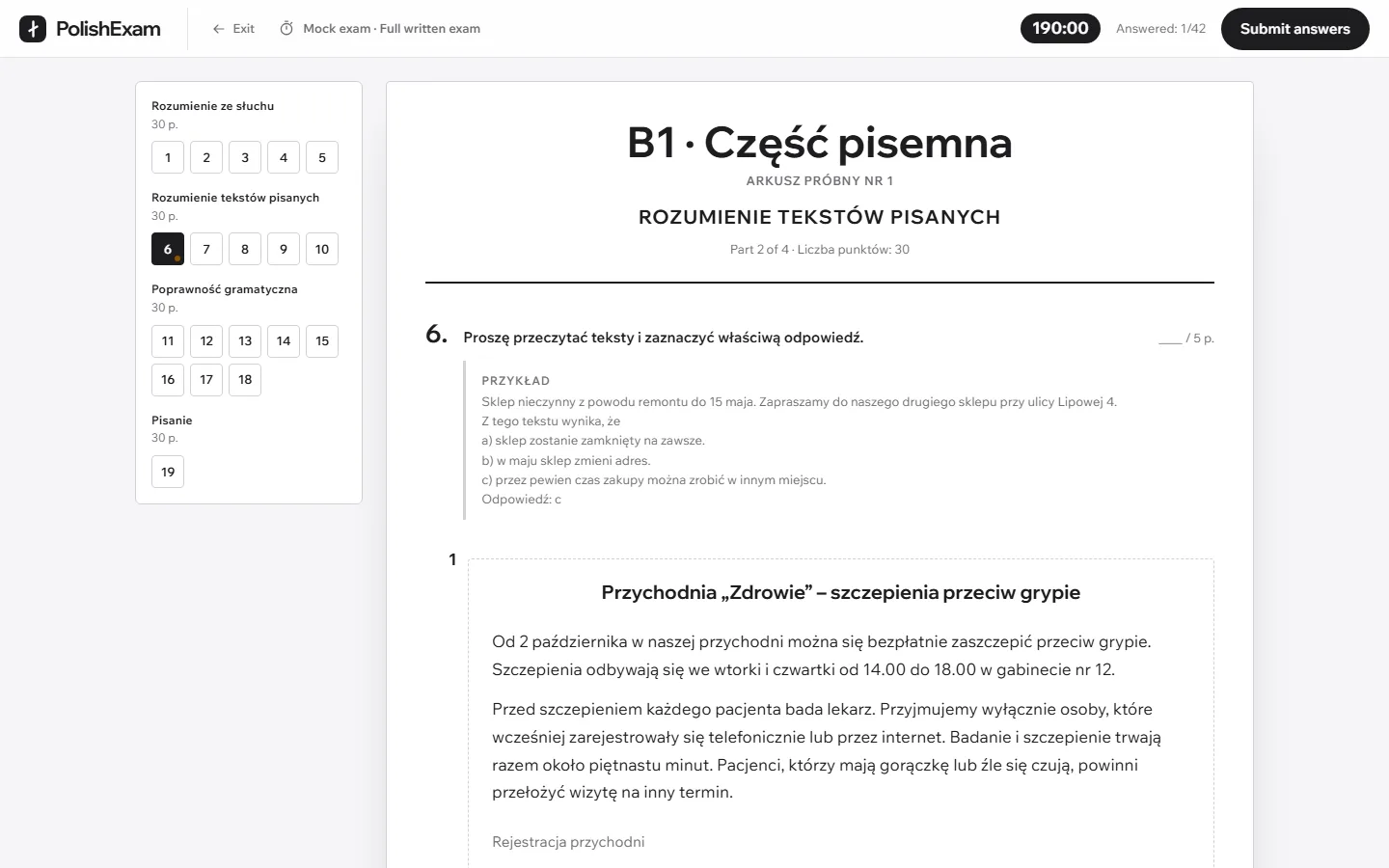
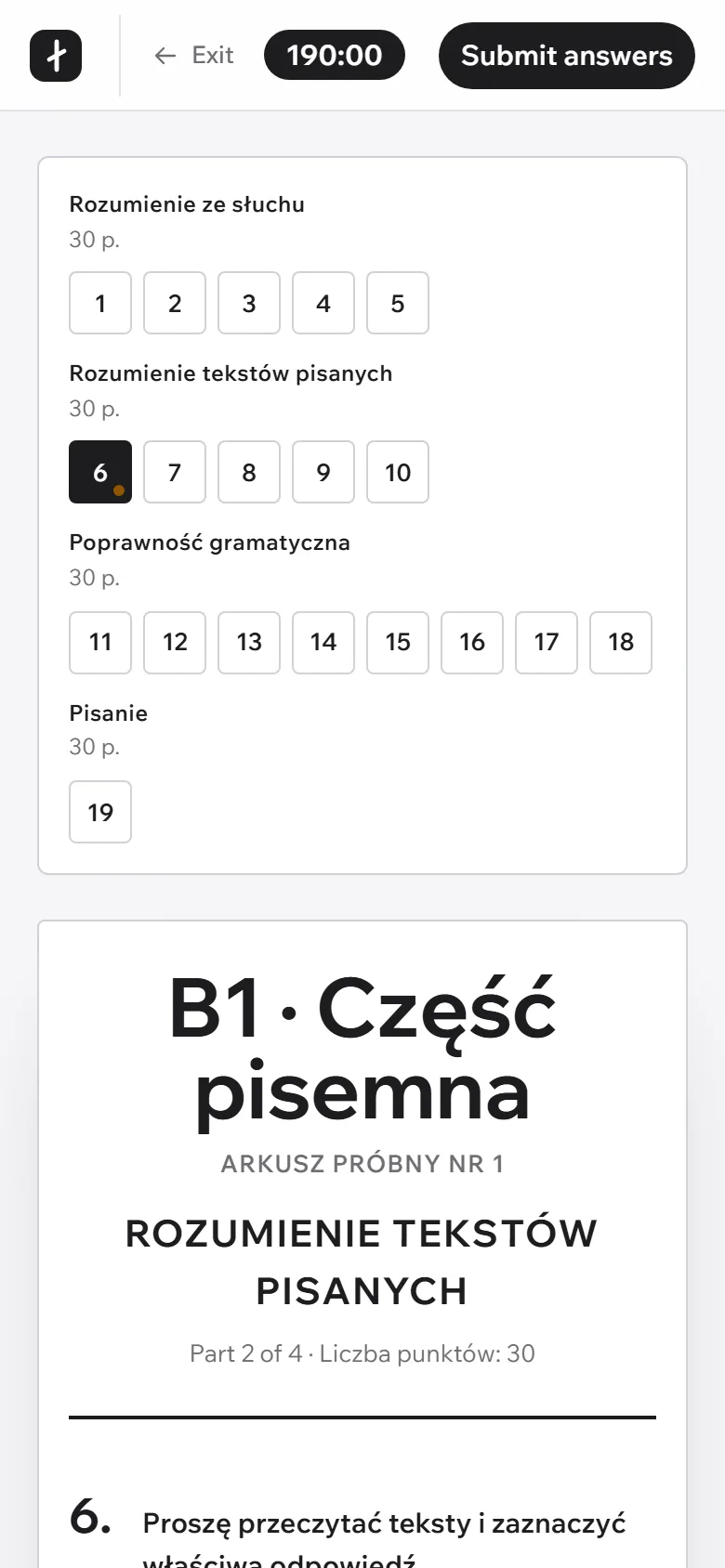
A full written part under exam timing
Our original paper follows the official B1 structure: four modules, tasks 1–19, one 190-minute timer and one hand-in.
- Move freely between tasks in the side panel
- Recordings limited like on the exam
- Leave and continue later – the timer keeps running
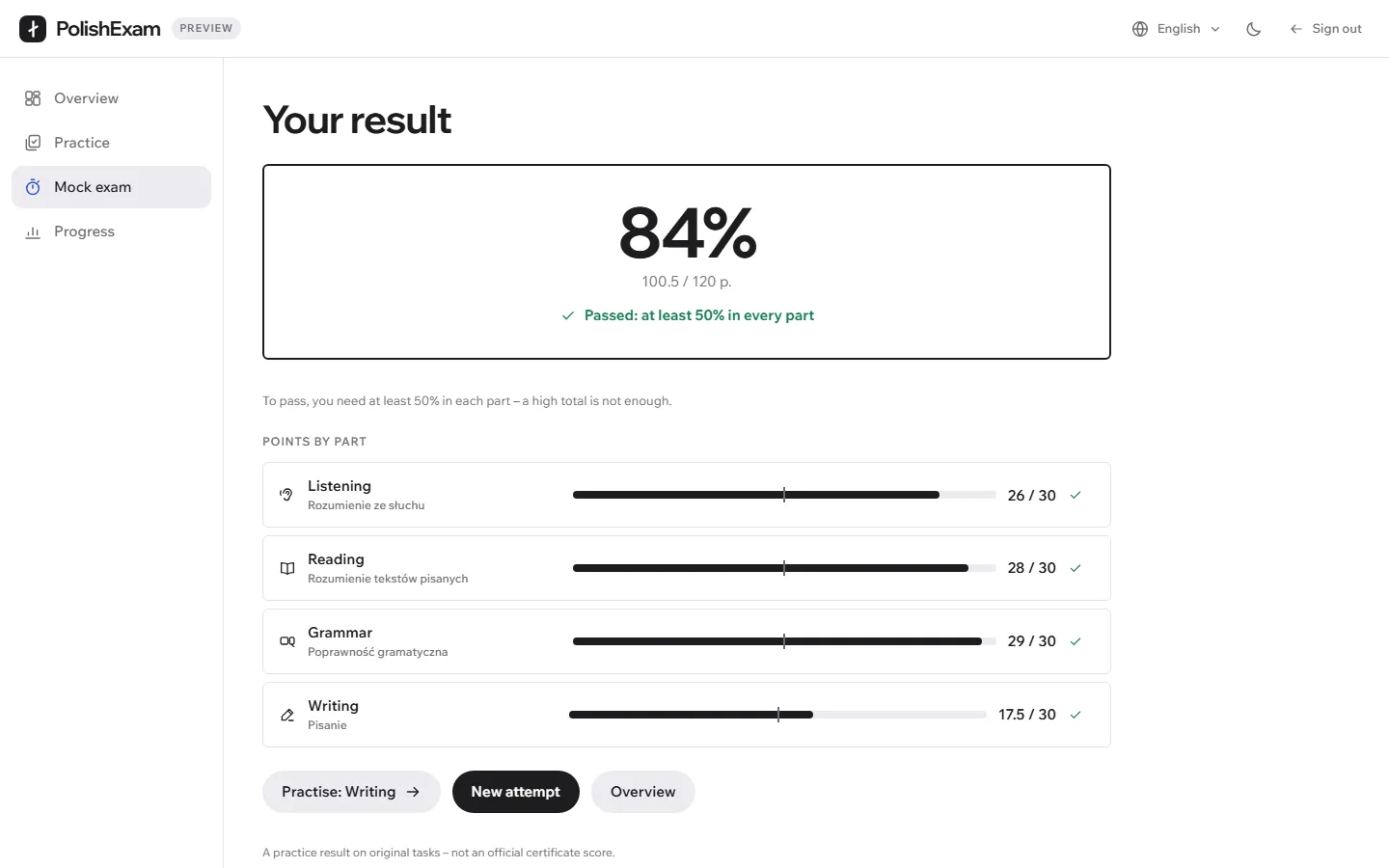
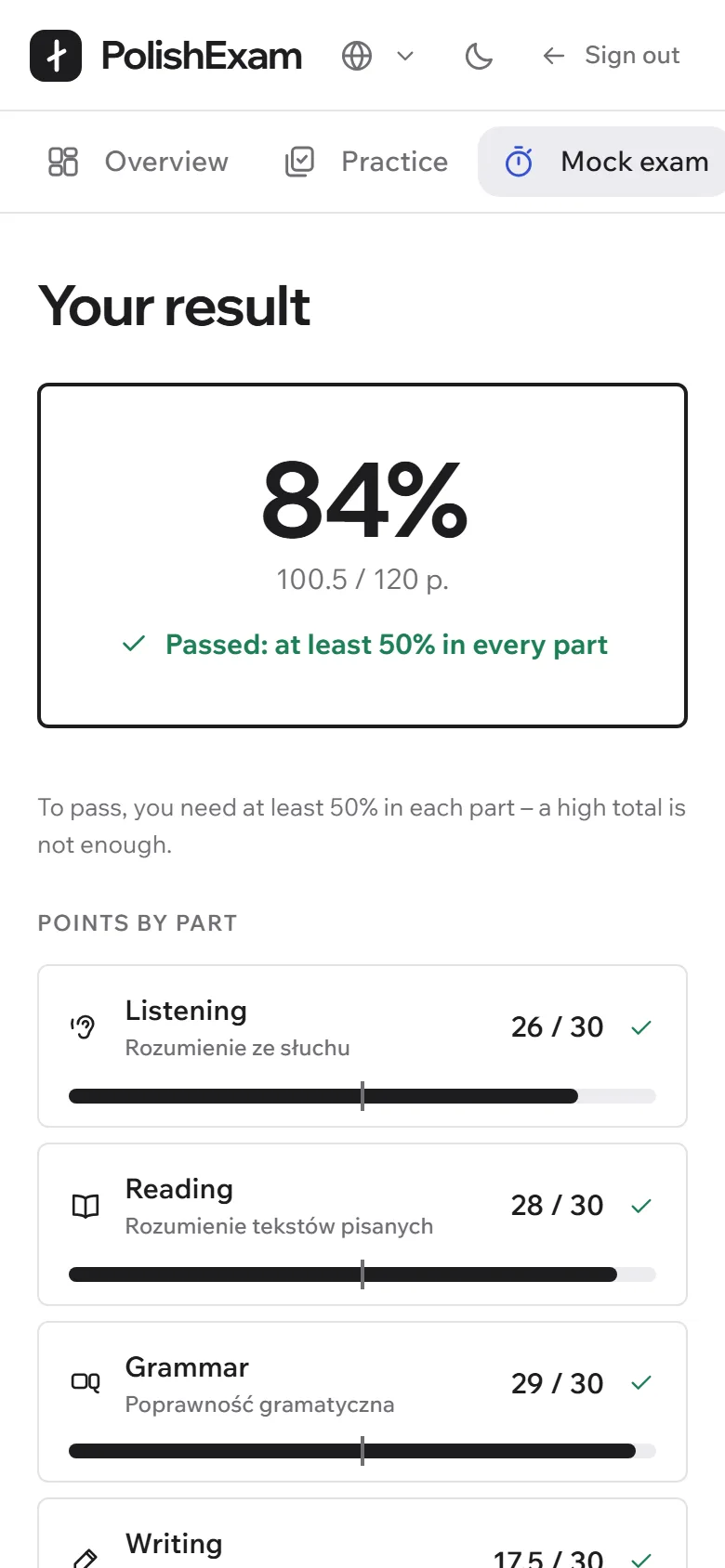
A result per module with the official rule
You see your points in every module and whether each one reaches 50%, then review the key with explanations.
Feedback on your writing
Your text is assessed against task fulfilment, range of language and accuracy, with errors marked and explained. It is an AI estimate, not an official score.
Avoid these
Common mistakes that cost the B1 certificate
- Relying on a good average. A strong grammar result does not rescue a reading score of 14/30. Every module needs 15 points.
- Skipping listening practice with real audio. Reading transcripts is not the same as following speech at natural speed once or twice.
- Ignoring Polish letters. In typed or handwritten answers ą, ę, ł, ó, ś, ż, ź, ć, ń are part of the correct spelling.
- Missing a content point in writing. Each task lists what the text must include. Leaving one out lowers task fulfilment straight away.
- Running out of time in writing. About 75 minutes for two texts goes fast. Plan both before you start and leave time to check.
- Not knowing Polish instructions. All instructions are in Polish; learning their typical wording beforehand saves minutes.
- Registering too late. Centres register candidates with the Commission at least a month before the exam, and places can run out.
- Assuming TELC or ECL works for citizenship. For citizenship by recognition only the state certificate or the listed school certificates count.
Official materials
Official preparation materials
The Commission publishes free materials. We link to them and never copy them; all tasks in our app are original.
Past exam papers
B1 papers from 2023–2024, also for the youth group, with recordings and transcripts.
Sample tests B1 1–3
Sample tests from 2017, 2019 and 2020 with answer keys.
B1 task collections
Collections of practice tasks for level B1 (2017).
Textbook lists
Recommended textbooks and materials, updated in August 2026.
Blog
Read more on this topic

The monologue in the Polish B1 oral exam: a structure and phrases
A four-part frame for the monologue in the Polish B1 oral exam: opening, points with reasons, an example from your life and a closing, with phrases and a model.
The last 7 days before the Polish B1 exam: a revision plan
A day-by-day plan for the last week before the Polish B1 exam: one final mock, an error list, writing and speaking run-throughs, exam instructions and the day before.
Polish B1 vocabulary: what to learn and how to make it stay
How to learn vocabulary for the Polish B1 exam: the sixteen topic areas of the official standard, words learned in sentences with their forms, and spaced reviews.


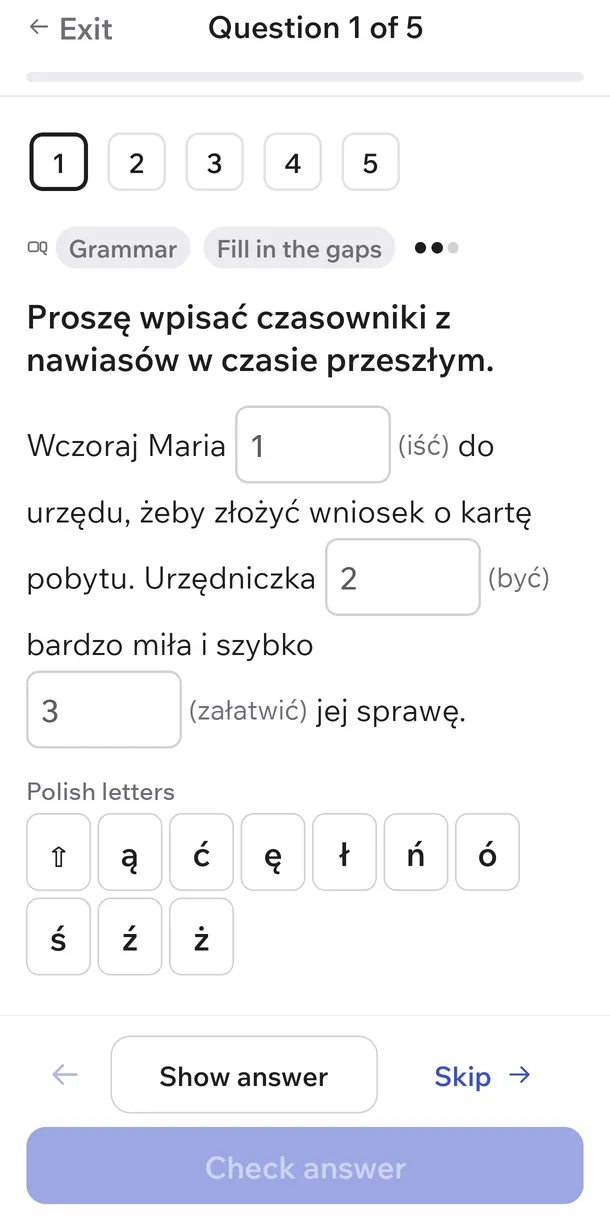
Practise on your phone, too
The PolishExam Android app has the same tasks, mock exam, speaking practice and vocabulary trainer. One account on the website and in the app. About the app

Frequently asked questions
How long is the Polish B1 exam?
The written part lasts at most 190 minutes in total, split into four modules with breaks of at least 10 minutes between them. The oral part lasts up to 15 minutes and takes place the same day or the next day.
How many points do I need to pass Polish B1?
Adults need at least 50% in every written module (15 of 30 in listening, reading, grammar and writing) and at least 50% in the oral part (20 of 40). A high total does not help if one module is below 15. Try the score calculator.
How hard is the Polish B1 exam?
B1 is an intermediate level: you need to handle everyday situations, understand clear standard speech and write simple connected texts. What makes it demanding is the rule that every part must reach 50%, so one neglected skill can decide the result.
Who issues the Polish B1 certificate?
The State Commission for the Certification of Proficiency in Polish as a Foreign Language (Państwowa Komisja…), with administrative support from NAWA. The exam itself is run by centres authorised by the Ministry of Science.
Is the Polish B1 certificate valid for life?
Yes. The certificate is valid indefinitely. From 2027 a duplicate can be obtained within 25 years of issue.
Are the instructions in English or Ukrainian?
No. The whole exam, including all task instructions, is in Polish. It helps to learn the typical wording of instructions before the exam.
Can I retake only the part I failed?
We have found no rule allowing a retake of a single module, so plan to take the whole exam again. There is no waiting period: you can register for the next session.
Does a TELC or ECL certificate count for Polish citizenship?
No. For citizenship by recognition the Act lists the state certificate and certain school certificates; TELC and ECL are not listed. They are accepted for the EU long-term resident permit. See the citizenship page.
When do I get my result and certificate?
The centre informs you in writing within 3 days of receiving the protocol, and the Commission issues the certificate within 30 days of receiving it. In practice expect about 8 weeks or more from the exam to the certificate.
What changes in the exam from 2027?
From 1 January 2027 the age groups become 16+ and under 16, the fee cap is tied to 7% of the average salary, the certificate costs 100 zł and an oral-part exemption is possible for hearing or speech disabilities. The B1 structure stays; the 50% pass rule for 2027 depends on the new regulation, not yet published.
Sources
- Act on the Polish language, consolidated text Dz.U. 2026 item 81 – art. 11a–11m, the certificate
- Regulation on exams in Polish as a foreign language, Dz.U. 2025 item 217 – structure, timing, pass rule, results
- Amendment Dz.U. 2026 item 676 – changes from 1 January 2027
- Act on Polish citizenship, Dz.U. 2025 item 1611 – art. 30(2), B1 requirement
- certyfikatpolski.pl – exam structure
- certyfikatpolski.pl – State Commission
- certyfikatpolski.pl – frequently asked questions
- certyfikatpolski.pl – announcement on spelling rules (5 February 2026)
- certyfikatpolski.pl – certificate without the exam
- gov.pl – list of authorised exam centres
See where you stand before the real exam
Take the full written part under exam timing and get a result for every module with the official 50% rule.