Mówienie · the oral part
Polish B1 speaking exam: tasks, topics and how to prepare
The oral part is short, but it carries 40 points and has its own pass mark. Here is how it runs, the three kinds of tasks you will get, what examiners listen for, original example prompts with useful Polish phrases and a four-week plan.
Facts checked:
- ≤ 15 minfor the whole oral part
- 40 p.maximum score
- 50%needed to pass (20 points)
- 3 tasksin the set you draw
Format
How the oral part works
Mówienie is a separate part of the exam, held on the same day as the written part or on the next day. It lasts up to 15 minutes and is worth 40 points. At B1 for adults you need at least 50%, so 20 points, and this threshold stands on its own: a good written part does not compensate for a weak oral one, and the other way round.
You speak with examiners, not with a computer. At the start you draw one of the prepared sets. According to the official B1 sample materials, a set contains three tasks of different kinds: describing a picture, a monologue on a topic and a conversation in an everyday situation in which the examiner plays the other person. You get a short time to prepare before you speak; the official materials we checked do not state an exact number of minutes, so do not plan around a specific figure.
Everything, including the instructions, is in Polish. Nobody expects a native accent or perfect grammar at B1. What counts is that you complete each task, say enough, and can be understood without effort.
Tasks
The three task types
Describe a picture
Say what you see, where it is and what people are doing, then guess what happened before or what will happen next. The examiner may ask a question linked to your own experience.
Monologue on a topic
Speak on your own about an everyday topic: home, work, travel, free time, health, shopping. Give your opinion with reasons and examples, not just a list of facts.
Role-play with the examiner
A practical situation such as a doctor’s surgery, a shop, an office or a landlord. You need to ask, explain, react and reach a solution, in the polite form Pan/Pani.
Assessment
What examiners listen for
We do not reproduce the official marking grid here. In general terms, examiners of speaking at B1 pay attention to these four things:
- The task. Did you do what was asked: describe, give an opinion, solve the problem in the role-play? An answer that drifts to another topic loses more than an imperfect one that stays on track.
- Range of language. Enough vocabulary for the topic and more than one sentence pattern: reasons with ponieważ and bo, contrasts with ale and jednak, past and future forms.
- Accuracy. Cases, verb endings and aspect that do not get in the way of meaning. Correcting yourself is fine and natural.
- Fluency and pronunciation. Speaking in sentences rather than single words, keeping going after a mistake, and pronouncing words clearly enough to be understood.
Examples
Polish B1 oral exam topics: example prompts and phrases
These prompts are our own, written in the style of the exam. Practise each one aloud for one to two minutes, using the phrases in the right-hand column. A longer list, by topic and task type, with model answers: Polish B1 oral exam questions.
| Task | Example prompt (original) | Useful Polish phrases |
|---|---|---|
| Describe a picture | Proszę opisać zdjęcie: rodzina robi piknik w parku. Follow-up: Jak Pani / Pan lubi spędzać wolny czas na świeżym powietrzu? | Na zdjęciu widzę… · Na pierwszym planie…, w tle… · Po lewej stronie / po prawej stronie… · Wydaje mi się, że… · Chyba jest lato, bo… |
| Describe a picture | Proszę opisać zdjęcie: ludzie czekają na peronie, pociąg jest opóźniony. | Ludzie wyglądają na zmęczonych. · Prawdopodobnie jadą do pracy. · Myślę, że za chwilę przyjedzie pociąg. |
| Monologue | Proszę opowiedzieć o miejscu w Pani / Pana mieście, które lubi Pani / Pan najbardziej. Dlaczego? | Chciałbym / Chciałabym opowiedzieć o… · Po pierwsze…, po drugie… · Na przykład… · Dlatego uważam, że… · Podsumowując… |
| Monologue | Czy lepiej podróżować samemu, czy z grupą? Proszę uzasadnić swoją opinię. | Z jednej strony…, z drugiej strony… · Moim zdaniem lepiej jest…, ponieważ… · Kiedy byłem / byłam w…, … |
| Role-play | Jest Pani / Pan w przychodni. Chce Pani / Pan przełożyć wizytę u lekarza na inny dzień. Egzaminator jest recepcjonistą. | Dzień dobry, mam prośbę. · Czy mogę przełożyć wizytę na inny termin? · Niestety w czwartek nie mogę, bo pracuję. · Czy jest wolny termin w przyszłym tygodniu? |
| Role-play | Kupiła Pani / Kupił Pan w sklepie kurtkę, ale zamek jest zepsuty. Egzaminator jest sprzedawcą. | Chciałabym / Chciałbym zwrócić tę kurtkę. · Zamek nie działa. · Mam paragon. · Czy mogę ją wymienić na inną? · Przepraszam, czy może Pan powtórzyć? |
Forms like Chciałbym / Chciałabym show the masculine and feminine versions: use the one that matches you.
Plan
A four-week speaking practice plan
Fifteen to twenty minutes a day is enough if you speak aloud every time. Record yourself on your phone: listening back is the fastest way to hear your own gaps.
Week 1: pictures
Describe one photo a day from a news site or your own gallery for one minute. Use the same frame every time: what and where, people and actions, a guess, a personal link.
Week 2: monologues
Make a list of ten everyday topics (home, work, food, transport, health, holidays…). Talk about one per day for two minutes: an opinion, two reasons, one example from your life.
Week 3: role-plays
Act out situations with a partner, a teacher or simply both roles yourself: booking, complaining, asking for information, changing an appointment. Practise the polite Pan/Pani forms until they come automatically.
Week 4: full sets under time pressure
Take three tasks of different kinds, give yourself a short preparation and then speak without stopping. Do it with someone listening at least twice, because nerves change how you speak.
Avoid
Typical mistakes in the oral part
- One-word answers. Tak. Nie wiem. Every answer should be at least one full sentence with a reason.
- Long silences. If you lose a word, describe it (to jest rzecz, którą…) or say Nie pamiętam tego słowa, ale… and keep going.
- Learned speeches. A memorised text on a slightly different topic sounds rehearsed and often misses the question. Learn phrases and structures, not whole answers.
- *Mixing ty and Pan/Pani in the role-play. Decide at the start that the examiner is Pan or Pani* and stay with it.
- Only the present tense. Add one past and one future sentence to each answer; it shows range at almost no cost.
- Not asking for repetition. Przepraszam, czy może Pan / Pani powtórzyć? is normal and correct Polish. Guessing the question is worse.
Practise speaking in the app
In the Speaking section you practise all three task types: describing a photo, a short monologue (each followed by one question from the examiner) and a role-play with an AI examiner who answers you in a synthesised voice. There is also an oral mock exam: one set of three tasks, 5 minutes to prepare, then the tasks in a row and one result. You speak into the microphone, your answer is transcribed automatically and AI gives an estimated score on the official B1 criteria for task fulfilment, grammar and vocabulary, with corrections quoting what you said, a corrected version, a model answer and notes on pace and pauses. Pronunciation is not assessed yet, because we cannot measure it reliably, so the result is out of 36 points instead of 40 (18 to pass). It is a practice estimate, not an exam result, and it does not replace an examiner or a teacher. A free account lets you try one speaking task; there is a daily limit of speaking assessments.
Blog
Read more on this topic
The monologue in the Polish B1 oral exam: a structure and phrases
A four-part frame for the monologue in the Polish B1 oral exam: opening, points with reasons, an example from your life and a closing, with phrases and a model.
The Polish instrumental case: jestem lekarzem, z kolegą, za sklepem
When Polish needs the instrumental: after być, z meaning "with", za, przed, nad, pod, transport and verbs like interesować się. Endings and a self-check.
Polish B1 vocabulary: what to learn and how to make it stay
How to learn vocabulary for the Polish B1 exam: the sixteen topic areas of the official standard, words learned in sentences with their forms, and spaced reviews.


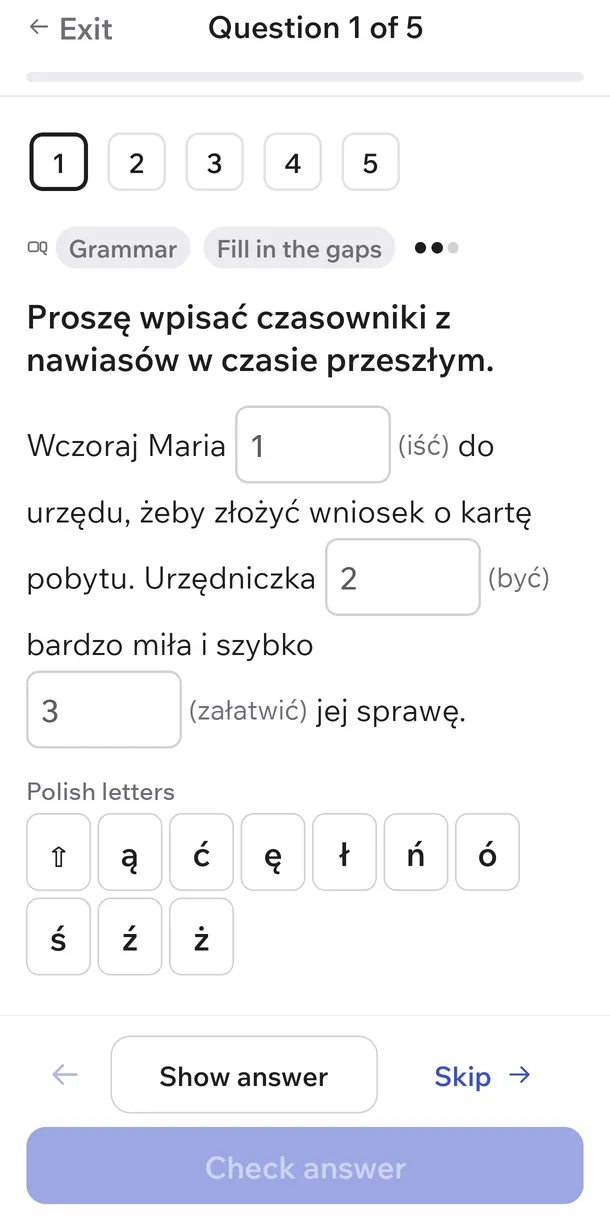
Practise on your phone, too
The PolishExam Android app has the same tasks, mock exam, speaking practice and vocabulary trainer. One account on the website and in the app. About the app

Frequently asked questions
How long is the Polish B1 speaking exam?
Up to 15 minutes, including the tasks in the set you draw. It takes place on the same day as the written part or on the next day.
How many points do I need to pass the oral part?
At least 50% of 40 points, so 20. At B1 for adults the oral part has its own threshold; points from the written part do not make up for it.
What topics come up in the oral exam?
Everyday topics at B1 level: home and family, work and study, shopping, health, transport, travel, free time, the place where you live. The role-play is a practical situation such as an office, a shop or a doctor’s surgery.
How much time do I get to prepare?
You get a short time to prepare before speaking. The official materials we checked do not state an exact number of minutes, so practise starting to speak after a brief pause.
Do I speak with a computer or with people?
With examiners. In the role-play the examiner plays the other person in the situation, so you have to react to what they say.
Can I ask the examiner to repeat the question?
Yes. Przepraszam, czy może Pan / Pani powtórzyć? is natural and polite. It is better than answering a question you did not understand.
Can I practise speaking in PolishExam?
Yes. The Speaking section has practice of the photo description, the monologue and the role-play with an AI examiner, and an oral mock exam with one set of three tasks. AI gives an estimated score on the official criteria without pronunciation, so out of 36 points instead of 40. It is practice feedback, not an exam result.
Sources
- certyfikatpolski.pl – structure of the exam
- certyfikatpolski.pl – B1 task collections (2017), including the oral part
- certyfikatpolski.pl – frequently asked questions (pass thresholds)
- Regulation of 14 February 2025 on exams in Polish as a foreign language (Dz.U. 2025 item 217) – oral part up to 15 minutes, same or next day
Start speaking Polish out loud
Describe a photo, talk about a familiar topic or play a scene with the AI examiner, and get feedback in English or Ukrainian on what you said.