Residence
Permanent residence or EU long-term resident: where you need Polish
Both permits are granted for an indefinite period and both can lead to citizenship. The difference that matters here: permanent residence (pobyt stały) has no language requirement, while the EU long-term resident permit needs B1. Here is what each article says.
Facts checked:
- Nolanguage requirement for permanent residence (art. 195)
- B1for the EU long-term resident permit (art. 211)
- B1for citizenship by recognition after either permit
- Indefiniteboth permits are granted without an end date
Side by side
Permanent residence vs EU long-term resident: the conditions
They are separate procedures under the same Act on Foreigners. Who can apply is decided by the grounds in each article, not by choice alone.
| Permanent residence (pobyt stały) | EU long-term resident (rezydent długoterminowy UE) | |
|---|---|---|
| Legal basis | Act on Foreigners, art. 195 | Act on Foreigners, art. 211 |
| Who can apply | People with one of the grounds listed in the act, e.g. Polish origin, a valid Karta Polaka, marriage to a Polish citizen (3 years, with 2 years of temporary residence), children of permit holders or of Polish citizens, refugee status after 5 years | Anyone who has stayed in Poland legally and without interruption for at least 5 years directly before applying, if the other conditions are met |
| Income and insurance | Required only for some grounds | Always: stable and regular income and health insurance |
| Polish | Not required | B1 – certificate from the official list (state, ECL, TELC and others) or a Polish school or university document |
| Language exemption | – | Under 16 (art. 211(4)) |
| Basis for citizenship by recognition? | Yes (art. 30(1)) | Yes (art. 30(1)) |
Simplified from the text of the act as of 11 November 2026; the full list of grounds and exceptions is in art. 195 and art. 211–213.
Permanent residence
Why permanent residence needs no Polish
Art. 195 of the Act on Foreigners lists the grounds for permanent residence one by one: being the child of a holder of a permanent or EU resident permit, the child of a Polish citizen, a person of Polish origin intending to settle, a spouse of a Polish citizen after 3 years of marriage and 2 years of temporary residence, a holder of a valid Karta Polaka intending to settle, and several others. None of these grounds mentions knowledge of Polish.
So on these grounds the act does not ask for any language document. The Karta Polaka itself asks only for “at least basic” Polish, which the consul can check in a conversation – see Karta Polaka.
EU long-term resident
Why the EU resident permit needs B1
The EU long-term resident permit is open to people without special grounds: what counts is 5 years of legal, uninterrupted stay, income, insurance – and confirmed knowledge of Polish (art. 211(1)(3)). The proof is a certificate of at least B1 from the official list or a document from a Polish school (not post-secondary) or university.
The list of certificates is wider than for citizenship: it includes TELC and ECL. Details and the full list are on the EU long-term resident page.
One rule links the two procedures: under art. 196(1)(1)(d), proceedings for permanent residence are not started for a person staying in Poland on the basis of an EU long-term resident permit. Which permit fits your situation is for the voivodeship office to assess.
The next step
Either way, citizenship asks for B1
Art. 30(1) of the Act on Polish Citizenship builds every route to recognition on one of these permits (or the right of permanent residence) and then adds the language requirement of art. 30(2).
After 3 years
With permanent residence or the EU resident permit, a stable income and a legal title to housing (art. 30(1)(1)).
After 2 years
With one of these permits and at least 3 years of marriage to a Polish citizen, or if you have no citizenship (art. 30(1)(2)); also on permanent residence granted after refugee status (art. 30(1)(3)).
After 1 year
On permanent residence granted because of Polish origin or a Karta Polaka (art. 30(1)(7)).
After 10 years
Of legal, uninterrupted stay, with one of these permits, income and housing (art. 30(1)(6)).
In every case: B1
The state certificate, a certificate from a school in Poland (not post-secondary) or from a Polish-language school abroad – TELC and ECL do not count here (art. 30(2)–(2a)). Certain minors are exempt. See Citizenship and B1.
Permanent residence now, B1 later
Getting permanent residence without a language document does not remove the language step – it moves it. If citizenship is the plan, the B1 exam is ahead of you, and on the Karta Polaka route it can come after just one year. Seats in a session can go quickly, so it is worth knowing the registration rules early.
Not legal advice
This page summarises the acts listed below as of 11 November 2026. It is not legal advice, and PolishExam is not connected with any office. Which permit you can apply for and whether your documents are enough is decided by the voivodeship office (urząd wojewódzki) handling your case.
Prepare with PolishExam
Get ready for the B1 step
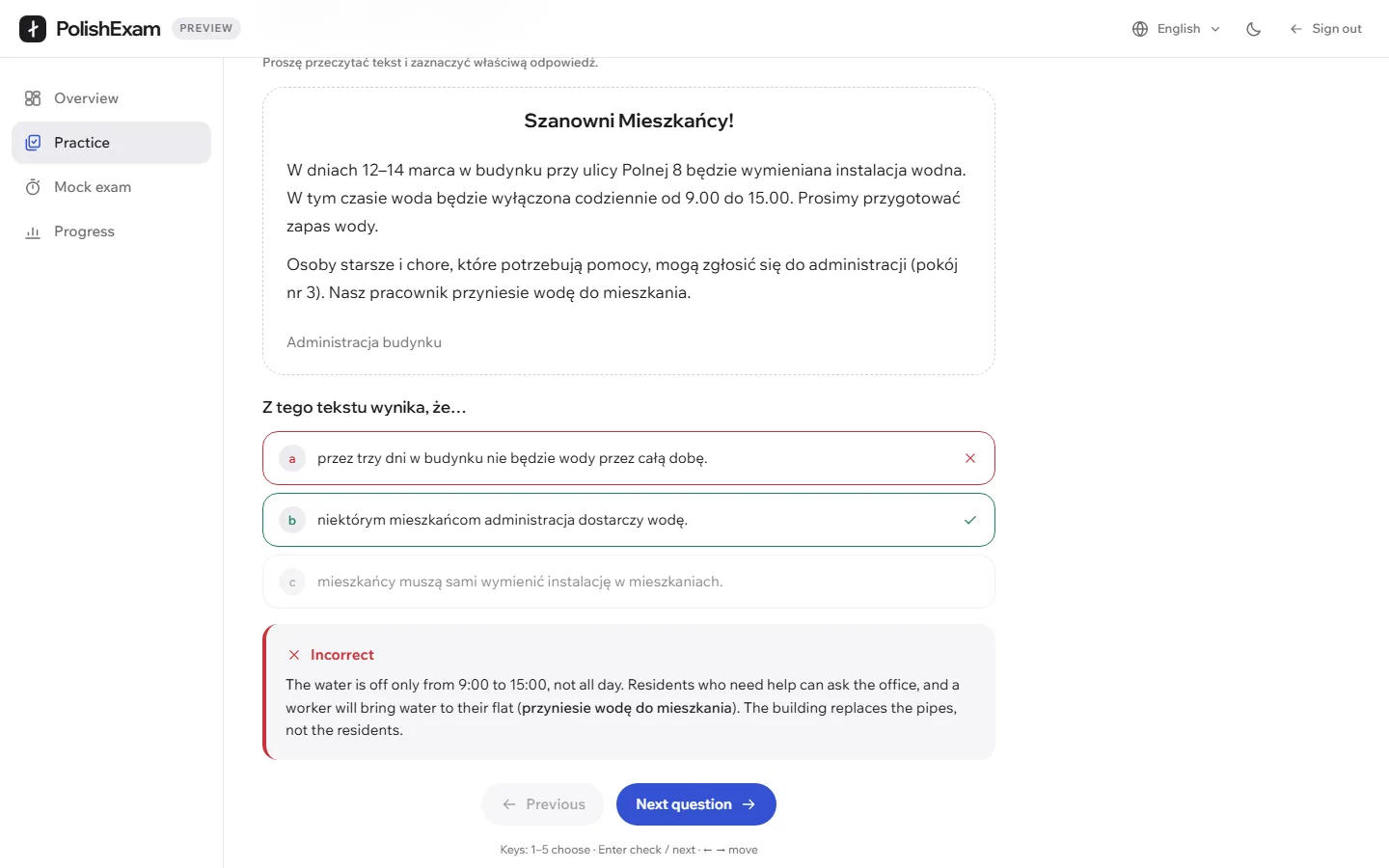
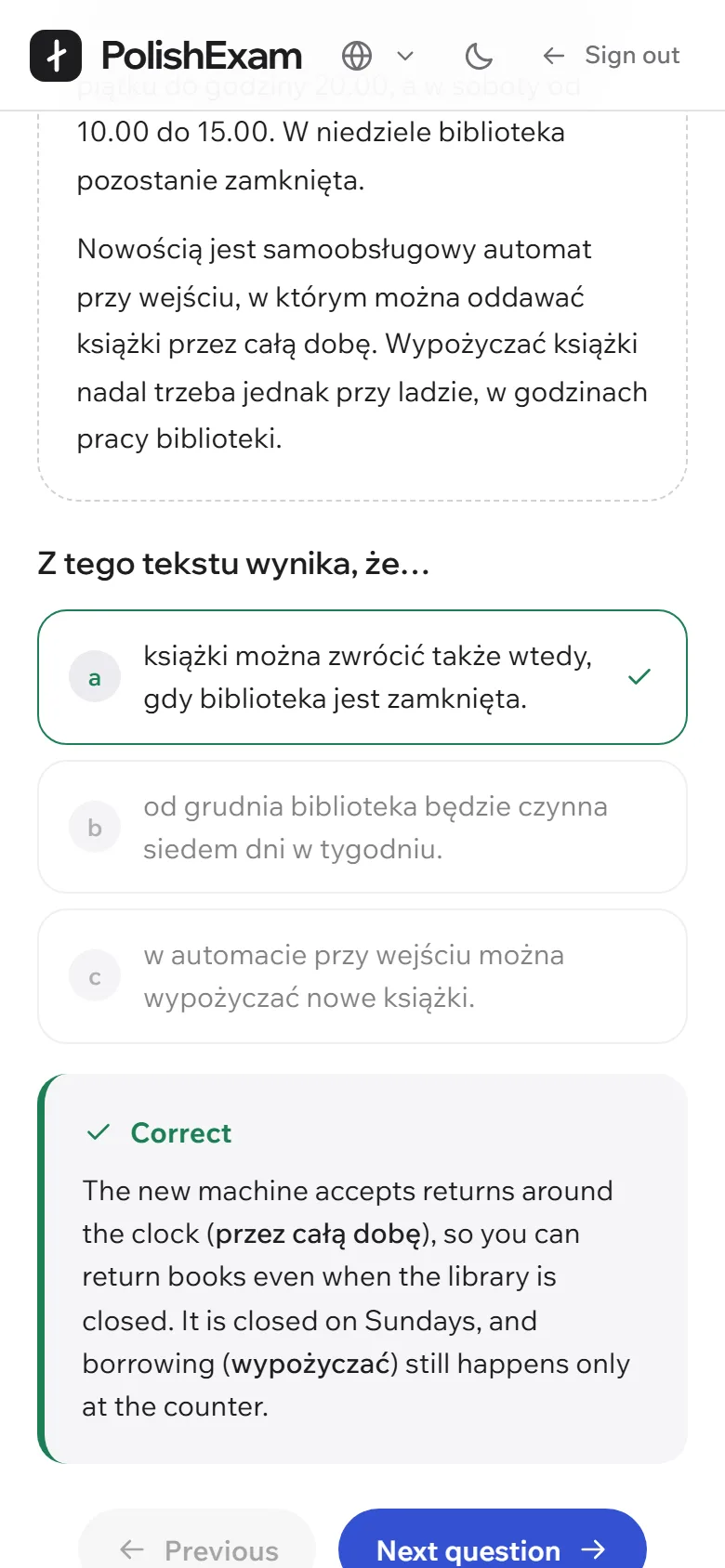
Practice with explanations
Tasks in the official B1 formats, in Polish like on the exam, with explanations in English or Ukrainian.
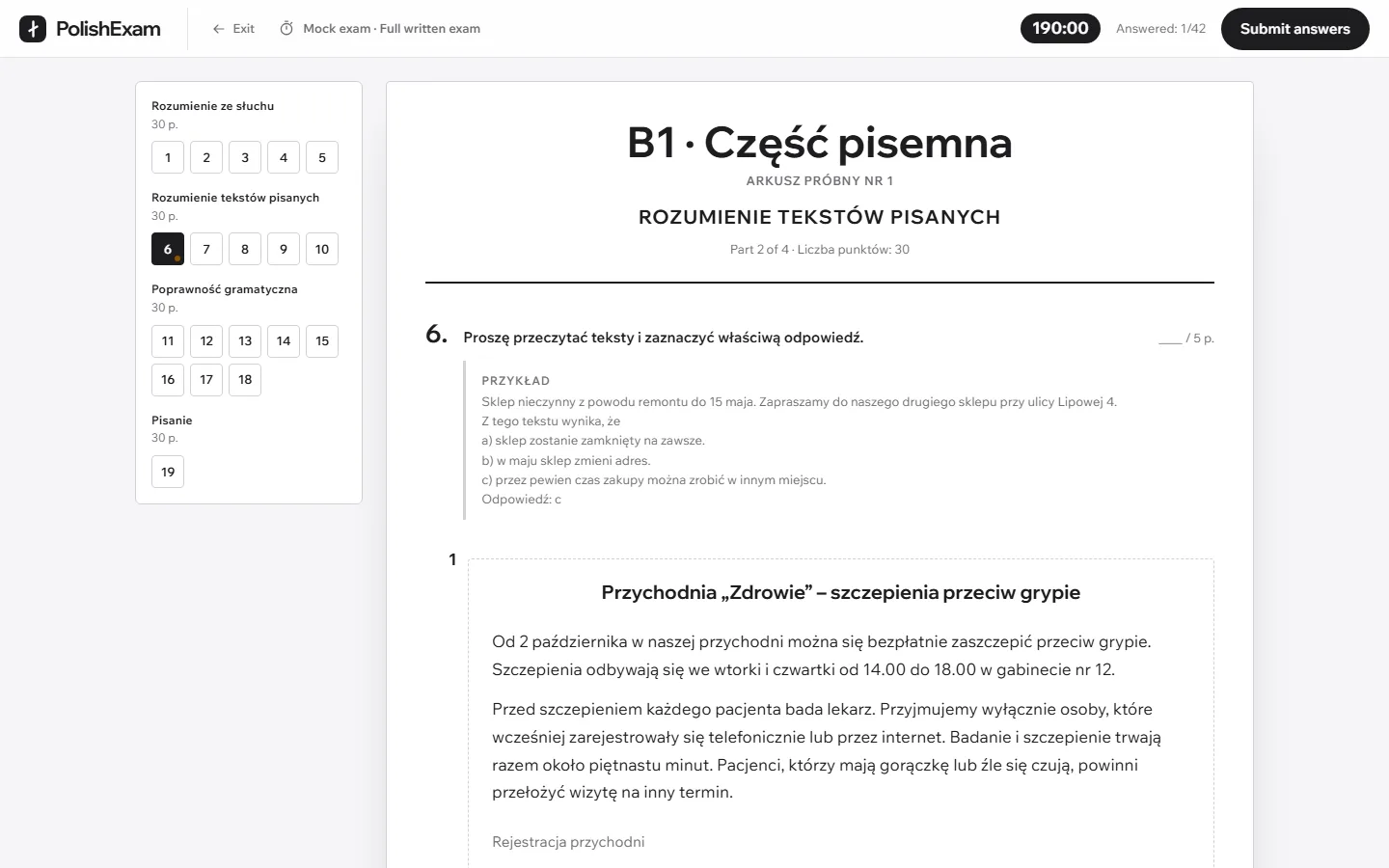
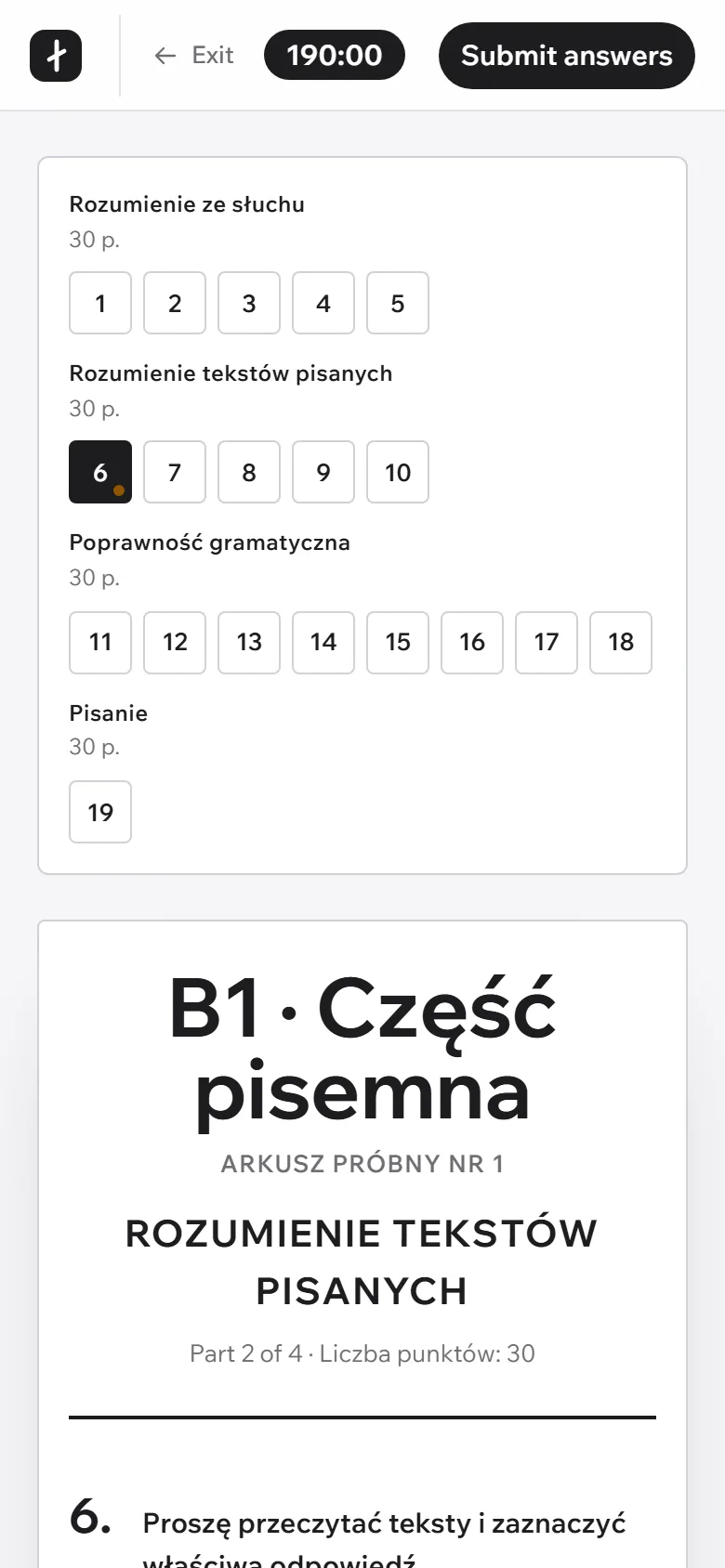
A full mock exam on one timer
The whole written part as one exam: 190 minutes, 120 points and the result per part with the official 50% rule.
Frequently asked questions
Do I need a Polish certificate for permanent residence?
No. Art. 195 of the Act on Foreigners sets no language requirement for any of its grounds.
Do I need B1 for the EU long-term resident permit?
Yes. Art. 211(1)(3) requires confirmed knowledge of Polish, and art. 211(3) accepts a certificate of at least B1 or a Polish school or university document. People under 16 are exempt.
Which is better for citizenship – permanent residence or EU resident?
Both are a basis for citizenship by recognition under art. 30(1) of the Act on Polish Citizenship, and in both cases citizenship then requires B1. Which permit you can get depends on the grounds you have; ask the voivodeship office.
Can I hold both permits at once?
Art. 196(1)(1)(d) of the Act on Foreigners says that proceedings for permanent residence are not started for a person staying in Poland on an EU long-term resident permit. For your situation, ask the voivodeship office.
Does TELC count if I have permanent residence and want citizenship?
No. For citizenship the act accepts the state certificate and school certificates only. TELC and ECL count for the EU resident permit, not for citizenship.
I have a Karta Polaka. When will I need B1?
For permanent residence based on the Karta Polaka – not at all. For citizenship by recognition, which you can apply for after one year of that permanent residence (art. 30(1)(7)) – yes, B1.
Sources
- Act on Foreigners, consolidated text Dz.U. 2025 item 1079 – art. 195–196 (permanent residence), art. 211–213 (EU long-term resident)
- Act on Polish Citizenship, consolidated text Dz.U. 2025 item 1611 – art. 30(1): routes to recognition, art. 30(2): B1
- Regulation on accepted language certificates, Dz.U. 2023 item 1076 – certificates accepted for the EU resident permit
- Act on the Karta Polaka, consolidated text Dz.U. 2026 item 76 – basic Polish, no certificate
Whichever permit you have, B1 comes next
Find out which part of the B1 exam needs the most work and practise it with explanations in English.