The grammar module, Poprawność gramatyczna, is where many candidates lose the points they need. It has eight short tasks on cases, conjunctions, comparison, verb forms, questions, rewriting, aspect and prepositions. Below: the official structure, four free exercises, the B1 grammar you really need and the mistakes to avoid.
Grammar is the third written module, after listening and reading and before writing. It is worth 30 of the 120 written points, and at B1 for adults you need at least 50% in every written module, so 15 points here are required even if your listening and reading are excellent. The written part takes 190 minutes in total.
The module checks whether you can use the forms of B1 Polish, not whether you can name them. You choose or write the right case of nouns, adjectives and pronouns, connect sentences with conjunctions, form the comparative, put verbs into the present or past tense, ask questions with the right question word, rewrite sentences with a given verb (verb government), choose the right aspect and mood (imperative, conditional) and pick prepositions.
Unlike listening and reading, in three of the eight tasks you write the answer yourself. Endings and Polish letters (ą, ę, ł, ó, ś, ź, ż, ć, ń) are part of the form, so accuracy matters at the level of single letters.
Spelling note: new Polish spelling rules apply from 1 January 2026, and in the years 2026–2030 the exam accepts both the old and the new rules.
Task types
The eight grammar tasks of the B1 paper
Structure of the 2024 B1 paper for adults. Points add up to 30.
Task
Format
What is tested
Gaps × points
I
text, choose 1 of 3 forms
Declension: nouns, adjectives, pronouns in the right case
10 × 0.5 = 5
II
text, words from a box (6 words, 1 extra)
Conjunctions: ale, bo, dlatego, żeby, jeśli…
5 × 0.5 = 2.5
III
text, choose 1 of 3 forms
Comparison of adjectives and adverbs
5 × 0.5 = 2.5
IV
text, write the form
Present or past tense of the verb in brackets
10 × 0.5 = 5
V
five sentences, write the question
Ask about the underlined part: question word or phrase (z kim?, dokąd?)
5 × 0.5 = 2.5
VI
five sentences, rewrite
Same meaning with the word in brackets: verb government and cases
5 × 1 = 5
VII
dialogue, choose 1 of 3 forms
Verb aspect and moods: imperative, conditional
10 × 0.5 = 5
VIII
text, words from a box (6 words, 1 extra)
Prepositions
5 × 0.5 = 2.5
The module lasts 45 minutes in the 2024 paper. Tasks I, IV, VI and VII together carry 20 of the 30 points.
Free, no account
Polish B1 grammar exercises to try now
Four original exercises in the official formats, each shorter than the exam task: case forms in a text (like task I), verbs in the present or past tense that you type (like task IV), conjunctions from a box (like task II) and verb aspect and moods (like task VII). Every answer comes with a short explanation of the rule.
Poprawność gramatyczna
Proszę podkreślić poprawne formy wyrazów podanych w nawiasach.
Przykład
Wieczorem idę z (mój brat / moim bratem / mojego brata) do kina.
→ moim bratem
Mój syn od kilku dni źle się czuje, więc dzisiaj rano zadzwoniłam do . Pani w rejestracji zapisała nas do lekarza na szesnastą. Lekarka obejrzała gardło syna i powiedziała, że to tylko przeziębienie. Nie przepisała mu , ale poleciła syrop i dużo herbaty z .
Poprawność gramatyczna
Proszę uzupełnić tekst poprawnymi formami czasowników podanych w nawiasach (czas teraźniejszy lub przeszły).
Mam na imię Olga i od roku mieszkam w Gdyni. W zeszłą sobotę (ja – pojechać) z mężem do Gdańska na koncert. Tego dnia podróż kolejką (trwać) aż godzinę, bo był remont torów. Na co dzień (ja – jeździć) do pracy autobusem, a mój mąż zawsze (on – chodzić) pieszo, bo jego biuro jest blisko domu.
Poprawność gramatyczna
Proszę uzupełnić tekst wyrazami z ramki. Uwaga! Jeden wyraz w ramce jest niepotrzebny.
ale
bo
dlatego
jeśli
żeby
Kasia pracuje jako pielęgniarka w szpitalu. Lubi swoją pracę, często jest bardzo zmęczona. W tym miesiącu ma dużo nocnych dyżurów, w dzień musi spać. W przyszłym roku chce zrobić kurs, zostać położną. Latem pojedzie z rodziną nad morze, szef da jej urlop w lipcu. Na razie jeszcze nie wie, czy to możliwe.
Poprawność gramatyczna
Proszę wybrać poprawną formę czasownika.
What to know at B1
The seven Polish cases and their B1 uses
You do not need every exception at B1. You need to recognise what triggers each case and to produce the regular endings reliably.
Case
Questions
Typical B1 uses
Example
Mianownik (nominative)
kto? co?
subject; after to jest
To jest moja siostra.
Dopełniacz (genitive)
kogo? czego?
object of a negated verb; after do, od, z (from), bez, dla, u; quantities; possession; after szukać, potrzebować, uczyć się
Nie mam czasu. Idę do apteki.
Celownik (dative)
komu? czemu?
recipient; after pomagać, dziękować, dawać; Jest mi zimno
Pomagam mamie.
Biernik (accusative)
kogo? co?
direct object; direction with na and w; czekać na; days with w
Kupuję bilet. Czekam na autobus.
Narzędnik (instrumental)
kim? czym?
być + noun; z (with); means of transport; interesować się
Jestem lekarzem. Jadę tramwajem.
Miejscownik (locative)
o kim? o czym?
only after prepositions: w, na, o, przy, po; place and topic
Mieszkam w Gdańsku. Myślę o pracy.
Wołacz (vocative)
–
addressing someone directly
Panie Tomaszu! Aniu, pomóż mi!
Aspect, moods, prepositions and comparison
Topic
What to know at B1
Example
Verb aspect
Imperfective for habits, processes and repetition; perfective for one completed result. A perfective verb has no present tense: its present form means the future.
Codziennie kupuję gazetę. / Jutro kupię gazetę.
Future tense
Perfective: simple form. Imperfective: będę + infinitive or -ł form. będę + perfective does not exist.
Zrobię to jutro. / Będę pracować w domu.
Imperative
A one-off request: usually perfective. Negated: usually imperfective. Polite form: proszę + infinitive.
Zadzwoń do mnie! / Nie martw się. / Proszę usiąść.
Conditional
Past form + -by + personal ending; gdyby for unreal conditions; polite requests.
Chciałbym zapytać… / Gdybym miał czas, pojechałbym nad morze.
Prepositions
Where? w/na + locative. Where to? do + genitive, na + accusative. To a person: do.
Jestem w pracy → Idę do pracy. Idę do lekarza.
Comparison
-szy/-ejszy, irregular forms, or bardziej for long adjectives; niż + nominative.
dobry – lepszy – najlepszy; szybko – szybciej; Brat jest starszy niż ja.
Question words
The question word takes the case of the underlined phrase.
Rozmawiam z siostrą → Z kim rozmawiasz?
Verb government
Each verb takes a fixed case or preposition; learn verbs with it.
Lubię jazz → Interesuję się jazzem.
Strategy
How to solve the grammar tasks, step by step
1
Find the trigger before choosing a form
Look left of the gap: a preposition, a negation, a verb, a number. do → genitive, z meaning “with” → instrumental, nie mam → genitive. The trigger decides the case before you look at the options.
2
Check agreement
An adjective or pronoun follows its noun in gender, number and case: do nowego lekarza, z moją siostrą. If the noun is far from the gap, find it first.
3
For verbs, read the time markers
wczoraj, w zeszłą sobotę → past; codziennie, zawsze, teraz → present. Then check the person and, in the past tense, the gender: a woman writes pojechałam, a man pojechałem.
4
Decide the aspect by asking: one result or a habit?
One completed action or a single request → perfective (kupię, kup). A routine, a process or a general instruction → imperfective (kupuję, kupuj). After gdyby the result goes into the conditional.
5
Use the boxes systematically
In tasks II and VIII fill the gaps you are sure about and cross out used words. One word in the box is extra, so the last gap is not automatic: check it in the sentence.
6
For questions and rewrites, check the case
In task V the question word must match the underlined phrase (o pracy → O czym?). In task VI keep the meaning and change only what the new word requires: bać się takes the genitive, interesować się the instrumental.
7
Leave five minutes for a letter-by-letter check
Read your written forms once more: endings, ą/ę, ó/u, rz/ż, ch/h. With 55 gaps in 45 minutes, keep about 5 minutes per task and come back to the hard ones.
Typical mistakes
Grammar mistakes typical at B1
Nie mam czas instead of Nie mam czasu: a negated verb takes the genitive.
Jestem nauczyciel instead of Jestem nauczycielem: być + noun takes the instrumental.
Mieszkam w Kraków instead of Mieszkam w Krakowie: w meaning “in” takes the locative.
Idę na lekarza instead of Idę do lekarza: to a person you go do.
Jutro będę zrobić instead of Jutro zrobię: będę combines only with imperfective verbs.
Codziennie zrobię zakupy instead of Codziennie robię zakupy: habits need the imperfective.
bardziej lepszy or więcej tani instead of lepszy, tańszy.
Leaving out Polish letters: jezdze is not jeżdżę. Write every letter fully.
In the app
How PolishExam trains the grammar part
polishexam.pl/en/app/
Every answer explained
Check your answer and see why this form is right: the trigger, the case or the aspect, explained in English or Ukrainian. When a typed answer is right except for Polish letters, the app tells you exactly that.
Case forms, verb forms, conjunctions, aspect and moods
“Show answer” when you are stuck
polishexam.pl/en/app/
Practise the task type that costs you points
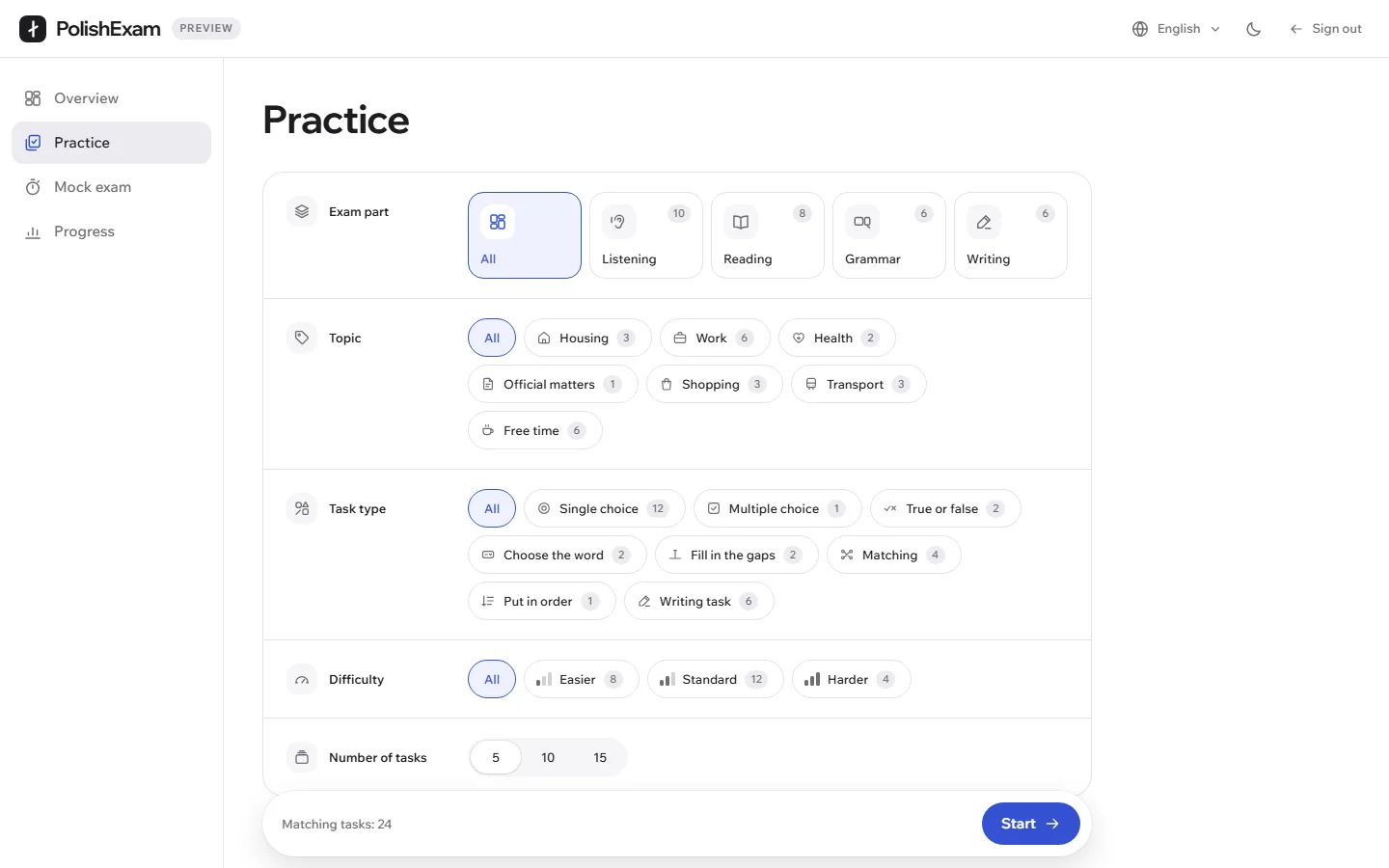
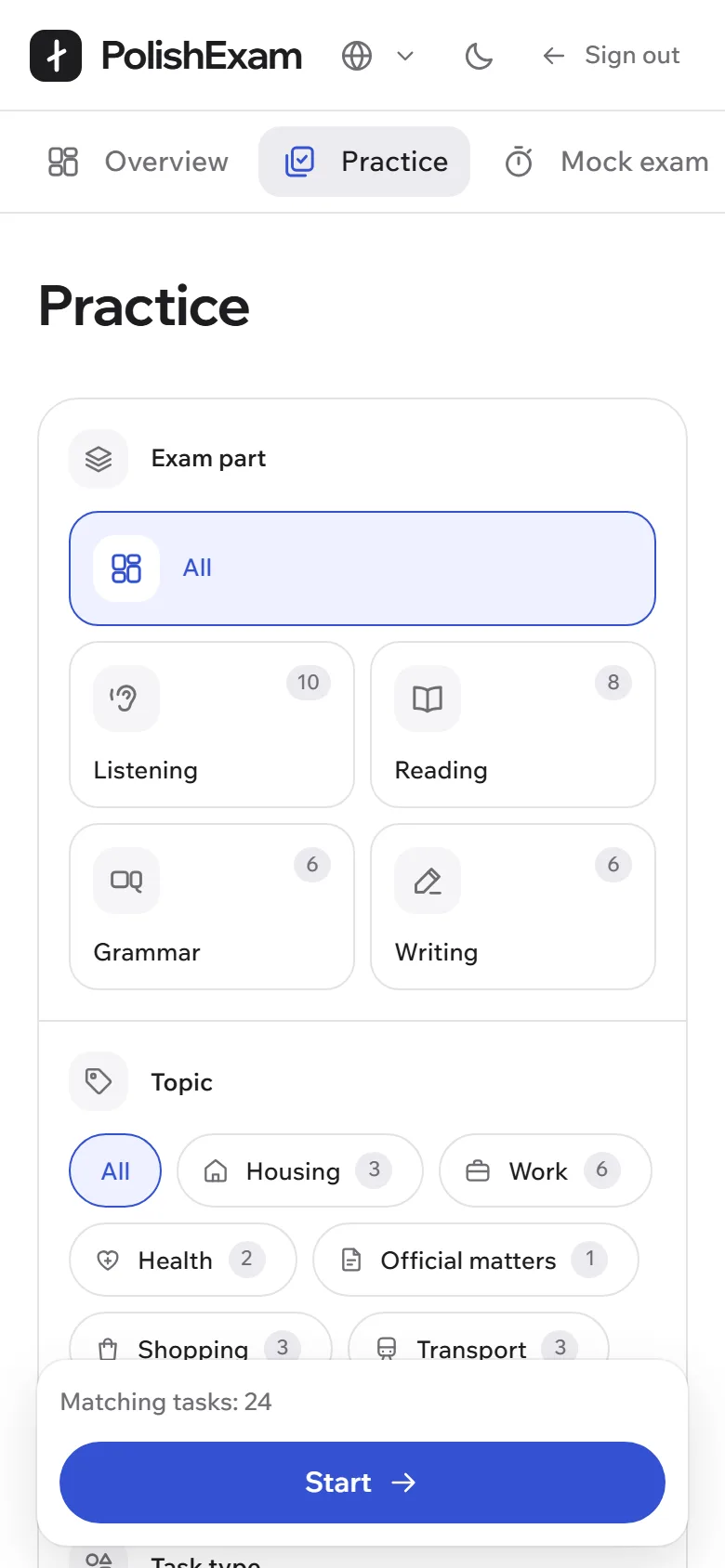
Filter by exam part, task type, topic and difficulty, for example only typed verb forms. Your progress shows results per task type, so you can see where the 15 points are at risk.
Grammar also as a timed mock with the official 45 minutes
Official materials
Official grammar materials to practise with
Real papers and sample tests from the State Commission are the best final check. We link to them; we never copy them.
Polish numbers, dates and clock times for B1 listening: która godzina and o której, wpół do, za pięć, dates in the genitive, prices, phone numbers, 12 vs 20.
When Polish needs the instrumental: after być, z meaning "with", za, przed, nad, pod, transport and verbs like interesować się. Endings and a self-check.
How to learn vocabulary for the Polish B1 exam: the sixteen topic areas of the official standard, words learned in sentences with their forms, and spaced reviews.
45 minutes according to the 2024 paper, with eight tasks and 55 gaps. It is the third module of the written part, which takes 190 minutes in total.
How many points do I need in grammar?
At least 15 of 30. At B1 for adults you need 50% in every written module and 50% in the oral part.
Which cases are most important at B1?
All seven appear, but the genitive, accusative, instrumental and locative cause the most errors because prepositions and verbs trigger them. Learn the trigger together with the ending.
Do I have to write answers or only choose?
Both. Tasks I, II, III, VII and VIII are choices; in tasks IV, V and VI you write verb forms, questions and rewritten sentences yourself.
Do Polish letters count?
Yes: jeżdżę without its Polish letters is a different, wrong form. Write every letter fully. Both the old and the new spelling rules are accepted in 2026–2030.
How do I practise verb aspect?
Learn verbs in pairs (robić/zrobić, kupować/kupić, pisać/napisać) and decide in each sentence: one completed result or a habit or process? Task VII on the exam tests exactly this, together with the imperative and conditional.
Is there a grammar test without writing a full text?
Yes, that is this module: short gaps and sentences only. Longer texts are written in the separate Pisanie module.
We would like to use Google Analytics cookies to see which pages and features people use, so we can improve PolishExam. You can change your choice at any time under “Cookie settings”. Privacy Policy