Karta Polaka
Karta Polaka and the Polish language: basic now, B1 later
For the Karta Polaka the law asks for at least basic Polish and does not require a certificate – the consul can check it in a conversation. But if the card is your way to settle in Poland and become a citizen, the last step needs B1, proven with a document. Here is what each step requires.
Facts checked:
- Basiclevel of Polish for the Karta Polaka
- Not neededa certificate – the consul may assess you in a conversation
- 1 yearon permanent residence before citizenship (art. 30(1)(7))
- B1needed for citizenship, with a certificate or school document
The card
What the Act on the Karta Polaka says about language
The Karta Polaka confirms that you belong to the Polish nation. Under art. 2(1) of the Act on the Karta Polaka (consolidated text Dz.U. 2026 item 76) you show your connection with Polishness through at least basic knowledge of Polish, which you consider your mother tongue, and through knowing and keeping Polish traditions and customs.
The other conditions are not about language: a written declaration of belonging to the Polish nation made before the consul (or, in some cases, the voivode), proof that you, at least one of your parents or grandparents, or two of your great-grandparents were of Polish nationality (or a certificate from a Polish or Polonia organisation about active involvement for Polish language and culture over at least the last three years), and a statement that neither you nor your ancestors were repatriated under the 1944–1957 repatriation agreements.
How you show your Polish is set out in art. 13(7)–(8). You can present a state certificate of proficiency in Polish, a school or university certificate from Poland, or a certificate from a school abroad where Polish was the language of teaching. If you have none of these, the consul assesses your Polish in a conversation (in some cases the voivode does). The procedure itself is free of charge (art. 12(3)).
The act names the state certificate as one of the possible proofs, without a required level. The requirement for the card is basic Polish – not B1.
The route
Karta Polaka → permanent residence → citizenship
Many card holders use it as the first step towards living in Poland for good. The language bar is different at each step.
Karta Polaka: basic Polish, no certificate
The consul decides whether your Polish is at least basic. A certificate helps, but it is not required (art. 13(7)–(8) of the Act on the Karta Polaka).
Permanent residence: no language requirement
A holder of a valid Karta Polaka who intends to settle in Poland permanently can be granted a permanent residence permit (art. 195(1)(9) of the Act on Foreigners). This permit has no language condition.
Citizenship after one year: B1 with a document
After at least one year of uninterrupted stay on a permanent residence permit granted because of the Karta Polaka or Polish origin, you can apply for recognition as a Polish citizen (art. 30(1)(7) of the Act on Polish Citizenship). Here the law requires Polish at least at B1, proven by the state certificate, a school certificate from Poland or a certificate from a Polish-language school abroad (art. 30(2)).
At a glance
What each step asks for
| Step | Polish required? | Level | How it is shown |
|---|---|---|---|
| Karta Polaka | Yes | At least basic | Certificate, Polish school document, or a conversation with the consul |
| Permanent residence (art. 195(1)(9)) | No | – | No language condition |
| Citizenship by recognition (art. 30(1)(7)) | Yes | B1 | State certificate at least B1, school certificate from Poland or from a Polish-language school abroad; post-secondary school certificates do not count (art. 30(2a)) |
Sources: Act on the Karta Polaka (Dz.U. 2026 item 76), Act on Foreigners (Dz.U. 2025 item 1079), Act on Polish Citizenship (Dz.U. 2025 item 1611). Status on 11 November 2026.
The gap
Why “basic” is not enough for the last step
The conversation with the consul and the B1 exam are very different things. The act does not describe the conversation – it only says that the consul assesses your Polish (art. 13(8)), and the level required is basic. The B1 exam is a written and oral test with fixed tasks: listening, reading, grammar and writing in the written part (190 minutes in total, 120 points) and a speaking part worth 40 points.
To pass B1 as an adult you need at least 50% in every part. People who speak Polish at home may feel confident in listening and speaking but still lose points in grammar and writing – endings, spelling, formal letters. A conversation is not a written test of these skills.
One year on permanent residence passes quickly, and exam sessions are fixed: five a year, with registration at a centre about two months before. If citizenship is your goal, it makes sense to start preparing for B1 while you wait for the permanent residence decision. See exam dates and fees and how registration works.
Already have a certificate from a school in Poland or from a Polish-language school abroad? It may be your proof for citizenship. A post-secondary school certificate is not – see post-secondary school certificates.
Planned changes – drafts only
Government draft UD491 (first published on the legislative work list on 27 October 2026) plans to change recognition as a Polish citizen, including B2 instead of B1 and a civic knowledge test. It is only a draft and not law. Today the citizenship step requires B1. We follow every official stage on the citizenship law changes tracker.
Not legal advice
This page summarises the acts listed below as of 11 November 2026. It is not legal advice, and PolishExam is not connected with any consulate, office or the State Commission. Whether you qualify for the Karta Polaka, permanent residence or citizenship is decided by the consul or the voivode handling your case – ask them about your situation and the documents they need.
Prepare with PolishExam
Close the gap between conversation and exam
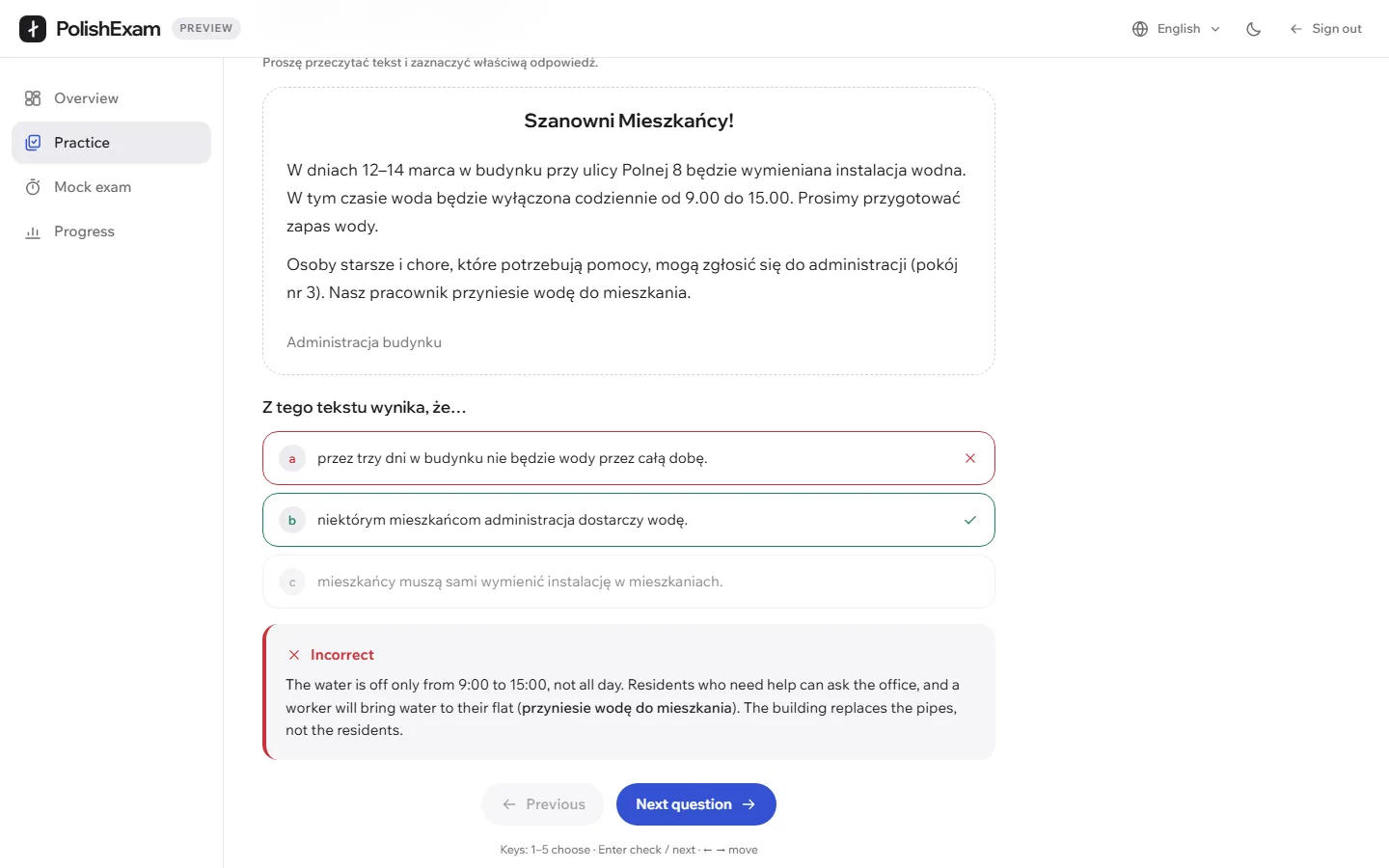
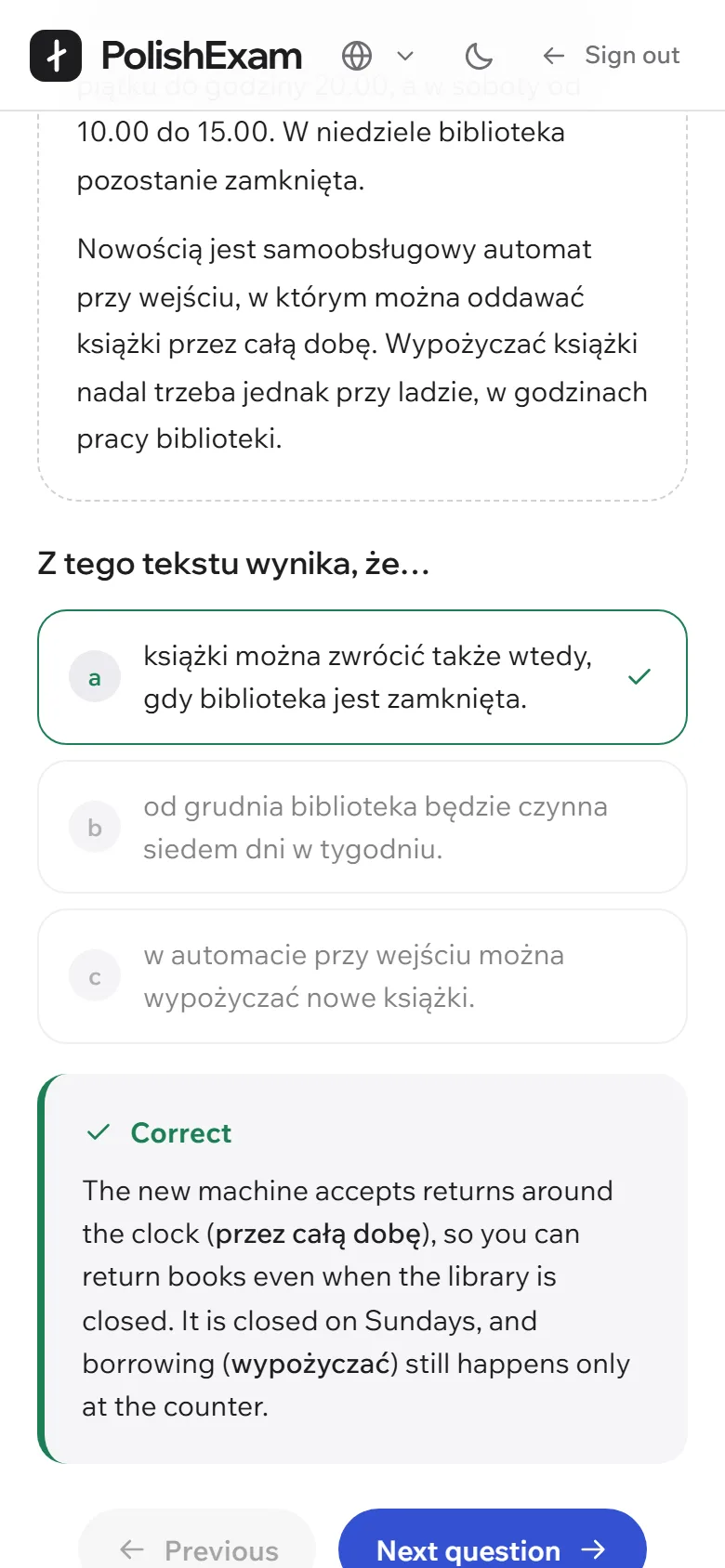
Grammar and reading with explanations
Tasks in the official B1 formats, in Polish. After each answer you see why it is right or wrong, explained in English or Ukrainian.
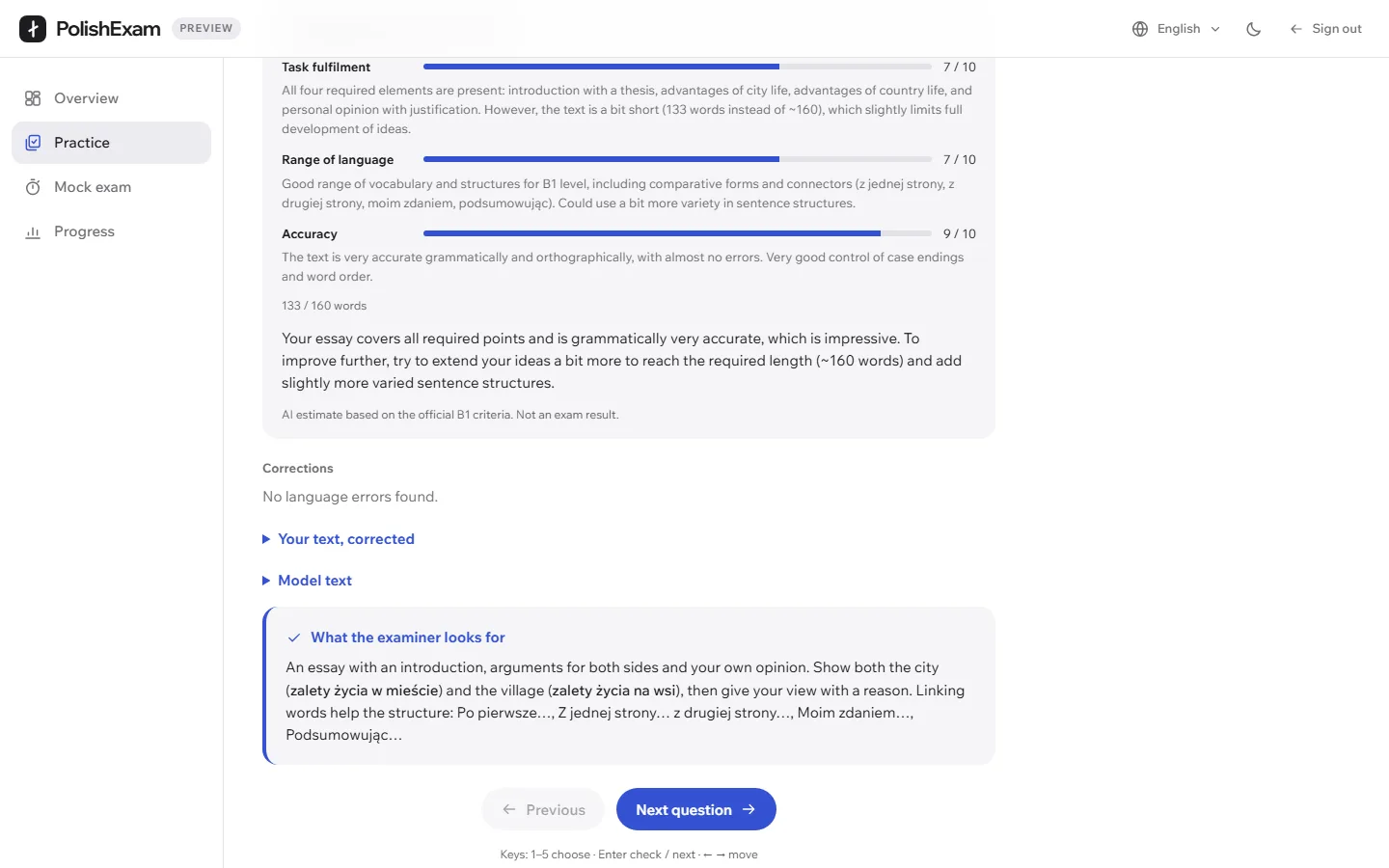
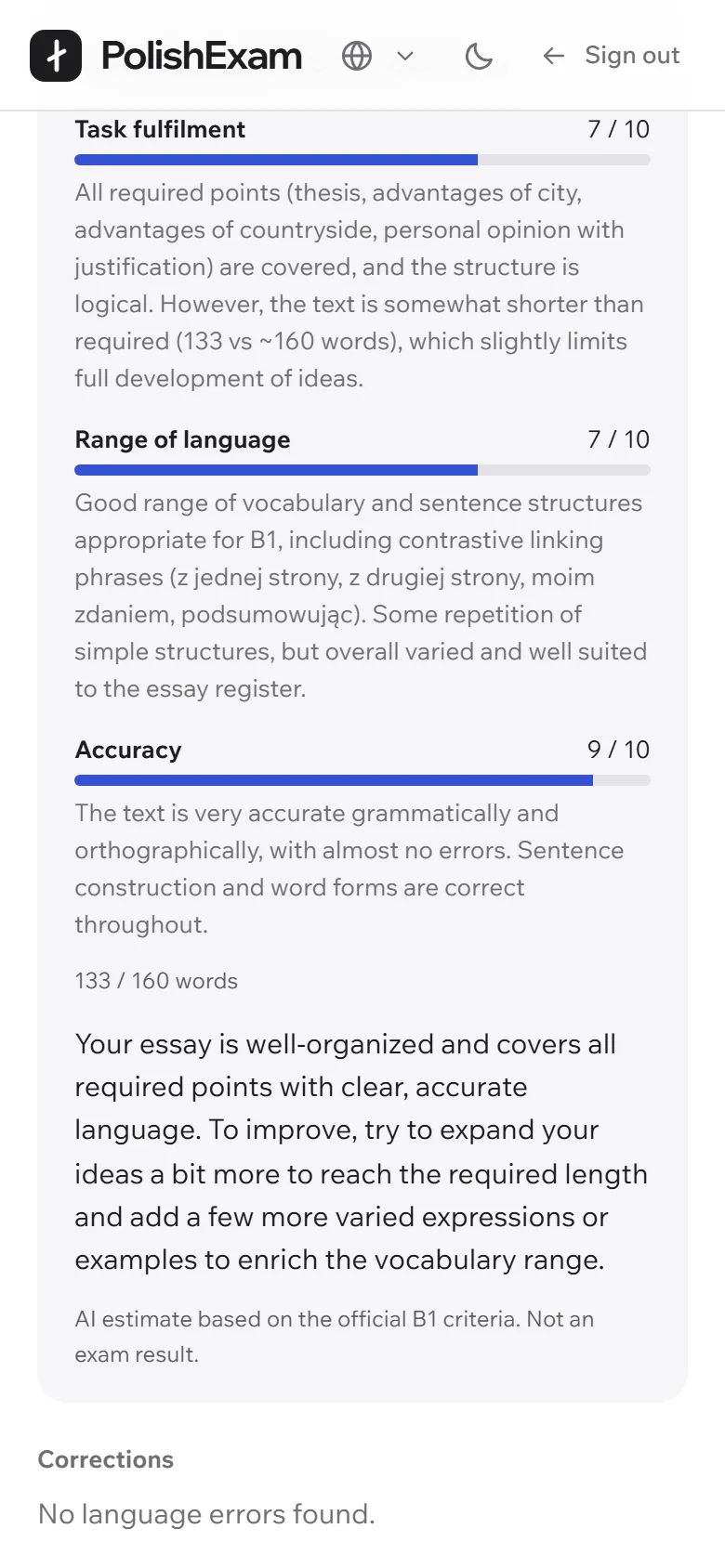
Writing checked against the official criteria
Write a letter or an announcement and get AI feedback on task fulfilment, range and accuracy – an estimate, not an official score.
Frequently asked questions
Do I need a B1 certificate for the Karta Polaka?
No. The Act on the Karta Polaka requires at least basic Polish. You can show it with a certificate or a Polish school document, but if you have none, the consul assesses your Polish in a conversation (art. 13(7)–(8)).
Does the state certificate help with the Karta Polaka application?
It is one of the documents the act lists as proof of Polish (art. 13(7)), without a required level. It is not obligatory.
Do I need Polish for permanent residence with the Karta Polaka?
No. The permanent residence permit for Karta Polaka holders who intend to settle in Poland permanently (art. 195(1)(9) of the Act on Foreigners) has no language requirement.
When can a Karta Polaka holder become a Polish citizen?
Under art. 30(1)(7) of the Act on Polish Citizenship, after at least one year of uninterrupted stay on a permanent residence permit granted because of the Karta Polaka or Polish origin – with Polish at least at B1 proven by a document.
Does the conversation with the consul count as B1 for citizenship?
No. For citizenship the law accepts only the state certificate at least B1, a school certificate from Poland or a certificate from a Polish-language school abroad (art. 30(2)). The consul’s assessment is part of the Karta Polaka procedure only.
Will the rules change?
Government draft UD491 plans changes to recognition as a citizen, including B2, but it is only a draft as of 11 November 2026. We track it on the citizenship law changes page.
Sources
- Act on the Karta Polaka, consolidated text Dz.U. 2026 item 76 (ISAP/ELI) – art. 2(1): conditions; art. 12(3): no fees; art. 13(7)–(8): how Polish is shown
- Act on Foreigners, consolidated text Dz.U. 2025 item 1079 – art. 195(1)(9): permanent residence for Karta Polaka holders
- Act on Polish Citizenship, consolidated text Dz.U. 2025 item 1611 – art. 30(1)(7): recognition after one year; art. 30(2)–(2a): B1 and accepted proofs
- Government draft UD491 amending the Act on Polish Citizenship (gov.pl) – entry in the government’s legislative work list, first published 27.10.2026
Planning citizenship after the Karta Polaka?
The last step needs B1 in every part of the exam. Find out where you stand now, then practise the parts a conversation never tests.