Proszę uważnie wysłuchać nagrania i zaznaczyć właściwą odpowiedź. Uwaga! Nagranie zostanie odtworzone tylko jeden raz.
On the exam this recording is played once.
Exam part 1 · Rozumienie ze słuchu
Listening opens the written part of the state certificate exam. Here you will find how Rozumienie ze słuchu is built task by task, which recording you hear only once, three free sample tasks with audio and a step-by-step strategy that works under exam conditions.
Facts checked:

What the part tests
Listening is the first of the four written modules, followed by reading, grammar and writing; the whole written part takes 190 minutes in total, with breaks of at least 10 minutes between modules. The listening module is worth 30 of the 120 written points, and at B1 you need at least 50% in every module, so 15 points here is the minimum regardless of how well you do elsewhere.
The recordings are everyday Polish: a sentence at a reception desk, a phone call to a garage, a radio announcement, an interview, a few people sharing opinions. The tasks check whether you can catch the main point of a short utterance, specific details such as times, prices and conditions, the intention of the speaker (offering, refusing, apologising, warning) and the opinions of different people speaking on one topic.
All instructions are in Polish, like everything else on the exam. You do not write anything in Polish in this module: every answer is a choice of A, B or C, TAK/NIE, or matching. That makes listening the module where good technique pays off fastest.
Learn the fixed instructions now: Nagranie zostanie odtworzone tylko jeden raz means the recording is played only once; dwa razy means twice.
Task types
Structure of the 2024 B1 paper for adults (the most recent published one). Points add up to 30.
| Task | What you hear | What you do | Items × points | Played |
|---|---|---|---|---|
| I | 14 short utterances, 1–3 sentences each | Choose what the utterance means, where it is typical or what kind of text it is (3 options) | 14 × 0.5 = 7 | once |
| II | 6 short dialogues | Complete Z tego dialogu dowiadujemy się, że… (3 options) | 6 × 1 = 6 | twice |
| III | one interview, about 2–3 minutes | 5 multiple-choice questions, 3 options each | 5 × 1 = 5 | twice |
| IV | one informational radio text | 6 statements: TAK (true) or NIE (false) | 6 × 1 = 6 | twice |
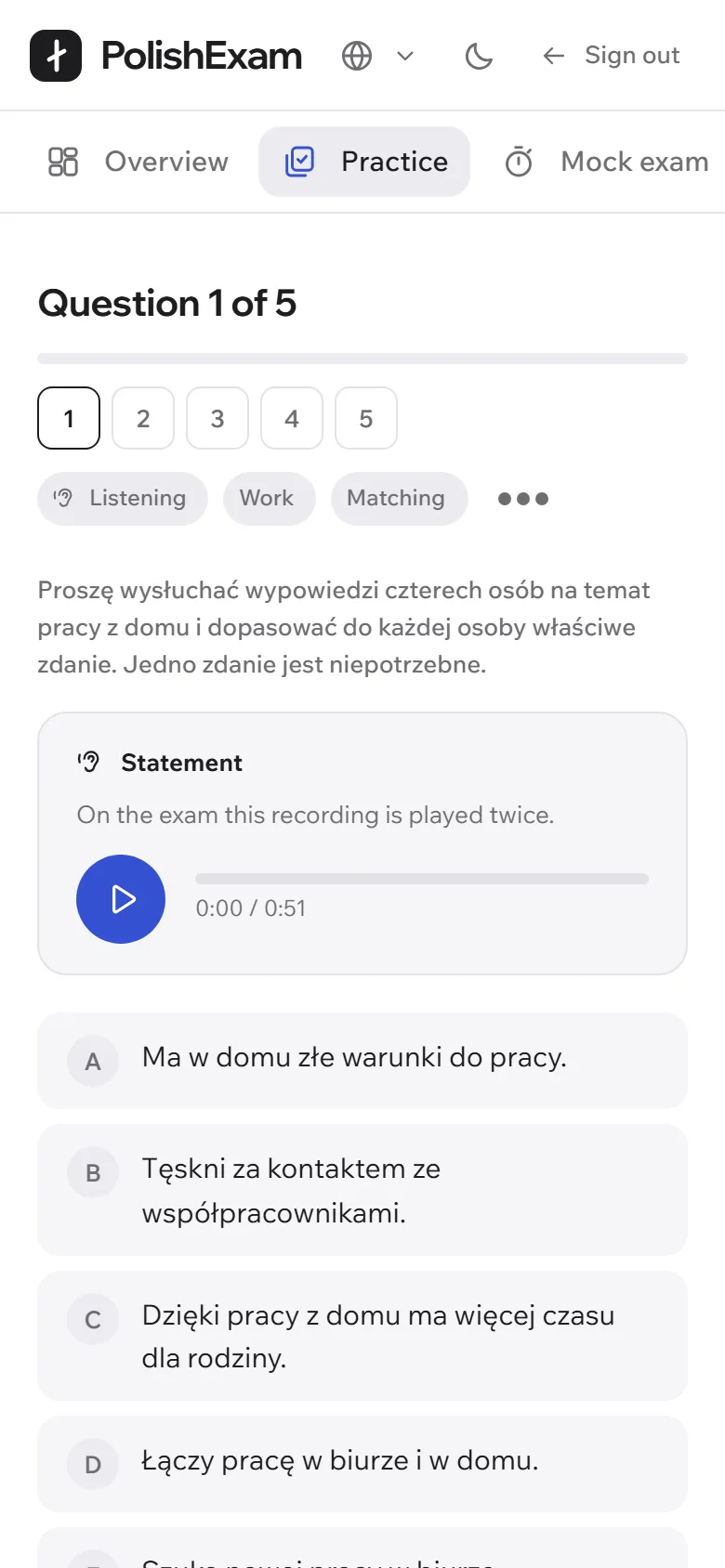
| V | four people speaking on one topic | Match 6 opinions to speakers 1–4; one speaker may express several opinions | 6 × 1 = 6 | twice |
Module time is given as up to 30 minutes in the 2024 paper; an older Commission table gives 25 minutes. Plan for about 30.
Free, no account
Original tasks written for this site in the official formats: a single utterance played once (like task I), a dialogue played twice (like task II) and a radio announcement with TAK/NIE statements (like task IV). Each sample is shorter than the exam task; after answering you see the key, the Polish transcript and an explanation in English.
Proszę uważnie wysłuchać nagrania i zaznaczyć właściwą odpowiedź. Uwaga! Nagranie zostanie odtworzone tylko jeden raz.
On the exam this recording is played once.
Proszę uważnie wysłuchać dialogu i zaznaczyć właściwą odpowiedź. Uwaga! Nagranie zostanie odtworzone dwa razy.
On the exam this recording is played twice.
Proszę wysłuchać informacji radiowej o Dniu Zdrowia i zaznaczyć: TAK – gdy zdanie jest zgodne z tekstem, NIE – gdy nie jest zgodne z tekstem. Uwaga! Nagranie zostanie odtworzone dwa razy.
On the exam this recording is played twice.
Strategy
Use every second of silence to read the three options or the six statements. Underline what differs between them: a day, a number, a negation (nie), a word like tylko (only) or wszyscy (everyone). You then listen for a decision, not for every word.
Fourteen utterances, each heard once and worth half a point. Mark your answer as soon as the utterance ends and move on. Getting stuck on one costs you the next one; a guess loses nothing.
On the first play mark a provisional answer and note doubts. On the second play check only the doubtful points. Most wrong answers come from options that use words you really heard but in a different relation.
Dialogues often contain a twist: Ale…, Niestety…, Okazało się, że…. The answer is usually what is true after the twist. In the garage sample the car is not ready, because a new problem appears.
A statement is NIE if one part does not match, for example wszystkie kobiety when the recording limits it to women aged 50–70. Watch for absolute words and for who does what.
Write a short note for each speaker (for, against, a reason). Remember that one speaker may match more than one opinion, so do not cross speakers out after using them.
There is no penalty for a wrong answer. Before the module ends, check that each of the 37 items has an answer.
Typical mistakes
What to know at B1
What makes B1 listening hard is rarely the vocabulary alone. These are the three things to train deliberately.
| Topic | What it means on the exam | How to train it |
|---|---|---|
| Speed | Speakers talk at a natural, everyday pace, with the reductions and fillers of normal speech (no, wie pani, znaczy). | Listen to short recordings without pausing, then again with the transcript. Do not slow the audio down for long; aim for the real speed. |
| Once vs twice | Only task I (14 utterances) is played once; tasks II–V are played twice. | Train task I with a single play from the start. For tasks II–V, practise the “gist first, details second” routine. |
| Transcripts | There is no transcript on the exam, but official past papers publish one. | After answering, read the transcript and find the exact sentence that decides each item. Then listen once more and hear it. |
| Numbers and time | Hours, days, prices and ages are favourite details. | Write down every number you hear in a recording and compare with the transcript. |
| Everyday topics | Shopping, health, work, transport, housing, leisure, official matters. | Practise by topic so that typical phrases (rejestracja, rezerwacja, zniżka, przesiadka) become familiar. |
In the app
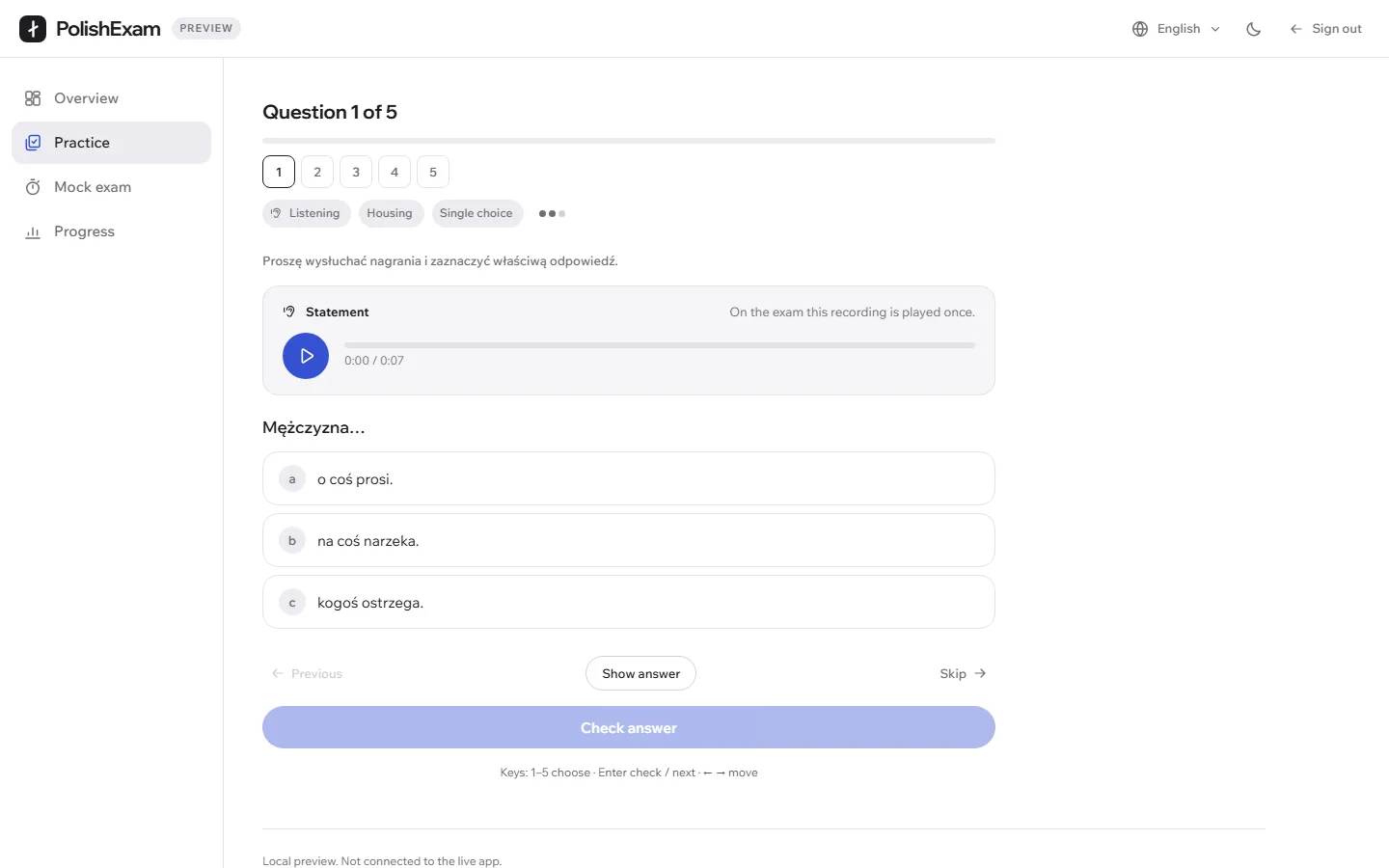
Every listening task has a recording with Polish voices. In practice mode you can pause, rewind and replay, then check your answer and read the explanation in English or Ukrainian.
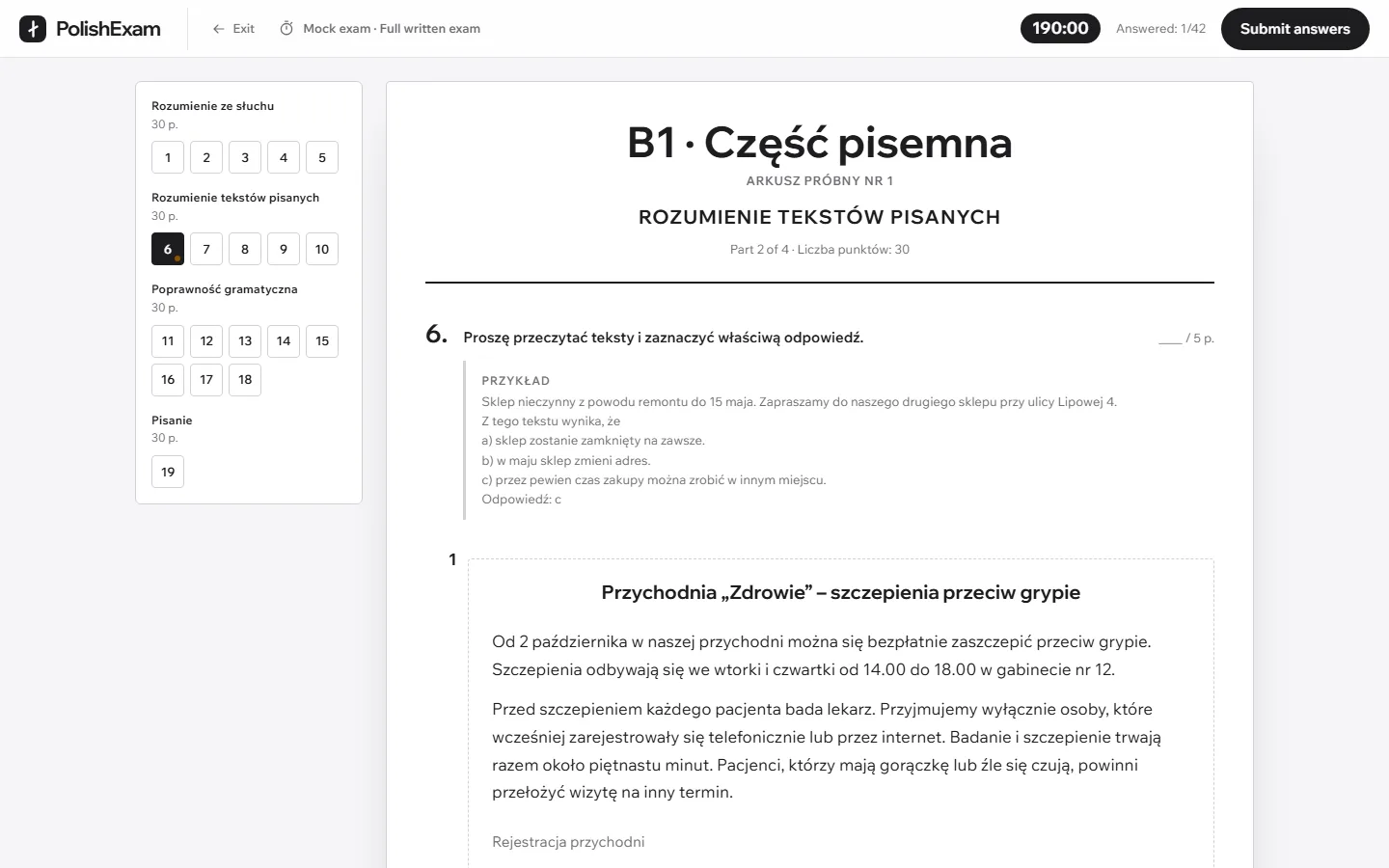
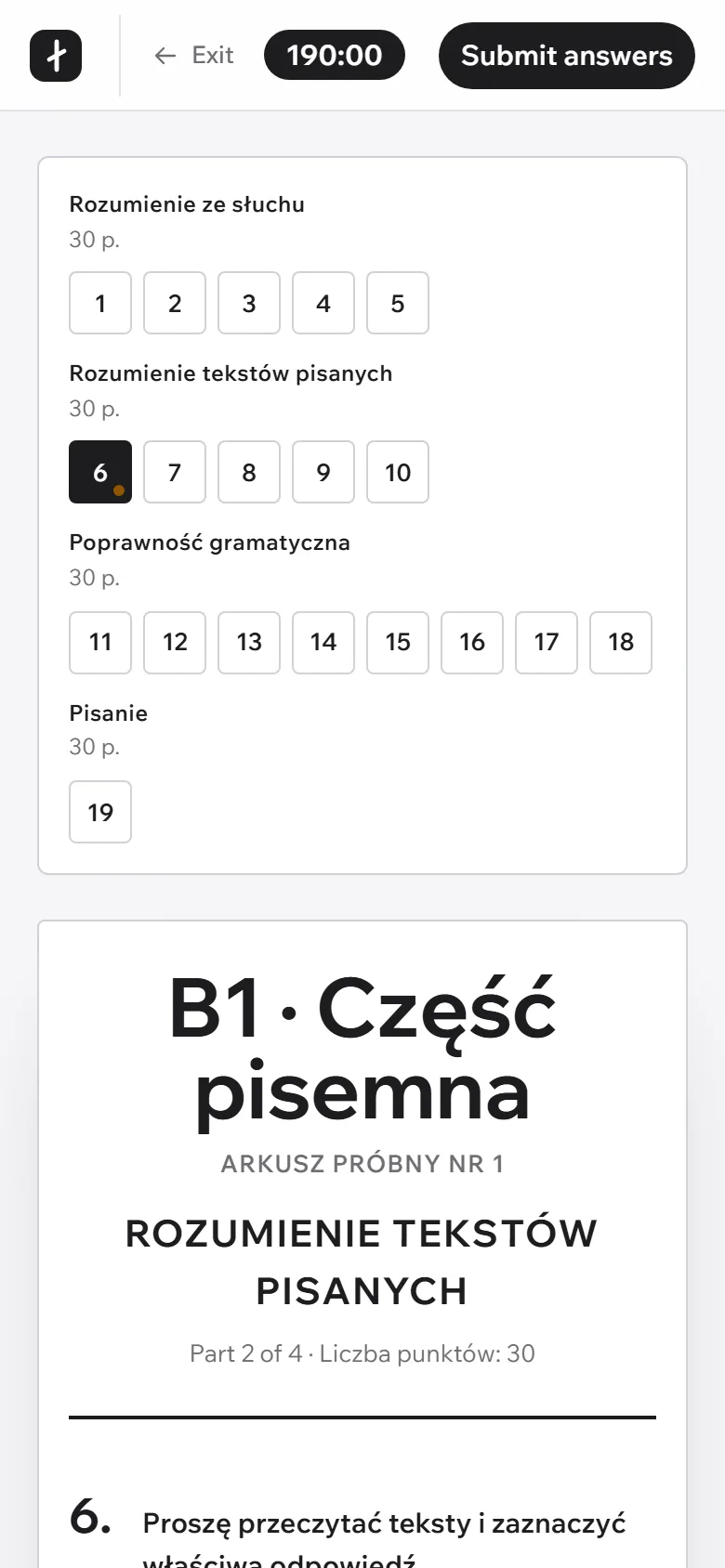
In the mock exam the player follows the exam limits: task I once, the others twice, no pausing. You can take listening on its own with its official time or as part of the full 190-minute written exam.
Official materials
The State Commission publishes real papers with recordings. Use them as your final check under exam conditions; we link to them and never copy them.
Blog

Polish numbers, dates and clock times for B1 listening: która godzina and o której, wpół do, za pięć, dates in the genitive, prices, phone numbers, 12 vs 20.

In the Polish B1 listening module some recordings are played once and others twice. Two routines, drills for each and the small Polish words that change the answer.
In the 2024 paper, task I (14 short utterances) is played only once and tasks II–V are played twice. The instruction on the sheet always says it: tylko jeden raz or dwa razy.
Up to about 30 minutes according to the 2024 paper (an older Commission table says 25). The whole written part takes 190 minutes in total, with breaks of at least 10 minutes between modules.
At least 15 of 30. At B1 for adults you need 50% in every written module and 50% in the oral part, so a strong reading score cannot make up for weak listening.
No. All answers are choices: A/B/C, TAK/NIE or matching speakers to opinions. Spelling does not play a role here.
Our recordings use Polish synthetic voices, so you can practise a large number of original tasks. For real speakers and exam-day sound, finish your preparation with the official past papers, which include recordings.
Yes, after you answer. Showing it before would turn listening into reading. On the exam there is no transcript.
No points are deducted for a wrong answer, so always mark something, even in task I where you hear each utterance only once.
Listening tasks of every official type, with recordings, transcripts and explanations in English or Ukrainian.